The Strangulation of Maasai Mara. That’s the title of a new slim book by Ulf Aschan . It’s a sad book; it’s an angry book. It’s about what he sees happening to a place he loves – the Maasai Mara National Reserve.
Ulf Aschan is Swedish-Kenyan. He spent his early years between both countries. But in 1967 he decided that Kenya would be his home. He was one of the first white hunters to change from shooting big game with a gun to shooting them with a camera.
He organised photograph safaris and, to do this, he set up Ulf Aschan Safaris in Nairobi. Perhaps he is better known as the grandson of Bror Blixen, the husband of Karen Blixen and the author of the biography The Man Whom Women Loved: The Life of Bror Blixen.
In his book on the Maasai Mara, his opening statement is that forests, the savannahs, the rivers, the mountains and the wildlife of today are not ours to dispose of as we like. In the short introductory section, he argues that ‘Geopolitically, the world faces instability driven by powerful and narcissistic people with questionable motives. Environmental destruction – from wildfires to deforestation, floods and the obliteration of wildlife – continues at unprecedented rates.’ He quotes a Native American Chief who once said, ‘Only when the last tree has been cut down, the last river has been poisoned, the last fish has been caught, the last antelope has been killed, will we realise that we cannot eat money.
Ulf includes an evocative piece he wrote many years ago when he was alone in a campsite he had set up in the Maasai Mara: ‘Far out on the plains rose a mournful wail of a hyena. A faint breeze awoke amongst the boughs of a giant fig tree next to my tent. It fluttered down the trunk and through the grass and bushes lining the river bank. A lion sighed nearby. It wasn’t a proud demonstration of strength. He sounded tired. Somewhere a bird chirped in the cool depths of the forest, followed by the duet of the tropical bou-bou.’
Earlier in the book, Ulf had talked about his first visit to the Maasai Mara in 1970. He describes the great amount of wildlife he could see then – the luxuriant trees along the Mara River, the hills covered in vegetation, the big herds of elephants and buffalo. And there were many predators. The rest of his book is about how the Mara is now and why this change has happened.
Ulf writes from his own experience, particularly from a recent visit to the Maasai Mara in February this year. He refers to some comments by other visitors and local experts, recorded in such as the Swara magazine and the Nation newspaper. He also gives some of what he calls ‘disturbing facts’ from the National Wildlife Census Report released in December 2025. It finds, for example, that nationwide there has been a serious decline in cheetahs and wild dogs, attributed to disease, human encroachment and habitat loss. It claims that, since 2021, the number of cheetahs has declined by 47.9 per cent and wild dogs by 51.9 per cent. The number of lions has declined by 3 per cent - mainly caused by poisoning, as is likely to be the case in the Maasai Mara.
Writing in the Swara magazine of March 2023, Johnathan and Angela Scott wrote that land sub-divisions, the increase of permanent settlements, the expansion of agricultural land, new roads and a vast amount of fencing has seriously restricted the animal migration routes. They said that the Loita plains used to be the breeding grounds for the Mara-Loita migration of wildebeest and zebra. They claim that the number of migrating wildebeests has declined by 81 per cent.
In relation to what the Scotts said about the reasons for diminishing animal migration routes, these are issues about the livelihoods of the people who live along those routes – and the same must be true of the main migration from the Serengeti to the Masai Mara. I remember what Richard Leakey told me soon after he was appointed the head of the Wildlife Conservation and Management Department (WMCD) by President Moi in response to the international outcry over the poaching of elephants and the impact it was having on the wildlife of Kenya.
He said that the people along the migration routes will support such wildlife conservation only if they can make the same or more money from it as they could from other enterprises. On this issue, a number of recent studies of the conservancy model show that, as well as helping to keep large areas of the Mara as unfenced rangeland, they also are providing a significant boost to the income of the local households.
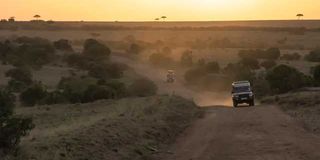
Ulf Aschan identifies another major problem – the proliferation of lodges and camps in the Maasai Mara. He writes that in 1977 there were only five lodges; today, there are about 200 lodges and camps – offering 5,000 beds and causing a swarm of vehicles. He includes a photograph of a signboard from a visit to the Mara he made many years ago. It says,’ Speed limit 50km. No off-road driving in High Use Zone. Stay on main roads and approved tracks.
Do not harass animals. Only 5 vehicles at a sighting. No closer than 25m from a sighting.’ His caption is ‘Those were the days’. It seems that discipline is not being enforced on drivers or their passengers by the rangers. Ulf Aschan quotes from a Sunday Times article by Chris Haslam who writes ‘I have counted 41 vehicles parked around a single leopard in an acacia tree.’ And there is an amazing photo in the book of what was happening at a wildebeest crossing of the Mara River. There is a crush of safari vehicles and about 20 people out of their vehicles and behaving as if they were watching a golf tournament.
So, Ulf Aschan is sad that such things are regularly happening; he is angry that so little is being done about it. However, he is careful in apportioning blame. He argues that the Narok County Government needs help from professional, un-political and un-corrupt people – and from many more uniformed rangers who are able to enforce the rules of the reserve.