The Gen Z phenomenon has animated public debate in Kenya for nearly two years.
When this digitally fluent generation burst onto the political scene in early 2024, few understood the long-simmering discontent and strategic imagination that preceded its emergence.
Fewer still anticipated the movement’s staying power — or the fact that at its core stood young feminist organisers reshaping protest and politics as we know them.
One of the most revealing studies of this moment is Denis Galava’s We Are the Leaders: How Kenya’s Gen Z is Rebooting Politics.
The study examines the symbolic, aesthetic, and political dimensions of Kenya’s 2024 Gen Z-led protests, offering a sharp departure from the tired caricature of Gen Z as unruly, politically naive digital natives.
Instead, it uncovers a sophisticated, intersectional, and deeply feminist infrastructure that powered one of the most consequential protest movements in Kenya’s recent history.
Galava, an interdisciplinary researcher who teaches journalism at the Aga Khan University, argues that the real story of Gen Z protests lies in how they re-centered women — not as tokens or mascots, but as the intellectual, emotional, and logistical spine of a movement redefining what leadership, citizenship, and resistance look like.
Through interviews with organizers and semiotic analysis of digital protest content — memes, AI-generated satire, livestreams, symbolic funerals — Galava tracks five interconnected strategies Gen Z used to mobilize, critique, and reimagine power.
These include digital activism, meme warfare, aesthetic resistance, symbolic confrontation, and decentralised leadership, all of which were developed, refined, and scaled by young women activists.
What appears to some as chaos was, in fact, choreography — protest by design, not by accident.
Crucially, Galava links the organisational grammar of the 2024 #RejectFinanceBill2024 protests to earlier feminist-led mobilisations like the End Femicide marches.
These demonstrations, while quieter in media coverage, were critical training grounds for the movement that followed.
It was in these marches that young women — outraged by state inaction in the face of gendered violence — learnt to crowdsource, coordinate encrypted chats, create protest aesthetics, and most importantly, trust each other in a system that had long betrayed them.
From these lessons emerged an unorthodox protest model anchored in horizontal accountability, care-based leadership, and emotional intelligence.
Leadership was not absent, but distributed. The facelessness of the protests was not a sign of disorganisation, but a deliberate rejection of patriarchal authority and co-optive political theatre. As one organizer told Galava: “We are not leaderless. We are leaderful.”
Take the emergence of Shakira Wafula as a protest symbol. Her now-iconic mugshot — arrested, defiant, eyes locked on the camera — was not just a portrait of state intimidation.
Shakira Wafula, a prominent figure in the June 2024 Gen Z protests, shared her experience of being at the forefront of the nationwide movement against the Finance Bill 2024.
Photo credit: Pool | Nation
It was an image of feminist leadership: raising bail, coordinating protests, holding vigils for the dead, and giving media interviews that were equal parts mourning and manifesto. Shakira didn’t speak for the movement — she embodied its feminist reimagination of what protest power can look like.
And herein lies one of Galava’s most compelling insights: these protests weren’t simply about the cost of living or new taxes.
They were about reclaiming symbolic and civic space in a country where protest had long been coded as male, elite, and partisan.
By putting young women at the frontlines, the movement not only disrupted the logic of protests — it disrupted perception.
This symbolic disruption mattered. The sight of young women being arrested, tear-gassed, and dragged through the streets exposed the violent, punitive reflex of a state that views youthful dissent — especially from women — as a threat to be crushed, not heard.
Older generations who had scoffed at previous opposition-led protests began to express sympathy. The state was not just confronting protestors; it was confronting its children.
What also changed was the tone of protest. Sarcasm replaced sloganeering. Memes became bulletproof vests. As one protestor quipped, “Laughter is our loophole.
When they try to silence us, we respond with sarcasm louder than their bullets.” Another declared, “We’re children of memes and mixtapes. We remix protest like we remix music — until it slaps hard enough to scare them.”
This redefinition of resistance — visually encoded, emotionally intelligent, digitally native — is precisely what makes Gen Z so difficult to dismiss or defang. Galava rightly warns, however, that protest aesthetics can be co-opted or emptied of meaning.
As meme culture goes mainstream and AI-generated satire is adopted even by government agencies, the risk remains that protest becomes aesthetic ritual rather than political force.
Yet even this ambiguity reflects the richness — and risk — of the moment. Like the mythical chimera Galava alludes to, Gen Z is many things at once: a lion roaring for justice, a goat mocking authority, a snake slithering through surveillance.
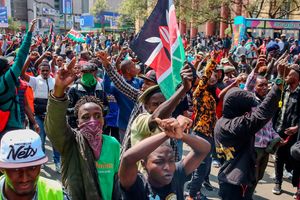
Protesters march along Kenyatta Avenue in Nairobi during anti-Finance Bill demos on June 25, 2024.
Photo credit: Bonface Bogita | Nation Media Group
This hybridity has led to misreadings and misjudgments — by political elites, media pundits, and even some scholars — who fail to grasp that this is not protest as we knew it. This is protest rebooted.
And while Galava’s research offers a powerful analysis of how Gen Z has reimagined protest — through digital mobilisation, feminist decentralisation, and meme-based resistance — it leaves largely unexamined the “so what” question that now haunts the movement: What lasting political vision are these protests pointing toward? Are these digital warriors building a coherent future, or simply reacting to a collapsing present?
By limiting his analysis to the tactical brilliance of Gen Z’s mobilisation — encrypted organising, symbolic funerals, satirical memes — Galava risks sidelining the deeper political anxieties many hold about the movement.
Can this fluid, decentralised protest culture evolve into a sustainable civic force capable of transforming institutions — not just mocking or resisting them? Or are these energies, as some government officials allege, being channeled by shadowy political operatives seeking regime change through the backdoor?
Such claims — however conspiratorial or self-serving — tap into a legitimate public concern: that protest must be tied to purpose, not just performance.
Galava’s work powerfully illuminates the form of protest but doesn’t fully engage with these thornier, realpolitik questions about outcome, accountability, and long-term vision.
And perhaps that, too, is part of the Gen Z ethos: a refusal to fix the future in rigid blueprints, choosing instead to build the plane as they fly it.
For all the talk of Gen Z’s supposed disorganisation, Galava shows that this generation has an implicit vision for Kenya — one rooted in radical imagination, civic refusal, and intersectional solidarity.
This has grave implications to older politicians. The likes of William Ruto , Raila Odinga, Kalonzo Musyoka, Rigathi Gachagua and Martha Karua must now think beyond their kingship mindsets to consider repositioning themselves in ways that appeal to generational rather than ethnic formations.
The old modus operandi of patronage and regional balkanization are gone, and new ways of digital rallying are in vogue and have little time for ethnic currencies for political horse trading that the older politicians are so adept at.
Even if they are to glance backwards to their ethnic backyards, these leaders still need to find narratives that appeal to the Gen Zs and package the same narratives in grammars that the young ones have invented. Leadership has shifted from personas to purpose — now dispersed across networks united by shared ideals and collective dissent.
This also may affect the tendency by politicians to perform post-election ‘handshakes’ that allow them to retain elite privileges at the cost of deflated electorates.
In all, then Gen Zs have forever altered the way we do politics in Kenya. They have reminded us that protest can be tender. That power can be shared. That memes can spark revolutions. That women, when they lead, do not need to ask permission.
Whether that script evolves into electoral power in 2027 — or dissipates in aesthetic fatigue — remains to be seen. But what is clear is that Gen Z, and the young women at its helm, have already expanded the space of what is politically possible in Kenya.
The writer is an Advocate of the High Court, and Associate Professor at the University of Nairobi. [email protected]