For the past few weeks, readers of this newspaper — and a surprising number of complete strangers — have been asking me the same question: why haven't you written anything about Ngũgĩ wa Thiong'o since he passed away?
Partly because I was dealing with my own health troubles, including a bout of severe depression. The doctors informed me that my brain was apparently not producing enough serotonin — or something like that — and prescribed Prozac. I suspected that it was too busy producing ideas to attend properly to its neurochemical responsibilities. The medical establishment remained unconvinced.
Also partly because, before the Prozac had properly kicked in, I was expelled from a WhatsApp group dedicated to celebrating Ngũgĩ's life and work before I had even uttered a word.
Nothing says "honouring a champion of intellectual freedom" quite like ejecting a participant before they've had the chance to commit any heresy.
Thus, while the world was composing solemn tributes to Kenya's most famous writer, I was busy defending myself against the allegation that I had been dispatched by the CIA to diminish his legacy.
If anyone at the George Bush Center for Intelligence in Langley, Virginia, is reading this, please note that I have yet to receive even a parking voucher for all my supposedly anti-Ngũgĩ work.
I would also appreciate the restoration of my research and travel funding before I resign from your American so-called universities and go back to Kawangware. Furthermore, my dental insurance is inadequate.
Ngũgĩ's death has already generated a flood of commentary, and more is certain to come. One of the most significant recent scholarly engagements with his work is Ngugi wa Thiong'o in Context , edited by Professor James Ogude and published a few weeks ago by Cambridge University Press, with a Kenyan launch expected in August.
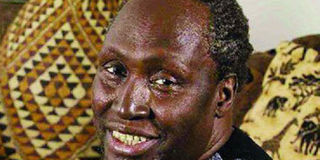
Prof Ngugi wa Thiongo during an interview on February 7, 2019. He was recently interviewed by ‘The Guardian’ newspaper.
Photo credit: File | Nation Media Group
The volume brings together an extraordinary range of scholars engaging various dimensions of Ngũgĩ's life, thought and literary legacy, among them Professors Simon Gikandi, Grace Musila, Tirop Simatei, Maina Mutonya (that's my student), Ato Quayson, Carol Sicherman, Oliver Lovesey (who generously cites me on my are of expertise in Ngugi studies: the author’s use naughty Kikuyu words I can’t reproduce here), Ndirangu Wachanga, Garnette Oluoch-Olunya, Kimani Njogu, Godwin Siundu, Emilia Ilieva, Senayon Olaoluwa, Maina Mutonya, Peter Amuka and Tom Mboya, among many others. The collection is a reminder that Ngũgĩ remains not merely an object of admiration but a continuing site of vigorous intellectual inquiry.
Long before he died, Ngũgĩ had become something larger than a writer. He had become a continent-sized argument.
For decades, it was a total war on Ngũgĩ.
Not simply a political war, though there was plenty of that. Not simply a literary war, though there was even more of that. It was a struggle over language, culture, memory, education and, ultimately, who got to define the future of African literature.
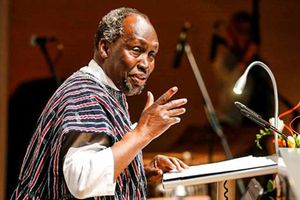
Prof Ngugi wa Thiong'o holds a copy of his autobiography titled 'Dreams in a Time of War, after it was launched on August 19, 2010 in Nairobi.
Photo credit: File | Nation Media Group
During my student years at the University of Nairobi in the 1990s, I had been trained, directly and indirectly, to regard him with suspicion.
Entire careers were built upon arguing with him. Others were built upon defending him. A few gifted intellectuals somehow managed to do both simultaneously.
Besides, mildly autistic, I’m still terrified of academic conferences in the US, where I’d have met Ngũgĩ.
Some of these scholars pronounce African names with the confidence of people ordering expensive wine in a Paris restaurant and the accuracy of people reading road signs through a thunderstorm.
To be fair, he enjoyed linguistic play himself. His fiction delighted in coded names, transformations, inversions and anagrams. Literature, for him, was never merely about transmitting information. It was also about performance, mischief and invention.
His acolytes sometimes forget that spirit of play when they treat him as a secular saint rather than, first and foremost, a literary artist.
The strangest thing about Ngũgĩ's reputation is that it has produced two rival mythologies.
In the other, he was a dangerous ideologue who single-handedly ruined African literary studies.
He was capable of intellectual generosity and intellectual ferocity. He inspired devotion and resentment in roughly equal measure. He was a literary revolutionary who spent much of his life revising his own assumptions.
Readers often discuss him as though the author of Homecoming in 1972 were identical to the author of Wizard of the Crow more than three decades later. He was not. His political thought evolved. His understanding of resistance — and even compromise — evolved. His reading of history evolved.
When I was a student at the University of Nairobi, the most entertaining lecturers were often the ones influenced by Ngũgĩ. They wore colourful African fabrics, sandals, improbable beards and expressions suggesting they had just emerged from a twelve-hour argument about Frantz Fanon at Afro Unity on Muindi Mbingu Street opposite Jeevanjee Gardens.
The more conservative lecturers, by contrast, possessed corduroy jackets, ties, polished shoes and administrative influence. Many openly detested Ngũgĩ. Some argued that he was wildly overrated. Others insisted he was a plagiarist. Still others never quite forgave him for lacking a master's degree while becoming the most internationally famous literary scholar in Kenya.
Students quickly learned which side was more likely to translate into good grades — and, if one was sufficiently careful, a coveted First Class Honours degree in literature.
Unlike the aspiring Ngũgĩ impersonators, we showered. We brushed our bad teeth, occasionally. We purchased corduroy jackets. We uttered anti-Ngũgĩ sentiments in strategic locations.
Prof Mukoma wa Ngugi (right) with his father Prof Ngugi wa Thiong'o (left) at a past event.
Photo credit: File | Nation Media Group
Survival, too, is a literary tradition. Especially in the notorious Nyayo days.
Ngũgĩ's name provoked extraordinary reactions within Kenyan intellectual life. Entire books were celebrated or dismissed according to their proximity to his vision. Certain writers flourished in the shadow of his influence; others were obscured by it.
Apparently, some participants found it unacceptable that one might admire Ngũgĩ's achievements while also acknowledging his flaws, contradictions and limitations.
He argued for African languages with unmatched passion. He challenged generations of readers to think seriously about linguistic power.
Even those who disagree with aspects of Decolonising the Mind continue to define their positions in relation to it. Few books enjoy that kind of afterlife.
At the same time, African literary history is richer and more crowded than many accounts allow. Outstanding writers in African languages existed before, during and after Ngũgĩ. He was a giant.
My own exchanges with him were limited to email. Despite my youthful attempts to argue with his work, he was unfailingly courteous. He addressed me simply as "Maina", a gesture that somehow felt both intimate and disarming.
It is difficult to sustain a grudge against someone who insists on treating you kindly.
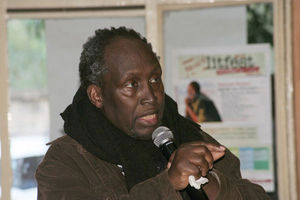
Kenyan author Ngugi Wa Thiong'o speaks to Reuters during an interview on his newly launched book "Wizard of the Crow" at a bookshop in downtown Nairobi January 16, 2007.
Photo credit: Reuters
His books remain in classrooms. His ideas continue to irritate, provoke, inspire and divide. New studies of his work continue to appear. Younger generations continue to discover him for themselves, often reaching conclusions that would irritate both his defenders and his critics.
That, I suspect, is exactly the outcome he would have wanted.
As for me, I remain unconvinced by the theory circulating in certain Ngũgĩ circles that I was planted in America by the CIA at the recommendation of my former teacher Prof Henry Indangasi in order to undermine Ngũgĩ's legacy.
To be fair to Prof Indangasi, he spent much of his career disagreeing with Ngũgĩ, but disagreement is not espionage.
Kenyan literary studies has always thrived on argument. If every student who emerged from that tradition carrying a few anti-Ngũgĩ habits were a CIA operative, Langley would by now have opened a regional headquarters somewhere between Chiromo Campus and Education Theatre II.
Besides, if my assignment was to diminish the greatest Kenyan who ever wrote because of his Marxist and Fanonist tendencies, the mission has gone spectacularly wrong.
Every time I return to Ngũgĩ's work, I end up arguing with him.
And every time I argue with him, I end up reading him again.
Their opponents keep talking about them. Their admirers keep quoting them. Their students keep revising them. Their critics keep returning to them.
So, yes, CIA headquarters, if you're reading this, please do reinstate my discretionary research funding at your earliest convenience, so that I can travel to Nairobi for the launch of a book on Ngũgĩ and say jambo to my living ancestors in Metumi.
Do you need me to heckle anyone at the launch? Or, now that Ngũgĩ has inconveniently gone and joined the ancestors, has my assignment been terminated? Am I free to pack up my files, surrender my imaginary security clearance and return to Kawangware?
Which means, in the end, that I remain his reader.
Also comically known in some circles as "Prof Evan Mwangi" (sic), Maina teaches English, comparative literature and African affairs at a US university and is professor of English at another university in South Africa.