In early April, 1961, the new Secretary of the Colonies, former bridge-playing gambling champion Ian Macleod, met separate delegations (from Kanu, Kadu and the new NKP) at the Royal Airforce’s base in Eastleigh, Kenya.
One KADU leader, Masinde Muliro – whom earlier at Lancaster had threatened to form the Abaluhya Peoples’ Party (APP) if Kenya didn’t go the Federalist way after independence – now demanded that Jomo Kenyatta (then in detention in Maralal) – be “released in mid-October,” nine years after his arrest for Mau Mauism in 1952.
Alarmed, Macleod rejected Masinde’s bluff outright, and advised London that “we ought to try and entice KADU leaders into office, and in that way break the KANU/ KADU united front” (as presented against Britain’s divide – and – rule).
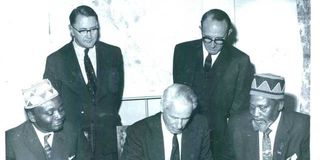
Then Kenya Governor Malcom MacDonald signing the proclamation which brought Kenya’s new constitution into effect on May 31, 1963. On his left is the Prime Minister Jomo Kenyatta on his right, Kadu President Ronald Ngala. Standing are the Attorney-General A.M.F Webb (left), and the Deputy Governor, Sir Eric Griffin-Jones.
Photo credit: File| Nation Media Group
That advice was strongly supported by the Earl of Perth, back in Great Britain.
On April 13, 1961, he wrote to his boss Ian Macleod in Nairobi, "The more I think of that Kenyatta, the more I’m convinced that we’re right to bend all our efforts to get KADU and others to form a government.
What you would in effect be doing is backing the rest, who are in fact the majority in Kenya, versus the Kikuyu and Luo. Knowing the fears of the rest of them (tribes), such a government might, if launched and strongly backed, last a long time. It is certainly what would best represent our European interests (after the inevitable Independence in Kenya).’
That mid-April, Iain Macleod, former bridge player extraordinaire, dangled the carrot of Leader of Government Business in front of the KANU leader, Ronald Ngala, which he chomped up like a hungry bad bunny.
His Deputy, Masinde Muliro, accepted the Cabinet post of Commerce, Chairman Daniel Arap Moi of KANU the Ministry of Education, and the Ameru Bernard Mate actually defected from his elected KANU to join KADU, just to take up the portfolio of Minister of Health and Social Affairs.
A ‘Minority party government’, the political gambler Iain Macleod reckoned; “would after a while prove to be no longer so, as it is like a magnet for other elements.”
The European dream prize was to have the KANU-besieged Tom Mboya cross the floor, and join KANU, as the last nail in the coffin for the detained Jomo Kenyatta.
They were encouraged by sly hints from Tom Mboya, still just 31, in writings like this one (extract) from a local newspaper; “It would be in Kenya’s government interests that those who are in power just before Independence, should be those who have a measurable chance of going into Independence (in power), otherwise the period of tutelage is but a waste of time.”
Yet it appears that Mboya was, quite accurately, pointing out that democracy can only be legitimate if the majority party (KANU then) is the one in government before uhuru.
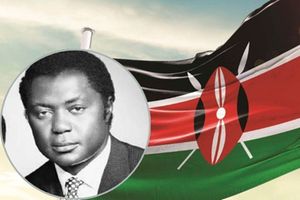
Tom Mboya greets his supporters after winning the election in 1963.
Photo credit: File | Nation Media Group
Barely three months later, though, Ian Macleod was promoted away from the colonial sphere to the Chairmanship of the Conservative Party in the UK.
The new Colonial Secretary was now Reginald Maulding, a large and shabby figure with an easy-going casual manner, that was in exact contrast to the sharp, taut and more combative style of his Colonial Office predecessor.
On the rather warm Monday morning of October 9, 1961, the first caller at the Colonial office in London was a Kenyan called Peter Habenga Okondo, P. S. in the Ministry of Finance (and one of KADU’s rare intellectuals), and he came bearing rather chilly news.
In his hands was an innocent looking brown envelope, inside were heaps of papers that contained the endorsed future Constitution of the Independent Kenya – a federalist / creature of Majimbo – that represented a radical departure from the style of government that the colony had known for years; and as well as the Westminster model towards which, favoured by KANU (and with the support of Jomo Kenyatta) it had ear-marked as our uhuru model.
In-fact it can be said that the Father of Kenya’s current system of Devolved Democracy ( itself born on 10th August, 2010 ), was conceived on that day in the Colonial Office in London by Okondo, its 48 year old father, prodded by Muliro.
Nor was the news of that conception well received at the (Colonial) Office floor. "The Idea of American – type Constitution for Kenya is ridiculous!" raged the Assistant Under- Secretary of the Colonies, Leslie Moore.
“The U.S. Constitution, itself the most cumbrous form ever thrust upon human beings by their own hands, has only survived because the American Government asserted itself in history’s bloodiest civil war.”