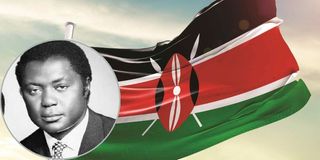
Last week, I traced the origins of the name Kenya , a name wrapped in colonial confusion. This week, I turn to another symbol of the nation, one even more visible and yet equally misunderstood: the flag.
To the casual eye, it is a banner of bold colours – black, red, green and white – crowned by a shield and crossed spears. But the story of how that flag was born is not one of simple design. It is a tale of politics, mischief, secrecy and compromise.
In the tense months before independence in 1963, the question of what flag would rise as the Union Jack fell was far from straightforward. Within Jomo Kenyatta’s Cabinet, Kanu hardliners, including Mbiyu Koinange pressed to elevate their party flag – black, red and green – into the new national symbol.
Former Cabinet minister Mbiyu Koinange.
Photo credit: File | Nation Media Group
To them, the Kanu flag was the very emblem of the liberation struggle, carried by the movement that had forced Britain to the table. Why reinvent the wheel when their colours already carried the weight of sacrifice?
But Tom Mboya, then Minister for Justice and Constitutional Affairs, thought differently. Mboya was no ordinary politician. He was young, brilliant, ambitious and deeply aware of optics. He understood that symbols could unify, but they could just as easily divide.
Kenya flags fly at Uhuru Gardens Park on December 11, 2021.
Photo credit: Jeff Angote | Nation Media Group
Adopting the Kanu flag wholesale, he said, would alienate the opposition Kenya African Democratic Union (Kadu) and poison what should have been a sacred moment of unity. In Cabinet papers, he wrote with deliberate caution: raising a partisan flag at independence “would undoubtedly give rise to considerable bitterness and resentment” and could spark “unpleasant incidents” at a ceremony meant to showcase harmony to the watching world.
Since the independence flag-raising would be broadcast globally, Mboya argued that any scene of division would be disastrous.
The challenge, then, was how to fashion a flag that acknowledged Kanu’s dominance without humiliating Kadu. Jomo Kenyatta turned to Dawson Mwanyumba, his Minister for Works, Communications and Power, and a moderate figure trusted to navigate between the two sides. Mwanyumba chaired a small committee tasked with finding a compromise. This story is long-forgotten.
What emerged was a subtle but significant act of political stitching. Kanu’s black, red and green remained intact, but between them a white stripe was inserted, borrowed from Kadu’s flag. To Mwanyumba, it was “a magnanimous gesture” towards the opposition, an act tending to unity rather than dissension.
The Cabinet abandoned earlier proposals for gold trim, with Mwanyumba arguing that gold would not soothe tempers the way Kadu’s white might. To crown the design, a Maasai shield and spears were added, rooting the banner in African heritage while distinguishing it from the simpler flags of Tanganyika and Uganda, which had merely adapted their ruling parties’ colours.
Yet compromise was not the only element in the creation of the flag. Secrecy also played a decisive role. Mboya, anxious about the bureaucratic delays of registering a new flag and securing Queen Elizabeth’s formal approval, recommended immediate manufacturing.
He feared time would run out and Kenya might celebrate independence without a national banner. In a Cabinet memorandum marked “Top Secret”, and now at the National Archives, he urged that the flag be produced at once, even before approval was granted, with the details withheld from the public until the Queen’s nod arrived. His colleagues agreed. And so, while Parliament was still debating the National Flag, Emblems and Names Bill, factories were already secretly producing the new flags.
When the Republic of Kenya was declared on December 12, 1964, the country was suddenly awash with flags. They appeared in streets and homes and atop buildings as if conjured out of thin air. Few knew they had been prepared in secrecy months earlier. Even the Queen never learned that her consent had been pre-empted by Kenyan politicians.
But the new flag, far from being left to flutter freely, was from the very beginning tightly policed, and a for a reason. In July 1963, before independence had even dawned, Mzee Kenyatta thundered in Parliament that Kanu party flags had been seen in toilets and other inappropriate places and warned that when the national flag is unveiled it “will not be flown by any person other than Cabinet ministers and authorised persons”.
It was the settlers’ way of mocking Kanu. He also declared that the “reproduction of the flag would not be allowed, and no person would be authorised to fly a flag with a Coat of Arms, except the head of government”.
This indignation was swiftly codified. Mboya and Attorney-General Charles Njonjo drafted the National Flag, Emblems and Names Act – Cap 99 of the laws of Kenya. It criminalised unauthorised use of the flag and extended protection to words that were considered national treasures: Harambee, Madaraka and Jamhuri. Later, under President Daniel Moi, the word Nyayo was added. To disrespect the flag, the anthem or these terms was to insult the nation itself, and police were empowered to arrest offenders.
And so the Kenyan flag, which had been born of compromise, became encircled by prohibition. The logic was that respect could be enforced by law, that dignity could be legislated. Yet in practice, the restrictions bred confusion.
Ordinary Kenyans discovered that they could not fly the flag on their rooftops. Vendors selling miniature flags during national holidays were technically breaking the law. Those who mounted the flag on their official vehicles were warned that they risked prosecution. The flag, symbol of independence, became an object that ordinary citizens could not touch.
The irony is hard to miss. A banner designed to unify was also born of mistrust. For Kadu, the white stripe that once symbolised the vision of a multi-racial society was reduced to a narrow band, its meaning reinterpreted by the Cabinet as “peace and unity”. For Kenyatta’s court, the compromise was elegant mischief, a way of pacifying opponents while ensuring Kanu’s dominance. For Mboya, it was a deft manoeuvre – protecting the independence ceremony from disruption while enshrining the party’s colours at the heart of the new nation’s identity.
Among its lingering echoes lies a peculiar clause in the Act: the national flag, symbol of sovereignty and unity, may not be flown on any motor vehicle save for those bearing the President, the Deputy President, the Chief Justice, a Cabinet Secretary, the Speaker of the National Assembly, the Speaker of the Senate or accredited diplomats. Any other display is deemed unlawful. For the transgression of unfurling the flag without sanction, the law prescribes a stern penalty – fines reaching up to Sh1 million, imprisonment for a term not exceeding five years, or, in the gravest reading, both.
As such, a national flag, ordinarily a unifying emblem for citizens, is legally confined to the vehicles of the political elite and the Judiciary. This transforms it from a shared symbol of national pride into a mark of privilege, reinforcing hierarchical distance between leaders and the governed. The exclusivity echoes colonial-era practices, where symbols of state – such as flags, coats of arms or official seals – were tightly controlled to maintain the mystique of power.
School children wave flags during a past Madaraka Day celebrations at Nyayo Stadium in Nairobi.
Photo credit: File | Nation Media Group
Until recently, when football fans and Gen Z carried the national flag into stadiums and onto the streets, it remained a restricted garment. Unlike in other countries where the flag is everywhere, in Kenya the law has long insisted that the banner is too sacred for “every Tom, Dick and Harry”.
Respect, here, has been legislated into restriction. Though citizens are shielded from arbitrary harassment and prosecutions under the Act, unless approved by the Attorney-General (perhaps the Director of Public Prosecutions), it is not lost to observers that the flag is a guarded relic rather than a living symbol.
There is a final word here: a flag does not inspire loyalty because the law threatens punishment. It inspires loyalty because people claim it, cherish it and make it their own. That was the lesson Mboya intuited – though he cloaked it in political mischief. It was the gesture Mwanyumba envisioned when he framed compromise as unity.
The black, red, green and white should not remain fenced off by law; they should flow into the fabric of daily life, visible wherever Kenyans live, work, celebrate and dream. The challenge before lawmakers is simple but profound: let the flag fly free, so it can finally be what it was always meant to be – not the possession of the state, but the true emblem of the people.
Kenya’s flag should cease to be a story of rivalries resolved in colour, of secrecy masked by ceremony, and of fear enforced through law. It should instead stand as a promise – that freedom, though negotiated and often tightly controlled in its infancy, can at last be trusted fully to the people it was meant to serve.
Kamau is a PhD candidate at the Department of History, University of Toronto, Canada. Email: [email protected] ; On X: @Johnkamau1