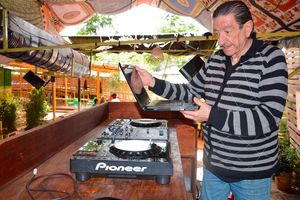
"When I was a baby," Signor Paco Perez said at the start of our book interview back in 2022 "I once peeped outside the window of our house ... and saw dinosaurs."
This is how the legendary Spanish deejay, of years of yore, let us know that he was now in his 70s.
Yet it was in 1972, as a young man in his twenties, that Paco Perez first set loafed heels in Nairobi, as the guitarist of a Spanish band that was performing a long gig at the Hotel Intercontinental, as part of a worldwide tour.
"When I was thirteen," Perez says, "I taught myself to play the guitar; and when I was 14, me and some teenage friends of mine decided to form a band, which got a touring contract at some point."
He attributes his love of soul music to his falling in love with the Afro-American singer Aretha Franklin’s records in the 1960s – a string of single hits such as Think, Respect, ‘You Make Me Feel, The Way I Love You, Chain of Fools and especially I Say A Little Prayer.
The writer, Prof Mikhail Iossel (Sentence, 2025), described how transformational that particular Aretha Franklin song was to many non-English speakers, living under dictatorial regimes such as Paco as a teenager under General Franco, or himself in his early twenties under Uncle Brezhnev in the Union of Soviet Socialist Republics (USSR).
Spanish DJ Paco Perez, who entertained Kenyans in the 1980s and 90s.
Photo credit: File | Nation Media Group
"I never tired of listening to that particular song, and I played it a few times almost every evening. I could understand many of the lyrics, too, which was cool and made me feel as if I were, in some small part, an American myself: “The moment I wake up, before I put on my makeup, I say a little prayer for you,” and then, “Forever and ever, you’ll stay in my heart, and I will love you forever, and ever, we never will part, oh, how I love you,” and “Together, that’s how it must be, to live without you would only mean heartbreak for me,” and, finally, “My darling, believe me, for me there is no one but you!”
Prof Mikhail remembers drinking acrid, half-dry Bulgarian red and listening to that song, and his heart filling with sadness and happiness, never mind that he was aware no one was saying any little prayers for him anywhere in the giant dark city of Leningrad or any place else in the world.
"But, well, so what? That was fine by me. It was no big deal, as long as when it was over, I could get up, go over to the cabinet, rewind the tape, and play it again ..."
And back in the 1980s, it was the music mix-tapes (or cassettes) of DeeJays like Paco Perez that were making the rounds amongst teenagers and matatu touts - from Nairobi to Mombasa - to be played in bedrooms and PSVs, straight out of the board decks of deejays like Perez who played nights to dancing crowds in nightclubs like Boomerang and the perennial Carnivore.
One of the underage people who walked into Club Boomerang for one night in the 1980s was Peter Chwani, popularly known as DJ Pinye, who swears he will never forget that first nightclub night: “I was a teenager, and here was this place with people dancing, that music, vibrating bodies …”
Young Peter made his way behind to where the DJ was, and there he stayed, mesmerised by what the DJ (Perez) was doing with the two turntables and a mixer, barely daring to breathe.
Spanish DJ Paco Perez, who entertained Kenyans in the 1980s and 90s.
Photo credit: File | Nation Media Group
It was like he was in the lyrics of that Oakenfeld song (Starry Eyed Surprise) where, with the bass coming from everywhere, “life is nice, so nice, I walk into a club and I’ve found paradise.”
It goes sweatbox, laser beams, flashing lights/ eclectic, electric ladies of the evenin’ (drinkin’ booze ‘n minglin’)/ mashing to the music, I (DJ) can do anything …
Once, when he tried to ask the DJ how he was managing to play without ‘fading’ the songs, he was chased away, and says, “I later realised he was irritated because I was spoiling his music flow, and you really had to focus on scratching n leveling them days, as there was no computer programme to prop you up back then.”
On that Easter weekend of 2022, the Sun Palm resort in Watamu hosted a legendary soul retrospective show of DJ Paco Perez, attended by hundreds of nostalgia seekers, an event titled ‘Return of the Boomerang,’ – after the iconic club ‘Boomerang’ that used to be on Museum Hill, and which was the place where Paco Perez first became a household name in the 1980s.
And renowned events organiser Noni Mbugguss, aka the ‘Queen of Kilifi,’ was key in putting the Kilifi event together.
Before that, early in the 1970s, Paco Perez had changed careers from being a guitarist to learning to be a disc jockey – and doing innovative things like incorporating live drums into his deejay performances.
"In the 1970s, my first gig as a DJ was in the Canary Islands. Then I came to Kimathi Street and played at a club called Pacha for some time. Then I went back to the Canary Islands to play the discos! Then I returned to Kimathi Street, a very nice club called Tamango (where Tanagers later used to be) ...’
DJ Paco Perez then returned to the Canary Islands for a year’s contract, but did not like the new music.
"Hard rock was the new thing, and the wild mzungus on the Canaries (sic) all wanted to mosh to this music."
He returned to Kenya, got a gig at Club Hollywood – now walled off like a poor pharaoh’s tomb opposite Lifestyle – but did not care for the ‘reggae’ music in demand there; since Paco Perez couldn’t stop the reggae, he looked for a new gig to do.
The blessing was a British entrepreneur who had just started a new club on Museum Hill called ‘Boomerang,’ and who literally gave DJ Paco Perez a free hand on the decks – and after that, just for the record, the rest is history.
Spanish DJ Paco Perez, who entertained Kenyans in the 1980s and 90s.
Photo credit: File | Nation Media Group
"Soul has always been in my soul," he says, "and at Boomerang, it seemed to seep into everyone else. Kenyans were dancing so nicely, all of the time, and as a deejay when you see the people are having so much of the fun, you also enjoy so much."
For Paco Perez, the 1980s were one long party, and like Oakenfeld sings in the song, ‘oh my, what a surprise, sunset to sunrise, after we’ve partied all night with this deejay ...’
But even with party after party, the party at some point must come to an end.
For Paco Perez, that was after the end of the 1980 after falling in love with a girl who was a lead singer at the Boomerang Club, and with whom they married and stayed in Spain, "and with whom I am still happily married to after thirty years. I’m happy, man, in my marriage and my Lord," Paco Perez told me that Easter of 2022.
Yet in Carnivore (Nairobi) and then again in Watamu, at the Sun Palm resort, over that weekend, the septuagenarian disc jockey rolled back time on the decks, and alongside DJ Kareez and the veteran DJ Adams, also from that era, unleashed a soul train on Kenyans over the 2022 Easter weekend.
Paco Perez, these days, is also a good Christian.
His last words to me that Easter were: “I am happy to do my last DJ event back in Kenya, here in Watamu, over this Easter. I love my Lord Jesus Christ, and when my gig on earth is over, I feel sure that I will go to heaven.”
Well, Paco Perez left the decks of the earth this mid-week.
For soul lovers, though, heaven was here on earth in those silvery nights of "Boomerang" in the 1980s, and for those who were lucky enough to get their requests played, back in those halcyon days, it was as if a little prayer had been answered.