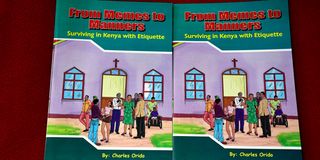
A new voice is emerging as far as pointing out Kenyans’ misbehaviour in public spaces is concerned. That voice is Charles Orido, a hospitality lecturer who has written a book condemning a number of pet peeves that some Kenyans consider normal.
The questions he poses invite the society to look deep into itself. They include: Why do people watch videos and listen to music in buses loudly without earphones? Why do people arrive late at meetings and not feel sorry? Why do some people dominate the airtime during meetings and deny others the time to talk?
In the book, From Memes to Manners: Surviving in Kenya with Etiquette, developed through interviews with various respondents, Mr Orido examines spaces such as shopping malls and public parks, offices, toilets and phenomena such as phone habits to deliver some of the feedback he got from Kenyans regarding common misbehaviours.
On the behaviours in the toilets, Mr Orido says some of the issues he picked from respondents include ladies leaving sanitary towels all over the place, not cleaning up after use, and people who take too long in shared toilets.
He concludes: “Toilet etiquette is perhaps the most honest reflection of a person’s character. It shows whether we think of others when no one is looking. It reveals whether we see ourselves as stewards of shared spaces or simply users with no regard for the next person.”
With regard to the usage of phones, six common “misbehaviours” were raised by his respondents. They include being contacted at inappropriate hours, being sent messages full of abbreviations or incomprehensible language, being inundated with “please call me” messages, lies about a person’s location, among others.
Utalii College Lecturer Charles Orido flips through his book From Memes to Manners: Surviving in Kenya with Etiquette on April 23, 2026.
Photo credit: Francis Nderitu | Nation
His rallying calls and his wide-eyed view of the society’s misconduct evokes memories of the late broadcaster Leonard Mambo Mbotela, who became a household name by packaging calls for better behaviour into a radio and television programme titled “Je, Huu ni Uungwana?” The show lasted over five decades, and until his death in February 2025, Mr Mbotela remained Kenya’s ultimate moral teacher.
Mr Orido is, in a way, aiming to pick up from him.
In an interview with Nation , Mr Orido said that drawing parallels between his work and the legendary programme is completely valid.
“Yeah, I’d say ‘Je, Huu Ni Uungwana?’ could exactly fit the description of common Kenyans, because that is something they can relate to,” he noted, adding that readers could easily connect his chapters to what Mr Mbotela preached on air.
Currently a lecturer at the Kenya Utalii College, Mr Orido’s inspiration for the book began while managing students and noticing an intergenerational erosion of baseline manners.
“I’ve been dealing with students and sometimes even parents as well, because there are certain things you don’t expect parents to do but it cuts across,” he said.
Though he has published academic journal articles before, this marks his first mainstream book. The baseline data was systematically collected starting around May 2024 through peer interviews. It took him about six months of writing to finish the piece.
Mr Orido targets a broad audience but has structurally designed the book, complete with pictures, to appeal heavily to Junior Secondary School (JSS) learners. He recounts an eye-opening personal experience while studying in New Zealand that highlighted how early etiquette training shapes national character.
Utalii College Lecturer Charles Orido flips through his book From Memes to Manners: Surviving in Kenya with Etiquette on April 23, 2026.
Photo credit: Francis Nderitu | Nation
At the museum, he crossed a disused railway line. A young boy who was observing him started crying, not aware that the line was out of use. The sobbing boy was telling the mum how Mr Orido was risking being killed.
“They’re taught from when they’re children what to do and what not to do. Later on I enquired, and I found out that at other places, they start inculcating certain things into children when they’re still young,” said Mr Orido.
By targeting younger readers, Mr Orido believes behaviour change can be effectively triggered.
One of the critiques of society that Mr Orido gives is the “disappearance of apology and acknowledgement” in modern Kenya.
“We’ve normalised certain things to an extent that we no longer feel as Kenyans that the courtesy of saying ‘I’m sorry’ when you’ve done a mistake,” he told Nation. “It has become so difficult that people no longer see it as important.”
Regarding local public spaces like malls and shared toilets, he said public restrooms are in a “serious mess” because users refuse to remain considerate of the next person.
“We are peeing on the seats and we are forgetting that that particular pee could be a source of infection to someone who is coming next,” Mr Orido warned, explaining that the sight of users stepping on toilet seats with shoes stems directly from this collective unhygienic breakdown.
One of the books authored by Utalii College Lecturer Charles Orido, pictured on April 23, 2026.
Photo credit: Francis Nderitu | Nation
Shopping malls tell a similar story of lawlessness. During public holidays, patrons sit on decorative flower vases, throw trash on the ground right next to clearly labelled waste bins, and bypass security entry lines.
“People don’t want to queue. You find that even in the supermarkets... they jump ahead of the queue,” he said, stating that he often stops perpetrators to ask, “Can you just go back and behave like the rest?”
The rot, he said, extends deep into government offices and public hospitals, where public servants treat citizens poorly or practice nepotism and tribalism.
Mr Orido, a public servant himself, heavily criticises the “coat-on-the-seat” phenomenon where officers leave their jackets on chairs for weeks to fake their presence while abandoning long lines of waiting citizens. He also condemns the bad habit of public officers switching to local dialects when serving clients: “Ideally, in most cases, when we switch to our local dialect, what does it mean? There’s a secret we are speaking to. We don’t want it out. There’s something we’re hiding,” he said. “It makes people uncomfortable.”
He laments in his book even structural settings like formal workplace meetings have fallen victim to bad behaviour, characterised by individuals over-dominating timelines, constantly interrupting others, or scrolling on phones. Mr Orido advises organisations to establish firm policies, such as turning devices off or placing them face down on the table.
The commuter space remains equally chaotic. Beyond passengers shouting over loud, unpalatable music in matatus, drivers cut corners and drive on sidewalks. Worse, financial altercations have turned fatal.
“We have cases where they throw passengers from a moving vehicle, and they’ve ended up dying. So, you’re asking yourself, ‘Does it really matter about that Sh50 they are scrambling for?’” he asks.