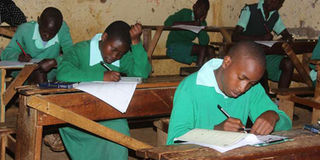
READERS' CORNER: Critics of Kenya’s education system are not being honest
Mr Vivere Nandiemo, an education writer/critic, has no kind words for our education system. In article after article, Mr Nandiemo alleges that Kenya’s education system is collapsing.
That it does not impart the knowledge and skills to learners; that it does not impart moral education; that society does not respect teachers — the latter evidenced in the government’s decision not to pay the 50-60 percent pay rise.
One thing that defines a poor education system is a weak curriculum and ill-prepared teachers. The 8-4-4 system of education is founded on a fairly strong curriculum that has capacity to help children learn, solve problems and make judgment.
Unlike in the 1970s, 1980s and early 1990s, our public schools are staffed with professional teachers.
Most public primary schools have P1 teachers, unlike before when most teachers were P2s, P3s, P4s or untrained. More than 60 percent of teachers in high schools have university education.
The government has continued to make massive investments in education sector with Education gobbling over six percent of the country’s Gross Domestic Product (GDP). Education sector takes about 30 percent of the budget allocations every financial year.
The need to remunerate the public school teacher fairly is the heart of reforms. Suffice it to say that the government has put education at the centre of its priorities. The system cannot be said to be collapsing when the government has put its thinking, and resources into it.
This is not to say that our education is perfect. But it can be perfected. It is being perfected by the reform the ministry is undertaking beginning with the enactment of the Basic Education Act, 2012 and Sessional Paper No. 14 of 2012.
No modern country has a perfect education system. Countries across the world are questioning and reforming their education systems. The ministry of Education has undertaken a curriculum reform that seeks to make major changes to the stuff our children will be taught.
The thinking is that delivery of the curriculum has been focused on passing examinations, which has sacrificed crucial educational outcomes embedded in the curriculum.
Education reform is always a work in progress. The ministry is running two transformational programmes. In partnership with Global Partnership in Education, it has developed the Kenya Primary Development Project, (PRIEDE) to improve early grade
mathematics competencies and will benefit six million pupils in grade 1 and 2 who will receive improved early grade mathematics textbooks.
Jointly with the USAID and the British DFID, the ministry is already implementing an early grade aimed at improving the teaching and learning of English and Kiswahili for millions of children in Class 1 and 2.
Underlying the two programmes is the thinking that fluency in literacy and numeracy in early grades lays a firm foundation for learning in subsequent years.
Our education system cannot be said to be collapsing when education policies are undertaking reforms to perfect the system of education.
Kennedy Buhere is the Communications Officer, Ministry of Education, Science and Technology
Are there any role models left for the younger generation to emulate any more? Role models cannot be found in the media, which is full of stories about how our country is being plundered by corrupt people in high office.
No wonder our children have learnt that rising to high office is synonymous with stealing and getting rich. They have also learnt one or two things on how to survive by being dishonest to their parents.
They lie because they have been taught there is nothing wrong with that. They lie to get more pocket money from their parents. Now they even dupe their parents into believing they are doing very well in school by altering marks in their end-of-term report forms.
This lazy lot will walk into a cyber café, get those report forms scanned, and proceed to alter all the results to impress their parents. As a parent, how often do you take your time to ensure that the report form brought to you is authentic?
If it bears congratulatory remarks from every teacher, that should trigger a red flag. Blame yourself if your model child ends up with a D. This generation is not reading because they know as long as they have money, they can buy the exams easily.
Writing skill is acquired, not an inborn trait
Many a time the big question has been raised on whether the skill of writing is acquired or inborn. I tend to think that there is not such a thing as artistic inheritance.
The art of writing can either come through reading an inspirational article or a piece of literature. The fact that one is born of a renown writer is not a guarantee that one will also become a literary guru. The only inheritance one can get from an author is by reading what he or she has written.
Aristotle the philosopher got it right when he talked about literature being a replica of what already exists. There is not a single author who can isolate society from his or her works. We only write that which affects our day to day life.
What contemporary authors write is just a modification of what already exists or existed in the past. What changes is the setting, plot, presentation style, stylistic devices, characterisation and theme.
To spur and arouse our literary skill, one has to read as many books as possible before siting down to write.
No less a personage than former US president Bill Clinton showered praises on President Kibaki after he initiated what many thought was an impossible dream — free basic education.
He cited Kenya as an excellent example from which the rest of African countries could learn a lot from when it came to provision of free primary education. He was impressed.
But has the dream of universal education remained so rosy? Apart from churning numbers after numbers, is there much concrete achievement to celebrate in the provision of universal education? Let us take stock.
Stay tuned. With the introduction of universal education, the Kenyan public teacher became the most overworked in sub-Saharan Africa, with a class ratio hitting as high as 50:1.
This is almost the double the preferred ratio. With such a ratio a teacher will seldom find time and space to give individual attention to a student.
The students are thus taught collectively. As a herd. The ability of each student, the needs and wants are overlooked. It is one-suit-fit-all kind of teaching.
The more monied parents have been forced to run into academies where the teacher ratio is lower. The irony is that the very government is working hard to short change sacrifice.
Students who have excelled in national examination from private schools are being told that their effort counts for less as far as admissions to national schools of their choice is concerned.
The academies are being punished for their hardwork, productivity and excellence.
It is noble and fitting to provide free universal education at basic and secondary level, but is it worth it to double tax the text books which the same student will utilise? Why the double taxation? Is it not that by taxing both the paper and the textbook, the government keeps the same text books from needy, deserving students?
Throw in the perennial teachers strikes. While the government is giving tonnes of money to universal education, the teachers, the implementers of the programme, are hugely demoralised by strong arm tactics the same government deployed in killing their voice for pay rise.
The same should be done by the teachers’ employer. How does one expect an employee who has stagnated in one job group for 15 years to be driven to produce excellent results? Many teachers dream of promotion yet they remain in the same job group for decades. Their self drive and morale is low.
The World Bank gave a stark verdict on our education system recently, citing qualification which did not match ability. The Mo Ibrahim index grading on our education also raised some pertinent questions. Our universities ranking is dismal.
The recently released Infotrack Poll ranked the ministry of Education as the worst performing ministry.
The writer is an author, a motivation speaker, and chemistry and biology teacher in Embu county. He blogs at www.4sightsite.wordpress.com
For many years, the prescribed set books for the Kenyan secondary schools have been fictive in nature. The novels, novellas, plays and short stories currently studied belong to the same category.
Now that the KICD is reviewing the curriculum, it is time it puts into consideration the introduction of non-fiction works like autobiographies and biographies.
Why? First, the current so-called, the dot-com generation, from my observation, has little time for fiction, especially the genres and sub-genres of orature and written literature texts.
They have been brought up watching western produced cartoons, science fiction movies, soap operas and playing video games. So to they take orature and literature for granted.
Autobiographies and biographies are realistic, hence believable. They are told through the first person, thus are more convincing. Furthermore, being a story told by the main characters, one will easily see a true human being through the weaknesses, strengths, feelings, idiosyncrancies and so on.
By reading these texts, one will be taking a look at the history of the main character and all that influenced and affected him or her. With a dearth of role models to emulate, works featuring iconic legends like Nelson Mandela, Wangari Maathai, Jaramogi Oginga Odinga, Bob Marley and others will provide figures worthy of aping.
Lastly, schools will be spared the burden of paying motivational speakers as these texts will motivate the learners.
There is nothing saddening like getting news that your favourite writer is ailing. In fact to me, Binyavanga Wainaina is not only a favorite writer but also a mentor in literary matters.
When I heard that the he suffered stroke at his home and needs to travel to India for treatment, I became sad.
It is Wainaina’s works that spurred me to begin my freelance writing. He is the very reason why I am a subscriber of Kwani?
So today as this literary giant lies in a hospital bed, I urge all to pray for his quick recovery from his illness.