As the world watches the escalating war between the United States, Israel, and Iran, the media's lens reveals more about global power dynamics than the conflict itself.
What began with joint US-Israeli strikes on various Iranian sites on February 28 has spiralled into a regional inferno, with bombings in Tehran, Beirut, and even drone attacks on Saudi Arabia's Ras Tanura oil refinery.
Iranian state media reports strikes on hospitals and the death of Supreme Leader Khamenei's wife, while Israel pushes for regime change, bolstered by US air superiority. Yet, in this chaos, the coverage by Western outlets like CNN, The New York Times, and Reuters often feels scripted, justifying aggression while muting dissent.
This skewed narrative echoes the media distortions I explored in my book, Tales of War in Africa, where African conflicts are routinely framed through a colonial prism of chaos and savagery, sidelining local voices and geopolitical truths.
I draw on evidence from wars in Somalia, the Democratic Republic of Congo, Nigeria and Sudan to argue that media coverage is not neutral but a tool of influence. Western reporting often dehumanises African combatants as "tribal militants" or "warlords," ignoring the roles of foreign interventions — be it resource extraction or proxy battles. For instance, the Rwandan genocide's and the aftermath of the Congo conflicts were portrayed as endless ethnic strife, obscuring how Western powers fuelled the conflict through arms sales and mineral exploitation.
This selective framing serves to absolve external actors, much like today's coverage of the Iran war.
Here, US and Israeli strikes are depicted as "precision operations" for "self-defence" and "regime change," while Iranian retaliations are labelled "terrorist escalations." Anew study highlights this gap: international media focused 77 per cent of legal scrutiny on Israel during related operations, but in broader contexts, pro-Israel bias dominates, with Iranian actions receiving scant critical attention.
US Navy sailors prepare for flight operations on the flight deck of the Nimitz-class aircraft carrier USS Abraham Lincoln in support of the Operation Epic Fury attack on Iran from an undisclosed location March 4, 2026.
Photo credit: Reuters
Consider the parallels. In African wars, casualties are under-reported or generalised as "collateral damage" in remote "failed states." Similarly, Iranian civilian deaths — from hospital bombings to the Natanz nuclear site attack — are glossed over in Western headlines, while Israeli or US losses dominate airtime. An analysis by The Intercept, extending from Gaza coverage, shows major US papers like The New York Times emphasising Israeli suffering with emotive language, while Palestinian or Iranian perspectives are marginalised.
This isn't mere oversight; it's systemic. As journalist Matti Friedman notes, media bias against non-Western actors stems from embedded assumptions, where Israel is the "victim-aggressor" and Iran the "rogue state." In Africa, this manifests as ignoring pro-government rallies or revolutionary movements, much like how Iranian anti-Israel demonstrations are dismissed while anti-regime protests are amplified.
From a Kenyan viewpoint, this matters profoundly. Africa's wars, as detailed in my book, are often proxies for global rivalries — think Ethiopia's Tigray conflict or Libya's post-Gaddafi turmoil. The Iran war risks spilling over, spiking oil prices (already rising post-Ras Tanura strike) and disrupting East African economies reliant on Gulf trade. Yet, African media, including Kenyan outlets, must resist adopting.
Western frames. In Tales of War in Africa, I advocate for "evidence-based journalism" that centres local impacts: how does this war affect Somali piracy resurgence or Sudanese refugees? Kenyan policymakers should draw lessons, pushing for balanced UN interventions rather than US-led unilateralism, which echoes colonial-era impositions.
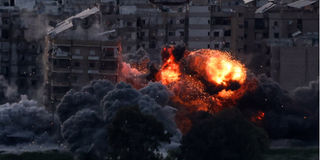
Smoke rises after an Israeli strike on Beirut's southern suburbs, following an escalation between Hezbollah and Israel amid the US-Israeli conflict with Iran, Lebanon, March 6, 2026.
Photo credit: Khalil Ashawi | Reuters
Critics might argue that media bias is inevitable in wartime, but history proves otherwise. During the Iraq War, stenographic reporting enabled falsehoods about weapons of mass destruction; today, Trump's "courageous" strikes are cheered on Fox News, while dissenters are branded "pimps for the enemy."
This propaganda overlooks public opposition — polls show Americans against escalation by wide margins — and violates constitutional norms, as no congressional authorization exists. In Africa, such biases have prolonged conflicts by justifying interventions; in the Middle East, they risk a wider war, potentially drawing in Hezbollah or even nuclear escalation.
To counter this, journalists must adopt the multidisciplinary approach I outline in my book: integrating security studies, postcolonial theory, and data analysis. For the Iran war, this means scrutinising all sides — US embassy closures, Israeli border build-ups, Iranian drone strikes — without favouritism. African media can lead by amplifying Global South voices, as Al Jazeera does, questioning regime-change fantasies that mirror failed Libya interventions.
Ultimately, the US-Israel-Iran war's coverage underscores a truth from Tales of War in Africa: media shapes reality, often to the detriment of the powerless. As oil surges and embassies shutter, Kenyans must demand nuance, lest we become collateral in yet another imperial narrative. Balanced reporting isn't optional—it's essential for peace.
Dr. Benjamin Muindi is the Dean of Research, Innovation and Postgraduate Studies at Zetech University, He is the author, Tales of War in Africa