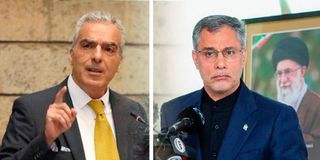
Iran and Israel may be in a stiff fight that has engulfed most of the Middle East in crisis. But far from the battlefield, in Nairobi, their respective envoys have perpetuated their home countries’ tough stance.
In interviews with the Nation , they offered two diametrically opposed accounts of a crisis that has already claimed hundreds of lives, including school children.
When Gideon Behar, the Israeli Ambassador to Kenya, was asked about the bombing of a girls' primary school in the southern Iranian town of Minab, a strike that, by Iran's own count, killed at least 180 people, his response was brief, categorical and unequivocal: it was fake news, he said—Iranian propaganda.
“The school, this is fake news,” he said in a virtual interview. “It is not real. It is done by Iranian propaganda.”
For Israel, attacking Iran, supported by the US, was an important first blow on an enemy expected to strike. It is a reasoning both Tel Aviv and Washington have cited when explaining the sudden bombardment of Iran last Saturday.
Ambassador of Israel to Kenya, Gideon Behar, speaks during the marking of the International Day of Commemoration in Memory of the Victims of the Holocaust at the United Nations Offices in Nairobi on January 27, 2026.
Photo credit: Bonface Bogita | Nation
“Since the Iranian regime has a plan and a strategy to destroy Israel, to annihilate Israel from the map, we understood that if we are not acting now, the Iranians will take their nuclear programme deeper underground, into deep tunnels where it will be impossible to hit them,” the Israeli diplomat explained.
Sitting across town, the Iranian Ambassador to Kenya had a different version of events entirely, one backed, to a significant degree, by satellite imagery, independent analysts, UNESCO, the United Nations Human Rights Office, and Nobel Peace Prize laureate Malala Yousafzai. Iran, he said, will decide when this war ends. And those responsible for the deaths of those girls will be held to account.
“On the first day of aggression, unfortunately, they attacked an elementary girls' school in Iran. Up until now, 185 students, girls, have been killed. And probably the number will increase,” said Dr Ali Gholampour, the Iranian Ambassador to Kenya
Their countries are at the centre of the Middle East’s most dangerous crisis in decades, blaming one another for the mess.
Iranian President Masoud Pezeshkian said the attack on the Minab school would never be erased from the historical memory of the Iranian nation.
The US Secretary of State Marco Rubio said this week, that American forces would not deliberately target a school, and that the Department of Defence would investigate whether the strike was theirs.
As the crisis deepened, President William Ruto condemned Iran's retaliatory missile strikes on eight neighbouring countries: the UAE, Qatar, Saudi Arabia, Iraq, Oman, Kuwait, Jordan and Bahrain. He called the regionalisation of the conflict a grave threat to international peace and security, and urged urgent multi-stakeholder engagement towards de-escalation, a message directed squarely at all parties to the conflict.
Iran Ambassador to Kenya Ali Gholampour addressing journalists at the embassy in Nairobi on March 2, 2026.
Photo credit: Lucy Wanjiru | Nation
The statement did not go down well in Tehran. Dr Gholampour said he was surprised that Kenya had chosen to condemn Iran's response rather than the original aggressor. In fact, Nairobi later clarified it was not taking sides but opposed to the ballooning of the conflict through attacks on countries not at war.
" Iran has been under attack, with military aggression by the US and the Zionist regime of Israel, in violation of international law and the Charter of the United Nations,” Dr Gholampour added.
Despite the public friction, Gholampour was keen to emphasise that Kenya-Iran bilateral relations remain intact. He urged Nairobi and all UN member states to redirect their condemnation toward what he described as the aggressors. Yet he said only Iran will determine the end of this.
“Everything depends on when the aggression is stopped. If it is stopped, our authorities will consider the situation.
“But if not, then we will continue to defend ourselves, we have no other choice, because this is an imposed war against my nation and my country.”
For Israel, Iran remains an existential threat. For him, Iran’s nuclear programme, a ballistic missile arsenal, and the funding and arming of proxy forces across the region, from Hezbollah in Lebanon to Hamas in Gaza and the Houthis in Yemen is a direct threat.
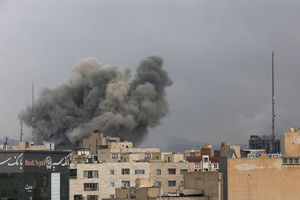
Smoke rises following an explosion, after Israel and the US launched strikes on Iran, amid the US-Israel conflict with Iran, in Tehran, Iran, March 2, 2026.
Photo credit: Majid Asgaripour | Reuters
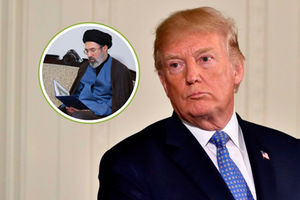
He argued that Iran had been dragging its feet for years, buying time to advance its nuclear programme, and that President Donald Trump had already given Tehran more than enough time to change course.
“We don't have a war with the Iranian people. The Iranian people and the Jewish people are friendly.
“You can see it in the protests worldwide where Iranian protesters march with Israeli flags. The problem is the Iranian regime — a terroristic regime which destabilises the whole region,” the Israeli envoy told the Nation.