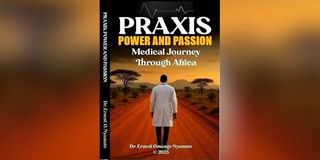
The cover page of Praxis, Power and Passion: My Medical Journey Through Africa by Dr Ernest Omenge Nyamato.
Rarely do Marxist or socialist thinkers such as Antonio Gramsci or Agostino Neto appear in public conversations in Kenya these days. Who still remembers Marxism? Who is Gramsci? Is Marxism that thing about overthrowing some order or having a revolution? Is it about workers and capitalism and capitalists? The proletariat and bourgeois? Well, are these not terms and philosophies of the past; of a time when the world was divided between the East and the West? Haven’t we all been liberated from communist or Marxist thinking after the fall of the Berlin Wall?
But why would Gramsci and Neto excite anyone reading a book by a Kenyan? Because both thinkers promote the idea of praxis. Although sounding very much a classroom term, praxis happens when the classroom experience (theory) and lived reality (practice) meet. Thus, even though Praxis, Power and Passion: My Medical Journey Through Africa (2025) by Dr Ernest Omenge Nyamato, is a very personal story of a doctor who worked in Kenya, and across Africa, especially in public health. This is a book about professionals who get committed to their work, who turn that work into a cause and what they discover in the encounter between them and the people.
Experimental space
But one does not come by praxis by accident or in a moment of revelation. It is built over time. In the case of Nyamato, it begins when he registers for a degree in medicine at the Moi University Medical School. This was not your regular medical school. By the time Nyamato arrived in Eldoret, the school did not even have what can pass as a medical school classrooms, laboratories or hostels. It was more or less an experimental space. As he writes, learning was unconventional - more tutorials, riding bicycles to visit rural health facilities, interacting with patients and delivering health talks when one had hardly studied how the human body works, 48 weeks of study compared to 38 at the University of Nairobi medical school.
This radical training, which demanded that the student interacts with patients and often their backgrounds lay the grounds for Nyamato’s later work as a public health specialist. From working at the Aga Khan Hospital to running a clinic for HIV patients in Mathare and Rachuonyo in Homa Bay, and later on supervising HIV programs in South Africa, Nigeria and Botswana, Dr Nyamato highlights the importance of a people-based and context-driven medical practice.
Rerouting their knowledge
In each of his stations as a doctor, Nyamato draws marvelous images of the people he worked with. He is full of praise for the women and men that worked alongside him, be they doctors, nurses, logisticians, lab technologists, civil servants in various ministries, fieldworkers, his superiors, and most importantly, patients.
Praxis, Power and Passion is about the professional ‘going back to the roots’ or rerouting their knowledge to the source. Whether one is a teacher, doctor, lawyer, engineer or pastor, the source of all knowledge is the lived experience. The curiosity that catalyses a search for solutions to problems is taught, learned or acquired in the experiential relationships between two or more persons. Understanding the dynamics of the relationships is the first route to addressing the problem.
One of Nyamato’s bosses had once told him that there is really no expert out there, but just someone who is more experienced and knowledgeable.
The writer teaches literature, performing arts and communication at the University of Nairobi. [email protected]