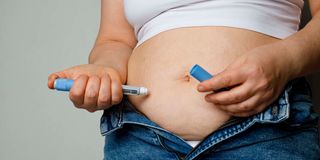
The Pharmacy and Poisons Board (PPB) has warned against celebrity-backed promotion of prescription drugs Ozempic and Wegovy, being endorsed for weight loss.
The aggressive social media marketing by influencers has fuelled a surge in over-the-counter use of the diabetes and obesity drugs.
Dr Fred Siyoi, the chief executive of PPB, says that under the Pharmacy and Poisons Act (Cap. 244), prescription-only medicines are strictly prohibited from being marketed to the public. He adds that for any health product to be advertised, the Pharmacy Board must issue a written approval.
“The board has noted the trend, and investigations are being conducted, and a comprehensive public safety alert and warning to both health care providers and members of the public will be issued soon,” he said.
PPB confirmed it has also not received any applications or granted approvals for advertising products like semaglutide (the active ingredient in Ozempic).
“None, but also advertising and promotion of these products are prohibited, including the distribution as marketing samples. Furthermore, the distribution of semaglutide is limited to health institutions; not allowed for public promotion,” he added.
However, many middle-aged Kenyans are buying semaglutide injections without prescriptions or obtaining them from beauty parlours, which often overlook the medical complexities of obesity and the potential risks.
Every day that a celebrity posts about losing eight kilos in three weeks, promoting the drugs on social media, or sharing the dramatic before-and-after photos, it attracts more than 150,000 likes and over 10,000 comments. A majority of these comments are asking for referrals, with the celebrities claiming they got the drugs for as little as Sh30,000 to Sh50,000.
“If the investigations reveal any pharmaceutical practitioner or other health care providers flaunting these rules by using celebrities and influencers in marketing the products, legal and regulatory action is imposed upon them,” Dr Siyoi warned.
Dr Rilwan Adan, the head of the Lions Diabetes Care Centre in Nairobi, says what Kenyans need to understand is that obesity is a chronic medical condition—just like diabetes or high blood pressure. While semaglutide (the active ingredient in Ozempic) has been proven to help in weight loss, she warns that it is important to first understand the root cause of obesity.
“There are secondary causes of weight gain,” Dr Adan explains. “For example, if you have hypothyroidism (when the thyroid gland doesn’t make enough thyroid hormones to meet your body’s needs), you’ll likely gain weight. But if the thyroid condition is treated and hormone levels normalise, the metabolic rate can increase, potentially leading to some weight loss or a return to a patient’s previous weight. That is not a type of weight gain that should be treated with Ozempic,” she says.
The aggressive social media marketing by influencers has fuelled a surge in over-the-counter use of the diabetes and obesity drugs.
Photo credit: Shutterstock
Similarly, prolonged steroid use for other medical conditions can lead to weight gain. “Steroids contribute to obesity, meaning the weight increase is a side effect, not the primary issue,” she adds.
That is why it is critical to evaluate the underlying cause of weight gain. Obesity is typically assessed using Body Mass Index (BMI), which is calculated by dividing weight in kilogrammes by height squared in metres. But Dr Adan notes that BMI is not always an accurate reflection of health risks.
“For us, we focus more on adiposity, that is, body fat. Fat is the real risk factor behind medical complications,” she says. “Yes, fat contributes to weight, but so does muscle.”
“You could be a bodybuilder with a high BMI due to large muscle mass but very little fat. That’s not a case of obesity I'm concerned about. BMI in such cases is misleading,” she adds.
Heavier bones can also skew BMI results, which may lead to an incorrect diagnosis of obesity. Instead, Dr Adan prefers to assess waist-to-hip ratio, which she finds a more reliable marker of unhealthy fat distribution.
“For example, if I prescribe Ozempic to a patient and they also commit to intensive behavioural therapy such as eating well, exercising, and strength training, they may build muscle while losing fat. Their weight might not change much, but their health improves. That, for me, is a win.”
Should one buy Ozempic or Wegovy over the counter?
“You should not self-prescribe Ozempic just because you are overweight,” she said.
Obesity can lead to type 2 diabetes, often without early symptoms, which in turn can silently damage organs like the eyes.
Ozempic, a medication originally developed for type 2 diabetes, has shown significant benefits in lowering blood sugar and reducing cardiovascular risks.
However, for people with diabetic eye disease (retinopathy), it can sometimes temporarily worsen vision problems, especially if blood sugar levels drop rapidly. This, however, does not mean that the drug causes blindness, but those with existing eye complications should be closely monitored.
“If you’re diabetic, we check your eyes at least once a year, whether or not you have symptoms,” Dr Adan says.
Another challenge is getting the right dosage. Those buying unprescribed Ozempic may be taking the wrong dosage.
“Ideally, most diabetes patients start with 0.25 mg, move to 0.5 mg in the second month, then 1 mg, followed by 1.7 mg or even 2.4 mg,” she explains. “The doses of 0.25 mg, 0.5 mg, and 1 mg have been approved for the management of diabetes. You’ll lose some weight as a side effect, but the 1.7 mg and 2.4 mg doses sold under the brand Wegovy are specifically approved for weight loss.”
The most common side effects are digestive, such as bloating, diarrhoea, vomiting and constipation. Therefore, you need a clinician to review you and do a thorough medical check before starting the dose.
There are red flags to look out for before buying semaglutide injections. Dr Adan says, “number one is if someone is not asking you for a doctor's prescription and the reason you’re using this drug, that's a red flag.”
“It’s not true that you don’t need to watch your food or exercise. Yes, Ozempic helps lower blood sugar and supports weight loss. But when combined with healthy habits like eating well, being active, and getting behavioural support, the results are much better and longer-lasting.”
She emphasises the importance of a slow and consistent approach. “Building healthier habits over time is what leads to sustainable change.”
Another warning sign is where the drug is sold. “If it's being sold in a spa, that’s a red flag,” she says. And finally, the price.
According to Novo Nordisk, the maker of Ozempic, the listed price for a 0.25 or 0.5 mg pen (11.5 mL) is $997.58 (around Sh128,887). The same applies to the 1 mg and 2 mg pens (13 mL).
Just three months ago, a Daily Nation investigation revealed that some pharmacies in Nairobi were selling Ozempic without a prescription, the highest priced at Sh105,000. Today, it’s being sold for as low as Sh30,000, a dramatic drop that raises questions about authenticity.
Influencing and false information
A source close to some well-known celebrities has revealed how beauty and weight-loss campaigns really work behind the scenes in Kenya’s influencer world. Behind these glowing endorsements, the reality is often very different. The celebrities sign short contracts, usually for one to three months, to promote cosmetic injections, including weight loss drugs, skin lightening and whitening, or body-enhancing shots.
But here is the catch: not all of them actually use the products. Those who use the products are also paid additional money as an endorsement fee or content creation fee.
“Some do their own research and choose not to take the injections or use the products,” the insider shared. “But when they create content, they make it look like they’re using them.” For one-time promotions, influencers are paid once. For ongoing posts, where the parlour reuses the adverts, the influencer might earn more. But none of it is free.
A 2025 report by the Reuters Institute shows that in Kenya, online influencers are the main source of false or misleading information. The concern is especially high in African countries like Nigeria (58 percent) and Kenya (59 percent).
“Male celebrities usually say no to promoting weight loss or injection-based products,” the celebrity insider said. “There’s still stigma, and people will mock them for not being masculine. But it doesn’t mean that Kenyan men aren’t using weightless drugs or skin whitening or body enhancement products.”