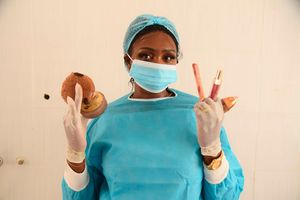
Margaret Santa Thoya, 26, paces outside the mortuary at Malindi Sub-County Hospital.
In her hands is a plastic makeup bag filled with skin and hair products: foundations in different shades, lipsticks, hairbrushes, and other beauty tools. Her bright green dress and makeup kit stand out against the sterile, sombre surroundings.
Margaret is waiting for a bereaved family to arrive. She is not there only to offer condolences; she is there mainly to work.
When she spots a bereaved family, Margaret approaches and offers her condolences. Once the first wave of grief has settled, she introduces herself and offers to prepare their loved one for viewing, not as a mortuary attendant, but by applying makeup, styling the hair and restoring a familiar, presentable appearance.
“By 8am every day, I arrive here to look for grieving families and ask if they need someone to do makeup for their loved ones,” she says.
This has been her job for four years now. She says her work involves preparing bodies to achieve a peaceful, dignified appearance for viewing. She applies opaque or cream-based foundations, tints and powders to correct discolouration and mimic a lifelike skin tone. She also washes the dead's hair, styles it and carries out general grooming.
Her charges range from Sh1,500 to Sh7,000 per client, depending on the age and the beautification or makeup styles required by the family. On average, she handles two bodies a day, but sometimes she can go for a whole week without work.
The job, she says, requires more than technical skill.
“This job needs confidence and determination. You need the heart of a lion to do it. It takes a lot of emotional and physical strength. For me, I feel it is a calling because you need deep empathy, but also the ability to detach yourself emotionally,” the makeup artiste says.
Unlike most jobs that end when the workday is over, Margaret says death has a way of following those who work with it.
For Margaret, it has followed her into her social life, relationships and prospects of marriage. Her biggest regret, she says, is that her work has driven away potential suitors.
Some people in Malindi have nicknamed her ‘Maggie Mortuary’, and many never want to associate themselves with her.
“Immediately they spot me from far; you’ll see them pointing fingers at me and saying, ‘yes, that one, the mortuary lady’ or ‘Maggie Mortuary.’ They even move aside for me to pass.”
“You can imagine, men don’t even want to talk to me or ask me out because I do makeup for the dead. They don’t want to be associated with me in any way,” she says.
Margaret Santa Thoya poses for a photograph with empty caskets at a shop near Malindi Sub-County Hospital Mortuary on August 26, 2026.
Photo credit: Kalume Kazungu | Nation Media Group
Asked why she does not date people such as doctors, whose work brings them into contact with death, Margaret says she has not closed the door on anyone. But even the medics she encounters regularly in hospitals and mortuary corridors have shown little interest in her, something she believes is because of the work she does.
“Maybe some fear there would be no buffer. Imagine two people working in fields tied to death and crisis. At home, there may be no one to provide an emotional break from it all,” she explains.
Margaret, the third-born in a family of four girls, says she did not set out to become a makeup artiste for the dead. After completing Class Eight at Karima Primary School in Malindi, Kilifi County, in 2016, she did not further her studies because of a lack of fees.
“My mother is a grocer at Malindi Municipal Market. She was widowed when we were still young. I did casual jobs for some time and later worked as a housekeeper for several years,” the 26-year-old says.
Margaret eventually found her way into the beauty industry through a friend who owned a salon. She would spend almost a year learning by watching others work and through apprenticeship.
“In the end, I became so good that clients would seek me to do hairstyling and nails,” she says.
Then, one day, people in her village in Muyeye, Malindi, approached her to help prepare their dead relative.
They asked her to accompany them to the Malindi Sub-County Hospital mortuary to do hair care for a female relative who had died.
“I gained courage, went with them to the morgue and did the woman’s hair. I removed her plaited braids, washed and blow-dried her hair, deep-conditioned and relaxed it. That was when I became known for the work. They paid me well,” she says.
She decided to turn the work into a profession, but it came at a cost. At first, she faced intense stigma and rejection, even from members of her own family.
Malindi Sub-County Hospital mortuary.
Photo credit: Kalume Kazungu | Nation Media Group
When she returned home from the mortuary, her mother and sisters would wait for her at the entrance and direct her to a washroom outside the house.
“They would insist that I could not enter the house in the clothes I had worn to the mortuary. They were afraid, so they would make sure I took a bath, changed my clothes, and left the mortuary clothes in the washroom. I felt like I had to go through a whole cleansing ritual before I could enter our home,” she says.
Over time, however, the family’s fear gave way to acceptance.
“I didn’t take offence at their initial reaction to my job. I know people fear death. Many associate corpses with bad luck, curses or evil spirits, so I understood them. The good thing is that my mother and sisters eventually understood me. They now fully support my work because it helps me earn a living and take care of myself, my mother and my siblings,” she adds.
Her sister, Elvina Karembo, remembers how difficult it was for the family when Margaret first started the work.
“Initially, her job worried us a lot. We were even hesitant to sleep in the same bed with Maggie because we kept thinking about her handling corpses and applying makeup to them. But over the years, we have come to understand and accept her profession. We love her,” Ms Karembo says.
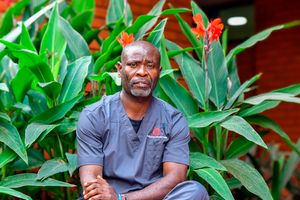
Margaret is not alone in this relatively new career. Samson Karisa, 35, relocated to Malindi from Kilifi Town, a distance of about 61 kilometres, to offer similar services.
His work involves dressing the dead and carrying out physical and facial reconstruction, particularly for victims of accidents whose bodies have been disfigured. He uses wax, cotton and specialised compounds to rebuild facial features or conceal trauma, bruising and swelling caused by illness or injury before dressing up the bodies for viewing.
Karisa charges between Sh1,000 and Sh5,000 depending on how complicated the work is and the financial status of the bereaved.
“I mainly do makeup for men who have died, especially those involved in accidents, so their relatives are not traumatised or frightened when they view the bodies. I always consult the family, and sometimes they provide photographs of their loved one when they were alive. I use these to understand their wishes and create a likeness that is as accurate and dignified as possible,” he explains.
Just like Margaret, his work has earned him a nickname among locals: ‘Karisa wa Kifa’, Giriama for ‘Karisa of Death’. But perhaps more striking than the nickname is what he has chosen to conceal.
Margaret Santa Thoya poses for a photograph with empty caskets at a shop near Malindi Sub-County Hospital Mortuary on August 26, 2026.
Photo credit: Kalume Kazungu | Nation Media Group
Karisa says his mother, wife, and two children are not aware of the work he does to bring food to the table.
“I moved to Malindi from Kilifi because I am well known back home, and I feared that people would isolate me if they found out that I do makeup for the dead. My family just sees me as someone focused on developing our rural village and nothing more,” says Karisa.
Both Margaret and Karisa adhere to strict sanitation rules, including wearing gloves, masks and other protective gear, particularly in mortuary environments.
While families want their loved ones to have a dignified final appearance, those who prepare the dead for viewing often struggle to receive the same acceptance in everyday life.
Andrew Masama, the Kenya Psychological Counselling Association (KPCA) Lamu Branch chairperson, says the stigma stems from a mix of psychological, social, and cultural factors. He says society naturally associates death with sadness, pain and loss.
In many traditional African communities, he says, there are also cultural taboos surrounding death and those who work closely with it.
“People often transfer their fear of dead bodies to those who handle them, such as Maggie and Karisa. There is also a belief among some people that handling the dead can attract bad luck, ghosts or negative energy,” said Mr Masama.
In some communities, people who work with the dead are required to undergo ritual cleansing by elders, reflecting the cultural weight that death continues to carry.
“People should not judge them because of the work they do. Preparing the dead is a profession like any other, and those who do it deserve to be respected for the service they provide to grieving families,” he says.