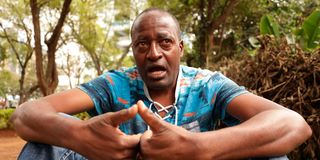
The sound of exploding teargas is usually the signal for most people to run, but for Julius Kamau Kimani, it is the moment to move forward.
As anti-riot police charge at protesters in Nairobi's city centre, the 48-year-old deliberately places himself on the front line, confronting rows of anti-riot and civilian police officers armed with shields, batons and tear gas, often becoming one of the last people to retreat.
It is a ritual he has repeated for more than a decade and for him, standing his ground is a way of sending a message to the government, whatever the consequences.
Activist Julius Kamau is ejected from the Supreme Court, Milimani for causing a disturbance during the presidential poll petition pre-trial conference on August 30, 2022.
Photo credit: Dennis Onsongo | Nation Media Group
Mr Kamau says he has lost count of the number of times he has been arrested, refusing to abandon a cause he believes is bigger than himself.
Since joining protests in 2013, he estimates he has been taken into police custody more than 50 times.
When he is not demonstrating, he earns a living selling second-hand clothes, popularly known as mitumba, a business that has sustained him since he moved from Kandara, Murang'a County, to Nairobi in search of a better life.
“I'm still learning from the streets and I know I still have more to learn from the people we interact with every day,” Mr Kamau told the Nation .
Like many migrants to the capital, he arrived hoping for economic opportunities. Instead, he says, he found himself in constant conflict with Nairobi County inspectorate officers, commonly known as kanjos.
He says witnessing what he considered repeated harassment of hawkers, including the death of one of his colleagues, pushed him into activism and inspired him to speak for people who often did not know their rights.
“When I came to the city, I never imagined we would reach a point where police killings would become so common. It pains me to see so many lives being lost. These things should not be happening,” he says.
Mr Kamau acknowledges that many people misunderstand him because of the causes he champions and the risks he is willing to take.
Away from demonstrations, he cuts an entirely different figure. Most days he can be found quietly going about his business in simple shirts and sandals, the modest lifestyle he has grown accustomed to. Seeing him in a tailored suit, he jokes, would be almost impossible.
“It is because of what I have gone through personally and what I have seen our people go through in this country that drives me to join others in demanding change. I believe change is possible. We should never lose hope because we are the ones who are here now,” he says.
Mr Kamau is married with two children, who, he says, pray for his safety every time he leaves home for a protest.
“My wife couldn't understand why I was doing this. At one point she left and went back to her parents. But with time she came to understand why I do it, and she returned. Our lives are now going on smoothly,” he said in an interview with Nation .
Despite spending years confronting police, enduring arrests and facing physical danger, Kamau insists he remains mentally strong.
“When I see these things, I ask myself, what happened to humanity? We have become either hypocritical or unwilling to stand up for what is right and defend those who cannot speak for themselves”
Activist Julius Kamau is ejected from the Supreme Court, Milimani for causing a disturbance during the presidential poll petition pre-trial conference on August 30, 2022.
Photo credit: Dennis Onsongo | Nation Media Group
Mr Kamau dismisses claims that activists are paid to participate in demonstrations or destabilise the government.
He says he earns his own living as a hawker and has never received payment from any organisation to protest.
“People keep calling us paid activists, and that really hurts because I work for a living. I run my own business. Nobody pays me to protest. Sometimes well-wishers have sent me money to help me, but I have never been paid by any organisation,"he explains.
Activist Julius Kamau hawking clothes along Latema street in Nairobi on August 23,2024. Kamau earns his daily living through selling second hand clothes which he described as a good business venture.
Photo credit: Evans Habil
He says the Defenders Coalition, a national network that supports human rights defenders, has repeatedly assisted him with legal representation whenever he has been arrested and charged.
Still, he jokes that if organisations paying activists truly exist, he would like to meet them.
“If those organisations are really there, I would like to find them and use that money for the right cause to mobilise people into a revolution because what this country needs is a people's revolution,” he said.
Mr Kamau says he will only stop protesting when Kenya fully embraces the rule of law and justice becomes a reality for everyone.
Until then, he intends to remain on the streets demanding accountability from every institution, including the Judiciary.
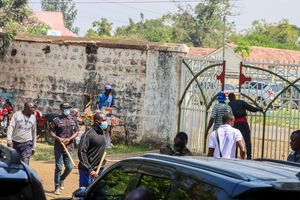
His activism has also come at a heavy personal cost. Over the years, he has been arrested dozens of times, bundled into police vehicles and on several occasions, assaulted by armed goons while taking part in demonstrations demanding accountability.
He believes the growing use of gangs to disrupt protests has made the work of human rights defenders even more dangerous.
According to Mr Kamau, the recent trend of politicians deploying goons to infiltrate demonstrations and attack opponents has significantly increased the risks faced by activists, making the struggle for constitutional freedoms more perilous than ever.