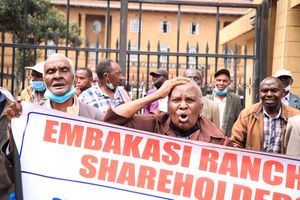
Embakasi Ranching Company in Ruai, Nairobi.

A leadership and ownership dispute at Embakasi Ranching Co. Ltd has spilled deeper into the courts after the Environment and Land Court temporarily halted proceedings in three separate land cases, exposing an intense battle over who legitimately controls one of Nairobi’s most controversial land-owning firms.
In a ruling delivered on Friday, May 7 2026, Justice Edward Wabwoto granted the company leave to file an appeal out of time and stayed proceedings in three suits at the Milimani Environment and Land Court, pending determination of the appeal.

Justice Edward Wabwoto, judge of the Environment and Land Court.
At the heart of the dispute is a fundamental question that has haunted the company for years: who has the lawful authority to represent and instruct lawyers on behalf of Embakasi Ranching Company.
The court battle pits directors listed in the company’s CR12 records against rival factions relying on earlier High Court orders issued in 2019 by Justice Grace Nzioka.
The dispute arose after a magistrate’s court struck out the law firm of Belinda Otieno & Company Advocates from representing the company in several land disputes. The magistrate ruled that the directors appearing in the CR12 records lacked authority to instruct counsel because of earlier orders issued in High Court Civil Case No. E096 of 2019.
The company challenged that decision, arguing that the magistrate improperly extended interlocutory orders issued in a separate case into unrelated proceedings.
Justice Wabwoto agreed that the appeal raised weighty constitutional and legal questions that deserved a full hearing.
“The intended appeal is clearly arguable,” the judge ruled.
“It raises bona fide questions on whether a subordinate court can extend interlocutory High Court orders which were preservatory and limited to a specific suit to strike out counsel in entirely unrelated proceedings.”
The ruling has effectively paused proceedings in Milimani MCELC/E312/2025, MCELC/E453/2025 and MCELC/E385/2025, all of which revolve around land disputes involving the company.
Embakasi Ranching Company has for decades been at the centre of numerous ownership disputes involving prime land in Nairobi’s eastern corridor. The company traces its origins to land-buying schemes that attracted thousands of shareholders seeking residential plots as Nairobi expanded.
But over the years, wrangles involving directors, shareholders, parallel officials and competing land claims have generated endless litigation.
In the latest case, the company argued that its constitutional right to legal representation under Article 50 had been violated after the magistrate struck out its lawyers based on interim High Court orders issued years earlier.
Through lawyer Achieng Otieno, the company maintained that the magistrate misapplied the 2019 orders issued by Justice Nzioka.
According to court documents, the disputed High Court orders were initially intended as preservatory measures in a separate dispute involving the Registrar of Companies and several parties.
The first respondent, Mr Robert Gachuhi Nduati, supported the appeal, telling the court that the CR12 directors still retained lawful authority to appoint advocates.
Mr Nduati, described as a shareholder and administrator of the estate of Lawrence Nduati, argued that the magistrate improperly expanded the scope of the earlier High Court orders.
But the application faced fierce opposition from Ms Pauline Mbeneka Mutua and the Embakasi Company Limited, listed as an interested party.

Embakasi Ranching Company's Phidelis Wangari speaking during the burial of the company’s chair James Njoroge at Lironi in Kiambu County on September 5, 2023.
Ms Mutua argued that the application improperly bundled together three separate suits involving different parties and factual circumstances.
She warned that granting blanket stay orders would unfairly delay unrelated proceedings and escalate legal costs.
The interested party, through director Walter Kigera Waireri, argued that the appeal itself had been filed without proper authority because the individuals purporting to act for the company lacked fiduciary capacity.
The rival faction invoked the famous corporate law principle in Foss v Harbottle, which generally bars unauthorised individuals from suing on behalf of a company.
But Justice Wabwoto declined to determine that issue at the preliminary stage, saying it was central to the substance of the appeal itself.
“The authority of the CR12 directors to instruct counsel is the very substratum of that appeal,” the judge ruled.
“Determining the objection at this interlocutory stage would require the Court to pre-emptively decide the merits of the appeal itself.”
The judge further held that the objection did not affect the court’s jurisdiction.
“The rule in Foss v Harbottle is a principle of company law that generally bars a minority shareholder or an unauthorised agent from bringing an action in the name of a company,” Justice Wabwoto stated.
“It is fundamentally a rule about locus standi and corporate capacity, not about the subject-matter jurisdiction of the Court.”
The court also addressed delays in filing the appeal.
Although the company claimed the delay was only three days, the court found that the appeal had actually been filed 19 days outside the statutory timeline.
The company blamed the delay on the temporary indisposition of counsel, though opponents criticised the explanation as vague and unsupported by medical evidence.
Justice Wabwoto acknowledged the weakness in the explanation but nonetheless exercised discretion in favour of hearing the appeal.
“The delay is not inordinate, the issues are arguable, no prejudice has been demonstrated, and the interests of justice favour a hearing on the merits,” the judge ruled.
One of the most significant aspects of the ruling was the court’s decision to extend stay orders even to one suit that was not directly before the appellate court.
Justice Wabwoto said allowing one of the cases to proceed independently risked creating conflicting judicial decisions on the contentious representation issue.
“The Court therefore invokes its inherent jurisdiction under Section 3A of the Civil Procedure Act,” the judge stated, adding that the stay was necessary “for the sole purpose of preventing multiplicity of conflicting decisions on the representation question.”
The court directed that the appeal be heard on a priority basis while ordering each party to bear its own costs.
The ruling now sets the stage for yet another major legal confrontation over the governance, representation and land interests tied to Embakasi Ranching Company — disputes that continue to shape ownership battles across Nairobi’s fast-growing eastern suburbs.
Follow our WhatsApp channel for breaking news updates and more stories like this.