Former long-serving Cabinet minister and Rongo Member of Parliament Dalmas Otieno Anyango, who died on Sunday, aged 80 , was an independent-minded politician whose pragmatism allowed him to navigate Kenya’s shifting political landscape.
His career was defined by an ability to forge alliances across party lines, often switching allegiances to maintain influence while pursuing the interests of his constituents.
Mr Otieno’s political manoeuvres sometimes led to clashes with senior figures, including the late President Daniel Moi and veteran politician Raila Odinga.
Yet, his adaptability also enabled him to serve in successive administrations, including those of Presidents Moi, Mwai Kibaki, and Uhuru Kenyatta.
For him, politics had no permanent enemies, only opportunities to advance governance and community development. Born on April 19, 1945, in West Kamagambo Location, South Nyanza District, Mr Otieno received his early education at Kitweru Primary School, Asumbi Intermediate School, and Rapogi Secondary School.
He earned a Bachelor of Science in Applied Economics from Makerere University, Uganda, in 1968 and later completed a Master of Business Administration at the University of Nairobi in 1980.
Between 1971 and 1982, he worked as an accounts manager for Insurance Agency Management. He later chaired the Kenya Commercial Bank Board from 1982 for three years and became the first Kenyan Fellow of the Chartered Insurance Institute in 1979.
Mr Otieno entered politics in 1988, winning the Rongo Parliamentary seat despite being a political newcomer, a victory attributed in part to support from Hezekiah Oyugi, Moi’s Permanent Secretary for Internal Security.
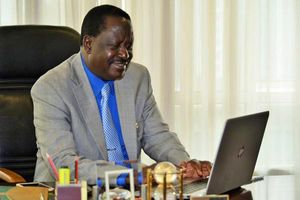
Dalmas Otieno during a media briefing on November 20, 2019.
Photo credit: File| Nation Media Group
Following his election, Moi appointed him Minister for Industry.
After multiparty democracy was reintroduced in 1991, he served as Minister for Labour and Human Resource Development and later as Minister for Transport and Communication from 1991 to 1996.
In February 1996, he was dismissed from Cabinet for opposing a government directive that allowed sugar imports, siding with local sugarcane farmers.
The Weekly Review at the time described him as “the first minister to be sacked in the multiparty era.”
In 1997, he co-chaired the Inter-Parties Parliamentary Group tasked with reviewing sections of the Constitution ahead of elections.
Throughout his career, Mr Otieno frequently switched allegiances.
He left Kanu for Raila Odinga’s Orange Democratic Movement (ODM) in 2007 but later fell out with Mr Odinga when he launched Kalausi —a political movement aimed at challenging Odinga’s influence in Luo Nyanza. This move contributed to his eventual political marginalisation in the region.
Former Rongo MP Dalmas Otieno's family hold his portrait at his home in Kangeso village in Migori county on September 7
Photo credit: George Odiwuor| Nation Media Group
Despite setbacks, he served as Public Service Minister in the grand coalition government under Raila Odinga and later as special envoy to Juba, South Sudan, in 2020.
His political ingenuity ensured he remained a significant figure in national affairs, even as local dynamics shifted.
Colleagues and political leaders praised his intellect, discipline, and dedication.
Deputy Chief of Staff Eliud Owalo described him as “an exceptionally brilliant and composed leader, a shrewd businessman, and a pioneer entrepreneur in insurance and banking,” noting that his passing deprived the nation of one of its most capable minds.
President William Ruto (left) with former Cabinet minister Dalmas Otieno in Homa Bay town on October 2, 2022.
Photo credit: PSCU
President William Ruto mourned him as “sharp, progressive, and industrious; a statesman whose ideas and leadership will continue to shape generations.”
National Assembly Speaker Moses Wetang’ula lauded his principled approach to public service, while Treasury Cabinet Secretary John Mbadi highlighted his influence on parliamentary debates and policy formation. Prime Cabinet Secretary noted his commitment to duty and example in leadership.
He was a staunch advocate for education, establishing Rongo University and Siala Technical Training Institute and supporting hundreds of students, including orphaned children, through a personal education fund.
His younger brother, Maurice Ariyo, remembered him as a champion of learning, ensuring that students pursued secondary and tertiary education, often personally funding their tuition. Athanasio Odhiambo, a relative, noted that his initiatives enabled over 400 students to attend university.
Dalmas Otieno was also revered as a community peacemaker, known locally as a “ruoth ” or “ogai. ”
Former President Moi shakes hands with ex-Cabinet minister Dalmas Otieno in Migori.
Photo credit: File | Nation Media Group
He mediated disputes and played a key role in peace negotiations during the formation of the grand coalition government after the 2002 election, working alongside the late Kofi Annan to broker a truce between Raila Odinga and President Kibaki.
He promoted local economic development, advocating for banks in Rongo town to provide residents with access to savings and credit, and supported farmers through initiatives such as introducing dairy cows and promoting Napier grass cultivation.
Many professionals in the region credit their education and business success to his mentorship and vision.
Family and relatives gathered at his Kangeso village home in Migori County to mourn his passing. Friends and colleagues remember him as a decisive, principled, and visionary leader whose legacy in politics, education, peacebuilding, and economic development will endure for generations.