On any given day on Thika Road—or any of Nairobi’s bustling highway—traffic jams transform into open-air markets. As engines idle and horns blare, hawkers weave through the maze of vehicles, calling out to drivers and stretching goods through car windows. It’s a risky way to make a living, but for many, it’s the only way to put food on the table.
For years, Nairobi’s hawkers have turned the city’s worst frustration into their daily opportunity. Every jam means a chance to sell—whether it lasts five minutes or an hour. The income is never certain, the danger is constant, but the jam keeps drawing them back to the road.
For Desire Ilandinknda, a 35-year-old Burundian living in Ruiru, hawking footballs along the Thika Superhighway is both survival and sacrifice. “I usually leave my place at 5.30am and by 6am, I’m already here at Muthaiga Square past Mathari National Hospital,” he says. “Carrying the balls is a challenge. I deflate them first, because moving with inflated balls in matatus gives me headaches. After arriving, I inflate them, arrange them in nets I sling on my back, and others I just hang on my shoulders or carry with my hands.”
Desire has sold on the highway for two years, sometimes stretching his trade to Nyayo or Mombasa Road. But Thika Road remains his favourite. “If I go to Mombasa Road, the fare is costly and sometimes I won’t sell even a single ball. But here, I’ll always get something, even if it’s Sh500 today or Sh2,000 another day. There are weeks I can go three days without a single sale, but I still come. At the end of the day, we have bills to pay.”
The job, he admits, is risky. Fast-moving vehicles and distracted drivers make every step dangerous. “Selling at the highway is risky because vehicles are driving so fast. You have to be watchful. Before I cross from the exit lane to the highway, I check right and left. One mistake and you can be hit just because you’re chasing a few coins.”
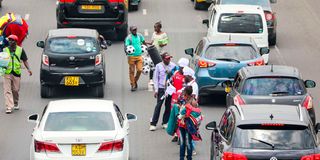
Hawkers selling their merchandise to motorists stuck in a traffic jam along Thika Road in Nairobi on September 30, 2025. The heavy traffic has provided hawkers with increased opportunities to sell their goods, as the prolonged congestion keeps motorists stationary and more receptive to purchasing items
Photo credit: Bonface Bogita | Nation Media Group
He knows this firsthand. “Two years ago, I was hit by a boda-boda while selling. It overtook a bus I was attending to and struck my leg.” Yet every morning, Desire returns to the tarmac—driven by determination and necessity.
For Alex Okumu, a 50-year-old ice cream vendor, Thika Road has been his office since 2004. Pushing his trolley along the highway’s shoulders, he waits for the sun to rise before business begins.
“I start my day at 10am, when the sun is up and scorching. That’s when people want cold things. I sell to passengers on matatus, drivers in private cars, or people who just come to my trolley. I close once my stock is done, sometimes in three hours, at other times the whole day.”
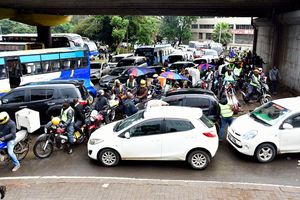
Hawkers sell their wares to motorists stuck in a traffic jam on Thika Road in Nairobi on September 30, 2025.
Photo credit: Bonface Bogita | Nation Media Group
But business is not what it used to be. “Back then, before Thika Road was this busy, I had so many customers. Today, the economy is worse. I sell an ice cream cone for Sh50, up from Sh30, and drivers argue with me. They don’t understand I need a profit. I’m a father with children to feed and educate.”
His earnings depend on the sun and the traffic. “If there’s a gridlock and the sun is hot, I can make Sh5,000 in a day. On bad days, it can be Sh200. It’s unpredictable.”
Despite the challenges, Alex says he will not move to another highway. “We earn from Thika Road’s congestion. Unless another highway brings in more money, I’m not relocating.”
Meanwhile, Janepher Nakhulo has spent the past decade roasting maize by the roadside near Mathari National Teaching and Referral Hospital. Every morning, she buys stock from Githurai 45 before setting up her umbrella and charcoal stove. By noon, the sweet, smoky aroma of roasted maize fills the air around her stall.
“I like to treat my customers with kindness,” she says. “A smile makes them come back.”
Her roasted maize sells for Sh20 half a cob and Sh40 a full one. On a good day, she makes just over Sh1,000. “It is not much, but at least I go home with something,” she explains, turning a cob over the fire.
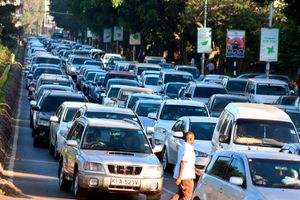
Hawkers sell bananas to motorists stuck in traffic jam on Kipande Road in Nairobi.
Photo credit: Evans Habil | Nation Media Group
Janepher’s busiest hours come in the evening when traffic thickens. She leaves her umbrella behind and runs between lines of cars, balancing cobs in her hands. “The traffic helps us,” she admits. “Sometimes a driver buys one cob, sometimes two. At least I get a coin.”
But her trade comes with hurdles. “The sun burns too much if I don’t use my umbrella, yet city county officers say we cannot use them. They sometimes demand heavy taxes or chase us away. Without this business, what else would I do?”
From late morning until around 9pm, she remains by the roadside—braving sun, smoke, and traffic until the day is done. For her, hawking is not just a job but a way of life. “For ten years, this has been my life: smoke, sweat, traffic, and a little money to take home.”
Nairobi’s hawkers have learned to survive by turning the city’s worst problem into their lifeline. Every jam means a chance to sell, whether it lasts five minutes or an hour. The money is never guaranteed, the risks are constant, but the jam keeps pulling them back to the road each day.