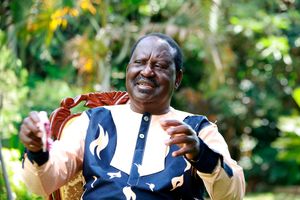
Former Prime Minister Raila Odinga’s family member and a cardiologist who attended to him at a hospital in India have recounted desperate attempts to save his life in the final moments.
While Kenyans were preparing to go to work on Wednesday morning, Devamatha Hospital in southern India's Kerala was abuzz with urgency.
Mr Odinga, Kenya’s former prime minister, had just been wheeled into the facility after suffering a cardiac arrest during a morning walk at about 8.30am (6am Kenyan time).
By his side were his personal doctor and security personnel Maurice Ogeta. The two had just administered cardiopulmonary resuscitation (CPR). Mr Odinga remained unresponsive, prompting them to rush him to the facility, which was the nearest private hospital. They were tensed but focused to save the veteran politician.
An Indian police official told the AFP news agency that Mr Odinga had been on a morning walk, accompanied by his sister Ruth, daughter Winnie, a personal doctor, and Indian and Kenyan security officers, when he collapsed.
At the facility, a team of doctors rushed, and immediately took over the resuscitation efforts. At the time of admission, Mr Odinga had no pulse or measurable blood pressure upon arrival, the doctor said.
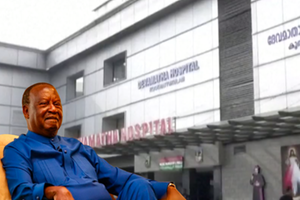
The Devamatha Hospital in Kerala, southern India, where former Prime Minister Raila Odinga died.
Photo credit: Nation Media Group
“Former Kenyan Prime Minister Raila Odinga was brought to our casualty emergency wing with a history of sudden collapse during his morning walk,” a Cardiologist, Dr Alphônš said.
“They had already started CPR. His doctor and security personnel were with him. We continued CPR and performed emergency intubation—inserting a tube into the respiratory system—and continued CPR along with other resuscitative measures,” she said.
“After stabilising him with IV fluids, we administered an injection to dissolve any possible clot in the coronary arteries.”
When in the Intensive Care Unit (ICU), the medics in the room momentarily detected a heart rhythm. The beeping then faltered, followed by heartbeat flat line on the screen.
The medics also observed swelling in his lower right leg. His personal physician informed them that he had a history of diabetes, hypertension, and chronic kidney disease. He had previously been treated for deep vein thrombosis. He had an inferior vena cava filter inserted in the vein.
“Recently, he had a thin subdural hematoma, which was detected last Saturday,” the cardiologist said.
Mr Odinga’s elder brother, Dr Oburu, also revealed that Mr Odinga was in good health until Tuesday night. He disclosed that they had a conversation that night.
“I informed you before that he was well and kicking, and that he would be back in the country. That was not a lie; it was the truth,” Dr Oburu said.
“He was very well until last night (Tuesday)—I spoke to him. He was vibrant, up and kicking."
According to Dr Mohamed Hasham Varwani, an interventional cardiologist at the Aga Khan University Hospital, Nairobi, what follows a cardiac arrest is a sudden collapse, loss of consciousness and stoppage of breathing.
“Without quick action, especially CPR (cardiopulmonary resuscitations that mainly entail chest compressions) and use of a defibrillator, which can apply an electric shock to the heart, a cardiac arrest can cause death within minutes,” said Dr Varwani.
“Acting quickly can make the difference between life and death. Every minute without CPR or defibrillation reduces the chances of survival by about 10 percent.”
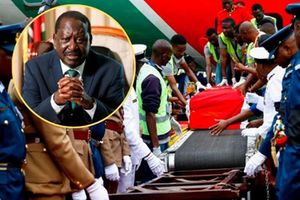
The casket bearing the body of former Kenyan Prime Minister Raila Odinga is received at the Jomo Kenyatta International Airport in Nairobi, on October 16, 2025.
Photo credit: Reuters
On October 11, Mr Odinga’s brother, Dr Oginga, had told the media that the ODM leader was “a bit indisposed, just like every human being sometimes becomes indisposed”.
“He went for check-ups, it’s finished. He’s now just recuperating. Very soon, he will be back.”
Also, this was not the first time Dr Oginga was discussing his younger brother’s hospitalisation. In 2020, when Mr Odinga went to Dubai for treatment, it was his elder brother who spoke to the media about the swirling rumours.
“Jakom (Raila) is out of the country for a minor surgical operation on his back. It is not a serious health issue, but just a minor one. So, he’s okay,” Dr Oginga told journalists in June 2020.
Later, in an interview with the Nation , Mr Odinga revealed that he had an issue with his spine.
“The doctors told me it is called Spinal Canal Stenosis,” he said, referring to a condition that causes the narrowing of the spaces within the spine and which can be painful in some instances.
“What they did for me in Dubai is a minor procedure. It’s called lumbar decompression and fusion…The operation itself takes some few hours and then you need time to recuperate.”
In March 2021, Dr Oginga was also in the news after responding to talks about his brother’s hospitalisation. He denied that Mr Odinga had contracted Covid-19, but the fact was later confirmed.
A decade earlier, in 2010, when Mr Odinga was the Prime Minister, he underwent a surgery at the Nairobi Hospital to remove fluid in his brain. Neurosurgeon Oluoch Olunya described the operation as “minor” and which was meant to relieve pressure that had built up outside Mr Odinga’s brain.
“Following examinations and initial investigations, he was found to have a build-up of pressure outside the brain leading to headache,” Dr Olunya told the media in June 2010.
“A team of doctors got together and within a short period it was agreed that a minor procedure be carried out on the left side of the head to relieve the pressure,” he said. “The pressure was relieved when some fluid was removed through a small opening in the skull.”
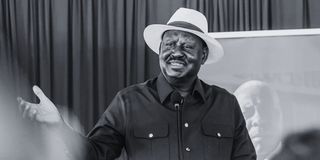
Former Prime Minister Raila Odinga.
Photo credit: File | Nation Media Group
The doctor also inferred that the pressure might have been caused by Mr Odinga banging his head in his car. However, his press team had announced that he was being treated for fatigue.
It is not clear whether the beatings he had received while in detention might have caused deeper injuries, but it is clear that Mr Odinga had it rough. In his 2013 autobiography, Flame of Freedom , he described a scene where he was clobbered while being interrogated about the botched 1982 coup. He mentioned Special Branch Senior Superintendent Josiah Kipkurui Rono as one of his assailants.
“The blows to my head dazed me and I fell to the floor, and as I lay there, Rono and the others jumped on my chest and my genitals. Through the blinding pain, I heard them cock their guns, then Rono’s voice: ‘I was either going to speak and tell the truth or I was dead meat’. I waited for the end… But it did not come,” wrote Mr Odinga.
He also described the other torture methods that included being placed in a lice-infested room and being stripped naked and placed in a water-filled room.
Another instance where Mr Odinga’s health became a matter of public interest was in March 2017 when he was treated at the Karen Hospital. He issued a statement saying it was food poisoning (consuming a meal with an overload of natural disease-causing toxins) and not poisoning by consuming a deliberately placed chemical.