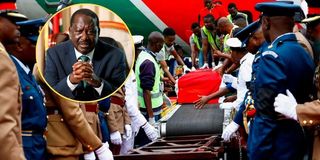
A military gun carriage under the command of the Kenya Defence Forces (KDF) was on the ground at the Jomo Kenyatta International Airport (JKIA) to receive his body.
Draped in the Kenyan flag, Mr Odinga’s casket was received by President William Ruto and Mr Odinga’s widow, Ida. Retired president Uhuru Kenyatta was also at the airport.
A military vehicle carrying the body of former Kenyan Prime Minister Raila Odinga in Nairobi on October 16, 2025.
Photo credit: Reuters
In honour of the fallen political icon, the Kenya Airways plane that carried his remains from Mumbai, India was christened RAO001 when it flew into the Kenyan airspace.
On touching ground, it was accorded a water salute–a ceremonial airport tradition where two fire tracks spray water arch over an aircraft to celebrate significant events.
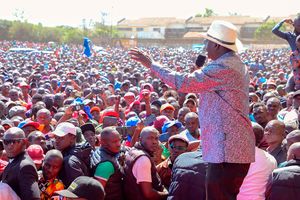
In the entourage from the airport was President Ruto, military personnel and sea of humanity, some overwhelmed with emotions following the death of a man they fondly referred to as ‘Baba’.
President William Ruto condoles Mama Ida Odinga during the State reception of the late former Prime Minister Raila Odinga at the Jomo Kenyatta International Airport, Nairobi on October 16, 2025
Photo credit: PCS
In Parliament, another military preparation was underway to receive his body for public viewing. The honour of lying-in-state at Parliament buildings is a special honour, which in the past, has only been accorded to former Heads of State.
Former Presidents Daniel Moi and Mwai Kibaki , who died on February 4, 2020 and April 21, 2022, respectively, were accorded the honour.
President Ruto on Wednesday declared Mr Odinga would be accorded a State Funeral with all intended honours. At Lee Funeral Home, where his remains were to be taken to from the airport, was also under tight military security.
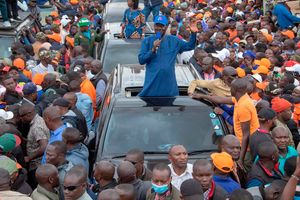
Some of the mourners were his ardent supporters, who have for decades voted for him to occupy State House.
But with his death, the 2022 presidential race marked his fifth so-close-yet-so-far presidential bids.
Popularly referred to as the enigma of the Kenyan politics , Mr Odinga had for close to four decades amassed huge political support base spread across the country.
President William Ruto looks former Prime Minister Raila Odinga's daughter, Winnie Odinga, hands her father's white fedora hat to her mother, Mama Ida Odinga, at the Jomo Kenyatta International Airport, Nairobi on October 16, 2025.
He became one of the most consequential political player in nearly all the General Elections, with campaign messaging either crafted around Raila-phobia or Raila-mania.
His reformist and pro-people credentials endeared him to the population, especially those who felt marginalised by successive regimes that have largely rotated between the country’s two main ethnic blocs.
In some of the presidential elections, like the 2007 contest, he entered the race as the perceived preferred candidate.
He narrowly lost to incumbent Mwai Kibaki in one of the country’s closely contested presidential race. The outcome of the election highly disputed, plunging the country in one of the deadliest post-election violence in the history of the country.
His supporters believe he was rigged out in the contest. In the election, his Orange Democratic Movement (ODM) won majority parliamentary seats, beating Mr Kibaki’s Party of National Unity (PNU).
He was named Prime Minister in the subsequent grand coalition that was formed after the peace talks mediated by late former United Nations Secretary-General Kofi Anan.
In the 2022 presidential race, Mr Odinga was once again perceived as a front runner in the contest that pitted him against then Deputy President William Ruto. In the election, Mr Odinga had the backing of then President Uhuru Kenyatta, who had fallen out with his deputy, Dr Ruto.
The veteran politician’s supporters – who for years believed he had been rigged out in the previous elections – were convinced the 2022 contest was his surest bet to ascend to the presidency. They believed with his massive traditional support bases and assistance by State machinery, his victory would not be stolen again. He lost to Dr Ruto .
Dr Ruto garnered 50.49 percent of the vote against his 48.85 percent. Mr Odinga challenged the results at the Supreme Court. However, the seven-judge bench upheld Dr Ruto's win .
Mourners gather to receive the body of former Prime Minister Raila Odinga at the Jomo Kenyatta International Airport in Nairobi on October 16, 2025.
Photo credit: PCS
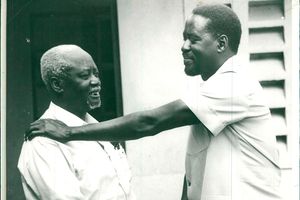
Born on January 7, 1945 to the country’s first Vice-President Jaramogi Oginga Odinga, Mr Odinga served as MP for Lang’ata between 1992 and 2013.
He first won the Lang’ata seat on a Ford Kenya ticket before he retained it on a National Development Party ticket in 1997, National Alliance Rainbow Coalition (Narc) in 2002 and ODM in 2007.
Mr Odinga had his first stint in public service in 1974 when he was appointed Group Standards Manager at the Kenya Bureau of Standards (KeBS) and promoted to the position of Deputy Director in 1978 until 1982 when he was detained because of his political activity.
He was placed under house arrest for seven months by the regime of former President Daniel Moi. He was later charged with treason, but was instead detained without trial for six years. During his time in detention, his mother died in 1984.
Mr Moi ordered his release on February 6, 1988, but he was re-arrested in September the same year and was once again detained.
Mr Odinga was released on June 12, 1989, only to be incarcerated again on July 5, 1990, this time with Mr Kenneth Matiba and Mr Charles Rubia during the agitation for multi-party democracy.
He was released on June 21, 1991, but fled the country for Norway the following November amid fears of another arrest.
He returned to Kenya in February 1992, and joined Forum for the Restoration of Democracy (Ford) – where he was elected vice chairman of the General Purposes Committee of the party.
The casket bearing the body of former Kenyan Prime Minister Raila Odinga is received at the Jomo Kenyatta International Airport in Nairobi, on October 16, 2025.
Photo credit: Reuters
Mr Odinga was elected Lang'ata MP in 1992 on a Ford Kenya ticket. When his father, Mr Jaramogi Oginga Odinga, died in January 1994, he challenged Mr Michael Wamalwa Kijana as the chair of the party but lost.
Mr Odinga contested the presidency in 1997 and finished third but retained his position as Lang'ata MP. After the election, he led a merger between his party, NDP, and Mr Moi’s Kanu party.
He served in Moi’s Cabinet as Energy Minister from June 2001 to 2002. In the subsequent Kanu elections, he was elected the party’s secretary-general as part of the power sharing deal of the merger.
In 2002, Mr Odinga fell out with Mr Moi after he endorsed Mr Uhuru Kenyatta as his successor.
Mr Odinga and other Kanu members, including Kalonzo Musyoka, the late George Saitoti and the late Joseph Kamotho, opposed this step arguing that the then 38-year-old Mr Kenyatta was politically inexperienced and lacked the leadership qualities required to govern.
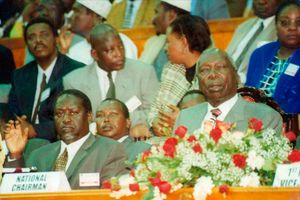
They joined the Liberal Democratic Party (LDP), which later teamed up with Mr Mwai Kibaki’s National Alliance Party of Kenya, a coalition of several other parties, to form the National Rainbow Coalition (Narc) that eventually defeated Mr Kenyatta in the 2002 poll.
He later fell out with Mr Kibaki and contested the presidential election in 2007 that was marred by Kenya's deadliest post-poll violence. He was named Prime Minister in the subsequent grand coalition that was formed after the peace talks mediated by late former United Nations Secretary-General Kofi Anan.
He also lost the 2013 presidential election to Mr Kenyatta. After the Supreme Court nullified the poll results, he boycotted the repeat election held on October 2017.
In the run-up to the 2017 poll, Mr Odinga had a strong coalition behind him—the Coalition for Reforms and Democracy (Cord)—which later became the National Super Alliance (Nasa), seven months to the polls. He successfully challenged Mr Kenyatta’s re-election at the Supreme Court.
He, however, chose to boycott the repeat poll, citing lack of reforms at the Independent Electoral and Boundaries Commission.
His death has now marked a permanent closure on his presidential ambition, but his achievements in the fight for democratic space and the second liberation will continue to stand out, according to his supporters.