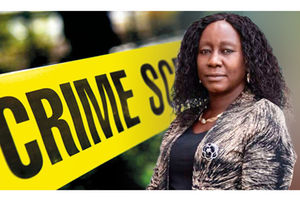
Going by the dwindling blood-money contributions to save Stephen Munyakho, the Kenyan on death row in Saudi Arabia, his family was certain that his return to Kenya was, in his mother’s words, “mission impossible”.
“By March, just a few weeks ago, I was in a panic mode,” said Dorothy Kweyu, Munyakho's mother, in an interview with the Nation in Nairobi on Monday.
“The (contributions) trend started well, then it completely went down. We were getting as little as Sh100 per day thanks to one Ms Florence Awimbo, who, since the start of the collection, sent a hundred shillings every single day. I have never met her physically, but her generosity made me call her because we could access her phone number when she sent the money.”
Then, out of the blue, the Muslim World League announced it had fully paid the Sh129 million blood money needed to secure the release of Munyakho and save him from the hangman’s noose . When this news came, the family, burdened by the reality of raising Sh150 million, had sat with the committee working to raise the amount and resolved to launch a fresh programme to shore up the contributions.
“The news was unbelievable! The message energised everybody! For the first time, I knew we would get back Stevo. The same month we were giving up is the same month my son, whom I say was dead, resurrected! I have come to believe that the darkest hour is nearest to dawn.”
To emphasise what she exactly felt, Ms Kweyu added a Luhya saying, “isingo yatishiranga hamuliango (The water pot breaks just at the entrance after a long trek from the river).”
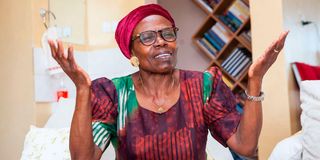
Veteran journalist Dorothy Kweyu, mother of Stephen Munyakho, during an interview on March 31, 2025, at her home in Katani, Machakos County.
Photo credit: Billy Ogada | Nation Media Group
“This is an allusion to the efforts we had already made and which seemed doomed to fail. It encourages one not to give up! I will never give up in any case henceforth,” she said.
The fact that Munyakho, now Abdul Karim and an Imam at a prison in Saudi Arabia, called her Sunday evening to inform her that he was fine and that he had heard the good news, did nothing but melt her heart.
“Stevo told me that the process for his release has started because the prison officials have already asked for his details, and that he has already seen several people, whose blood money was paid, leave prison!”
Whereas it is confirmed that Stevo is coming back home, his 74-year-old mother has yet to come to terms with his impending return. Looking back to when the case started in April 2011, after Munyakho fought with his Yemeni colleague Abdulhalim Mujahid Makrad Saleh, who unfortunately died after their fight, to now, some 14 years later, the news of his imminent return still sounds like a dream," she said.
She recalled that they were planning a relative’s burial here in Kenya when she received the bad news of Munyakho’s case and rushed to the Ministry of Foreign Affairs, where she was informed that her son had been arrested. Six months later, in October 2011, the matter went to court and in February 2012, Munyakho was sentenced for manslaughter and was to serve five years in prison.
“I knew that in less than three years, we would see him in line with international norms. However, almost immediately after the sentence, the aggrieved family went to court and appealed. It took two years and a few months for the matter to be heard in court afresh, and in June 2014, the initial judgment was overturned,” she said.
“At the time when he should have been coming home, his fate turned, and he was to be executed. Many people do not know he appealed against the decision that convicted Stevo of murder. Unfortunately, his case was never heard.”
When the news of her son’s execution reached her, Ms Kweyu said she did not know what to do. She was beyond shocked and numb to the point of paralysis.
“We all knew this was a manslaughter case. With the new judgment, his execution would have been imminent, but what stayed the execution was because his children were still too young and they were required to be adults to give their consent to the matter. They could not execute without the consent of the children and that is what delayed the execution,” she said.
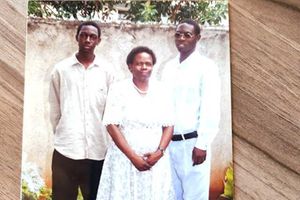
Stephen Munyakho with his brother, Cyprian (left) during annual leave from his work station in Saudi Arabia, with their mother, Dorothy Kweyu.
Photo credit: Pool
In 2018, Mujahid’s last born turned 18. With the last child attaining adulthood, the tough negotiations for blood money started. “They started with 10 million Saudi riyals, which is about Sh400 million. It was a lot of haggling and it was in 2023, after five years of negotiations, that we arrived at Sh150 million, about SAR3.5 million. This figure was still a lot!” she said.
“It is through my struggle that I learnt politicians are not good people. None of them, except former Vice President Moody Awori, sent even a coin. Another former MP sent Sh5,000 after being hassled by my friend. I am grateful to Kenyans and the Muslim World League for the immense show of love and support.”
It is the Foreign Affairs Ministry that communicated to the family about the option of blood money and that they needed to raise Sh150 million. Her first reaction was that the amount was way too high and there was no way they would raise it.
Nevertheless, she went, picked the letter detailing her son’s fate and sat with her other son, Cyprian Amakalu, who told her nothing is impossible.
They decided to fundraise and it took them three months to get a paybill, a process that began in November 2023 to February 2024.
“I did not know that starting a Paybill even needed the approval of the Communication Authority of Kenya. The process was daunting but we managed,” she said.
Whereas the family understood that the task would be daunting, they made their plight known to close friends who immediately began sending their contribution to bring Steve back home.
Within a few days, several people joined the “Bring Stevo Back Home” initiative, with more money being sent to the Paybill.
While meeting a friend, she suggested that the family should go public and utilise the mainstream media platforms to spread the message.
“The media is powerful. In one week, we were able to collect an amount of what we had raised in three weeks before engaging the media,” Ms Kweyu said.
The traction, however, diminished and by March this year, the 74-year-old mother revealed that “In our minds, we knew this was mission impossible. Actually, early this month, there was very little inflow. At some point, the collection went to as low as Sh100 per day. We knew it would be very tough,”
True to her words, the graph revealed the dwindling pattern. In the first three months-February to April, a total of Sh2.83 million was raised.
The second quarter ending July saw Sh8.3million raised. The period ending October saw Kenyans raise an additional Sh6.8 million, and this marked the end of the positive collection trajectory, with the amount raised between November 2024 and January 2025 standing at Sh713,131.
How God worked to have “strangers”, the Muslim World League, clear her son’s blood money, is a miracle she says she cannot fathom.
But the journey has not been easy, Ms Kweyu said as she recounted the several hurdles they have crossed.
For starters, she believes an injustice was done to her son, who, despite serving a sentence for manslaughter, found himself yet again battling murder accusations and being forced to stay in prison for over a decade.
Also, normally, the amount that should have been paid for blood money was roughly Sh11 million, as payment for 100 male camels or Sh12 million for the payment of 100 female camels— an arrangement that the septuagenarian said would have been easier to raise and have Stevo back home as early as 2024.
“Several people, including Saudi lawyers, informed us that the amount demanded by the aggrieved family was too high, but because there was no option, my son had to accept the astronomical amount lest he be executed,” she said.
Whereas Ms Kweyu has seen the good side of Kenyans, she has also seen how corrosive social media can be, especially when some people, unaware of facts on Munyakho’s case, post that he should be killed because he killed someone.
“My son’s case was clear manslaughter. He, too, was seriously injured during the fight with his colleague, who unfortunately died as a result of excessive bleeding. They both sustained serious injuries and bled profusely. Had there been a quick response, the deceased would still be alive today. My son sustained a serious cut on his thigh and thumb; it was a case of a fight gone wrong,” she said.
Though the reality the family has faced is far from ideal, Ms Kweyu said all those instances of injustices are water under the bridge— bygones that she will erase from her mind since the only news she cares about now is the return of her son.