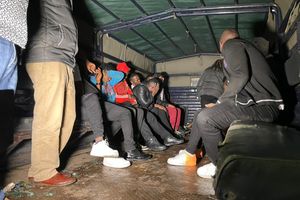
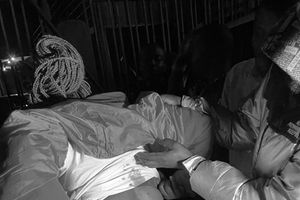
On November 16, 2019, the lives of six men were cut short in their prime in a record 10 minutes by angry mourners who beat them to death in Busia.
Phillip Kwach (Kwach), William Omondi (Sisqo), Evans Onyango Ochieng (Toto), Richard Odera (Nick), David Okeyo (Ouma) and Elvis Odoyo Otieno (Chief) left behind young families and a devastated lot of dependants.
Their bodies had dry blood stains, dents and cuts that were inflicted by sharp objects by a mob that descended on them at the burial of Johannes Okoth, who was shot dead by unknown assailants some two weeks before the incident.
Some people call them “Men in Black” others just know them as bouncers, but in Luo Nyanza, they have been christened “Sangwenya”.
These young heavily built men who have become common features in political events, church and social gatherings, and night clubs sometimes guard VIPs. But in most cases their employers, mostly, politicians, will look the other way should they be injured, killed or find themselves on the wrong side of the law.
The Busia case was not an exception. It was reported that after the “Ahero six” as they would later be known since they came from Ahero in Kisumu, had been subdued by the mourners, they were asked to reveal the identity of the person who contracted them, but the woman allegedly forsook them.
As opposed to trained and armed police officers who guard various leaders, these energetic and agile young men always make a grand entry into events as they shove and push anyone who dares to come close to their clients.
In villages, they have been given names like “Champe”, which is a slang for champion, and are dreaded for who they are and who they protect, with some claiming they are usually hired to “discipline” people.
But a look into the lives of these young men shows the numerous challenges that lurk behind the perceived funfare that is usually associated with the job. Many will agree that the line that separates the job and imprisonment or death is quite thin.
Security personnel follow proceedings during the commencement of the mandatory nationwide security vetting, training and licensing of all bouncers, bodyguards, event stewards, door supervisors, event security, VIP protection, close protection and crowd control personnel at the Stanley Hotel, Nairobi on Wednesday.
Photo credit: Lucy Wanjiru | Nation Media Group
Mr Joshua Ayugi started working as a bouncer at the age of 17, and 20 years later, this is the job that has fed and sustained his family. He is well known in Kisumu and on many occasions he is contracted to look for other bouncers for various activities in the Western region.
Mr Ayugi admits that they do the donkey work when it comes to security and crowd control more than even the police, but are neither recognised nor appreciated enough.
“I have been a bouncer in the club like most of us do and at the same time contracted to political rallies or events. We are not remunerated well, with some of us earning as little as Sh500 for a day long gig,” said Mr Ayugi.
He does not believe that the government is sincere on improving their welfare but only wants to make money from the recent directives regarding training and licencing.
The 37-year-old bouncer claimed that because of their well-built bodies, they are often profiled. He said that during the National Police Service or Kenyan Defence Forces annual servicemen recruitment, with just one look, they are disqualified.
“We have seen some of us getting injured in the line of duty but no client looks back to take care of us. If the government truly recognises and wants to help bouncers, let them absorb us in various institutions, including Parliament,” said Mr Ayugi.
He is disappointed that politicians usually abandon them after winning elections despite having encountered some difficult and life threatening situations while protecting them.
“In some instances, we get pelted with stones and attacked with all manner of crude weapons, but the politicians will only dish out thousands of shillings to their supporters and at the end of the day, they tell you that they do not have anything to give you and you have to wait. The moment they clinch the seat, they look for police officers to guard them instead of recommending you for training so that you can continue working for them,” said Mr Ayugi.
Many of the bouncers are not registered. They are now pushing for that to happen so as to enable them to bargain for a uniform and better remuneration package whenever they are contracted.
In Kisumu, they charge a minimum of Sh1, 500 each for their services, but because some are not under an umbrella body, some end up settling for as low as Sh500.
According to Mr Ayugi, the governmental should conduct a countrywide stakeholder consultation forum before implementing any new policy affecting bouncers in the country.
Mr Ayugi told the Nation that they play a critical role in security and that is why despite the presence of security guards and police officers in functions, they have to be called in to help because they are the ones on the ground and understand people better.
Mr Oliver Ochieng, popularly known as Oliveti, who has also been a bouncer for the better part of his life, said the killing of their colleagues in Busia was an eye opener. He discloses that after the incident, he made it a personal policy to always inform the authorities every time he goes out on a job.
“I am urging all bouncers that if there are suspicions surrounding a mission, please let the police know in advance. Going forward, they must ask for a contractual agreement before embarking on any assignment,” said Mr Ochieng.
Bouncers have been in the Kenyan political scene since the advent of multiparty politics, including the likes of Baghdad Boys, whose face is the current chairperson of the Kisumu City Residents Voice Audi Ogada.
In the 90s and 2000s, the did not commonly wear uniforms, but over time they decided to adopt outfits worn by security agents guarding VIPs, including black suits and dark shades.
This gave birth to the “Men in Black” title, which was made even more famous after the shambolic ODM nominations in Kasarani where youth dressed in black suits disrupted the process.
The Baghdad Boys members now run various associations, such as Baghdad for Peace, which advocates non-violent means of solving disputes.
Mr Ogada, a renowned activist, has seen it all—from when he was a young man fighting alongside politicians for multiparty democracy. He now engages in human rights related activities.
He recalls how, together with his colleagues, they would venture into dangerous places just to ensure that their leaders were safe.
He says to him, the objective was to protect the leaders and fight for a multiparty system in Kenya, which included forcing the President Daniel Moi government to release Jaramogi Oginga Odinga from house arrest. He was around 29 years old then.
He was an employee of the Kisumu Municipal Council when he formed the Baghdad Boys. Other members included George Oyola, Nyambuk Orimba, Ocholla Dengu, Ojiem Muga and Gwada Ogot.
He says that during this time, they were not paid for their services since it was purely voluntary.
“We would guard our leaders with our lives and many were detained. Ours was purely to support the cause, which we also believed in. And I don’t regret doing it at all. At some point, I was even photographed carrying an axe at a public rally,” said Mr Ogada.
He says that the VIP protection job has since taken a negative direction, with the current crop of youth abusing the occupation. He notes that many of the bouncers today are desperate and willing to do any job, including dirty ones, just to earn a living.
“There are many instances where they are used to settle property rows and evict people as well as accompanying auctioneers in their duties. Some are also hired to spoil controversial weddings while police take them to help in enforcement,” said Mr Ogada.
He feels that the youth should organise themselves in groups that can help them bid for contracts in the county governments.
But it is not all gloom and doom for bouncers. Some of them, like the current Milimani Market ward rep Seth Adui Kanga, have managed to curve out well paying careers.
There is also renowned rapper Brian Ouko Omollo, popularly known as Khaligraph Jones, who is one of the highly paid musicians in Kenya today.
In a notice dated January 8, Private Security Regulatory Authority Chief Executive Officer Fazul Mahamad said no person shall be allowed to engage in the provision of private security services unless they have been vetted, registered and licensed.
To enhance accountability, Mr Mahamad said all bouncers will be required to operate under the umbrella of corporate entities. He claimed that by aligning bouncer operations with corporate structures, there is a greater emphasis on standardised protocols, background checks and training, and this will, among others, ensure their welfare is taken care of.