The National Land Commission (NLC) faces a backlog of 7,000 cases challenging how public land changed hands, and the commission says it needs new procedural rules before hearings can begin or continue.
The commission’s vice chairperson, Dr Julie Oseko, says most matters concern requests to review instances where public land became private. Known as “review of grants and dispositions of public land”, this category of cases seeks to establish whether the transfers were lawful.
“We have 7,000 cases pending, not even to mention the ones that we have started receiving now,” she told the Nation .
“We could be reaching 10,000 cases,” she said, noting that increased awareness among Kenyans had led to more matters being filed.
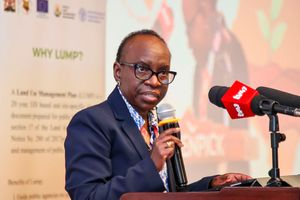
National Land Commission Vice Chairperson Dr Julie Oseko speaks during a public participation forum on historical land injustices and review of grants at the ACK St Stephens Cathedral in Kisumu on October 12, 2026.
Photo credit: Alex Odhiambo | Nation Media Group
The 7,000 cases do not include the commission’s separate historical land injustice caseload. Adding those claims would increase the backlog, although Dr Oseko did not give a combined total in the interview.
The two processes address different questions. A review of grants examines the propriety or legality of public land grants and dispositions. Historical land injustice investigations, on the other hand, address grievances arising from violations of land rights and seek appropriate redress. They are not limited to transactions in which public land became private.
Amendments to the National Land Commission Act that took effect on November 4, 2025, replaced the provisions governing both mandates. The revised section on review of grants covers public land grants or dispositions issued before August 27, 2010, when the Constitution was promulgated.
For historical land injustices, the amended law identifies a period running from June 15, 1895, when Kenya became a British protectorate, to August 27, 2010. Admission of a claim is subject to statutory criteria, including whether the grievance is verifiable, whether the claimant was a proprietor or occupant of the land, and whether the matter cannot be addressed through the ordinary court system on the grounds specified in the Act.
The amendments prescribe five years for reviewing grants from the commencement of the new provision. In its notice inviting public comments on the proposed 2026 regulations, NLC described that timetable as requiring the work to be completed by November 2030.
The question of time limits has also been litigated. In a judgment delivered on November 28, 2025, in a petition by Busia Senator Okiya Omtatah, the High Court declared that the Constitution does not provide for statutory time limits on NLC’s mandates.
So, what is causing the backlog?
Dr Oseko attributed part of it to unfinished work inherited from the commission’s first and second teams, including cases in which hearings had begun but were not concluded.
“The first commission did some of the cases, as did the second. So, we have quite some part-heard cases. Right now, we have a total of 7,000 for review of grants only. We have not talked about historical land injustice cases,” Dr Oseko said.
The commission says the new rules must be put in place before it can begin the pending hearings. The Act requires rules to guide the implementation of the review-of-grants mandate.
This is not the first attempt to establish a review framework. At a recent public participation forum in Nairobi, an NLC official told attendees that the earlier regulations were “thrown out because we did not provide evidence that there was public participation that we’re doing now”.
The current rule-making exercise follows the 2025 amendments to the Act, and NLC has spent recent months collecting public views on the proposed procedures. Teams travelled to different parts of the country to gather views on two proposed instruments.
Speaking to the Nation at the end of one such engagement, Dr Oseko said the commission planned to send the rules to Parliament once the process was complete.
“The two regulations are the ones that are going to assist us to operationalise the hearings,” she said. “It’s not very easy to do a case without procedures. It’s all about processes and procedures.”
Dr Oseko added: “The rules are going to make the cases much, much fairer to hear because without the regulations, we have had the courts sending back the files to NLC because the regulations were not followed…They are like our constitution, our Bible, to know what to do, what not to do, what time to do what, so that a case is heard fairly.”
She noted that the proposed rules would have to complete the parliamentary process and be gazetted before coming into effect.
Some earlier cases handled without the required procedures, she said, had been challenged in court.
The amended Act, which came into effect last year, has implications for both complainants and title holders. Under Section 14, people with an interest in a disputed grant must receive notice of the review, an opportunity to appear before the commission and access to relevant documents. NLC must hear the affected parties before deciding.
The Act also distinguishes between unlawfully acquired titles and those acquired irregularly. In the case of an unlawful title, it mandates NLC to “direct the registrar to revoke the title”.
For an irregular acquisition, it provides for “appropriate steps to correct the irregularity” and gives NLC the power to make consequential orders.
“No revocation of title shall be effected against a bona fide purchaser for value without notice of a defect in the title,” says the Act.
Asked who at NLC handles the more than 7,000 cases, an official said all commissioners are members of the Review of Grants and Dispositions Committee, supported by a secretariat responsible for day-to-day operations.
“They’ll hear the cases in panels,” the source said. “The commission is yet to start the hearings as the focus right now is to get the regulations approved before inviting more claims and starting the hearings.”
Public consultations have also raised questions about how accessible the process will be. In an account of a September 24 forum in Kajiado, Community Land Action Now (Clan!) reported calls for the acceptance of oral history and indigenous knowledge as evidence, clearer guidance on accessing land archives, witness protection and faster resolution of claims.
Beyond adopting procedures, the commission also faces the task of setting a practical pace for clearing the backlog. Mr Shadrack Omondi, the Kenya country director for Landesa, a global land rights organisation, said NLC needs a self-imposed deadline to complete the work.
“The current commissioners are not yet one year in the office. They could say, ‘In the next four years of our tenure, we want to push almost 70 percent of the historical land injustices.’ Then they can put in place mechanisms and processes to ensure that it delivers. That will take us to the rightful place,” he told the Nation .