The Kenyan government faces United Nations (UN) sanctions that include aid cuts for snubbing inquiries by the UN’s Special Rapporteur on Human Rights Defenders (HRDs) over widespread cases of human rights violations against protestors in the country.
This follows frustrations by Ms Mary Lawlor, the UN Special Rapporteur on HRDs, over the government’s failure to respond to her two letters on the abductions, persecution and enforced disappearances of government critics.
Going public about the frustrations on her X handle, Ms Lawlor notes that on October 1, 2024, she wrote to the government of Kenya seeking answers on the arbitrary arrest, detention, deportation and prosecution of human rights defenders.
Her letter sought clarity on the excessive use of force by the government against Kenyans, including those who stormed parliament on June 25, 2024 as they protested against the passage of the infamous Finance Bill 2024 that had proposed to introduce a punitive taxation regime, among other government excesses.
Of interest to the Special Rapporteur included allegations of abductions, enforced disappearances and detention of individuals, including protestors, activists, lawyers, medical professionals and human rights defenders in relation to the June, July and August 2024 protests calling for the rejection of the Finance Bill 2024 and accountability from the government.
The letters sought to bring to the attention of your Excellency’s Government information we have received” concerning allegations of violations against human rights defenders, media and civil society.
On August 5, 2025, the Special Rapporteur wrote again to the government of Kenya seeking answers on the government’s crackdown on peaceful protests by Kenyans in June 2025, the anniversary of the June 25, 2024 deadly protests, but without a response.
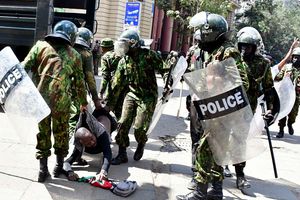
Police officers arrest activist Boniface Mwangi on Kenyatta Avenue in Nairobi on 25 July 2024 during anti-government protests.
Photo credit: Evans Habil | Nation Media Group
“I wrote to the government of Kenya about the arrest, detention, deportation and prosecution of human rights defenders as part of a wider crackdown on peaceful protests. I regret not having received a response,” Ms Lawlor says on her X handle.
The tweet is copied to the Kenya mission UN, Geneva, Switzerland, which coordinates Kenya’s overall representation in meetings, governing bodies and conferences held under the auspices of the UN and International Organizations (IOs) in Switzerland.
Former Attorney-General Justin Muturi, reached for a comment, said; “I am not aware of the letter.”
“I left the Attorney-General’s office on July 11, 2024,” said Mr Muturi.
The government’s non-responsiveness invites the scrutiny of the United Nations Human Rights Council (UNHRC), where it is a signatory, to pile pressure to address the issues or face sanctions like aid cuts from UN members.
Efforts to get comments from Attorney-General Dorcas Oduor and Foreign Affairs Principal Secretary Korir Sing’oei failed as they did not respond to inquiries sent to their known mobile numbers.
This is despite President William Ruto emphasising the importance of rapid results initiatives as a mode of performance in government to ensure Kenyans are updated on government policies and actions.
But even as Ms Oduor and PS Sing’oei kept mum, International Relations expert Prof Macharia Munene noted that the government’s no response attitude gives two impressions.
“That the government does not consider itself to be answerable to the UN official and that the government can do whatever it wants with the country and the people in it without entertaining any questions,” said Prof Munene.
This as Ms Lawlor noted that “we are considering to publicly express our concerns in this case in the near future, believing that the wider public should be informed about the implications of these allegations for the enjoyment and exercise of human rights in Kenya.”
“Any public expression of concern in this regard will indicate that we have been in contact with your Excellency’s government to clarify the issues in question,” she says.
The Independent Policing Oversight Authority (IPOA) has since reported that there were incidents of excessive use of force by the police and alleged police misconduct, including fatal shootings, shootings causing serious and minor injuries, assaults and abductions.
Ms Lawlor notes that Kenyans, like citizens of the world, enjoy the right to not be arbitrarily deprived of liberty and the absolute and non-derogable prohibition of torture and “other ill-treatment” under the International Covenant on Political and Civil Rights (ICCPR), ratified by Kenya on 1 May 1972.
“The allegations in the case of the crackdown on protesters raise serious concern on grave violations of international human rights law that may cause irreparable damage to the life and personal integrity of those involved, which we believe warrants prompt attention,” says Ms Lawlor.
She added; “without prejudging the accuracy of the allegations, we express our serious concern at the alleged abductions, enforced disappearances, detention and excessive use of force against activists, lawyers, medical professionals and human rights defenders.”
If confirmed, the Special Rapporteur says, the allegations would constitute prima facie violations of fundamental human rights.
From left; Activists Francis Mutunge Mwangi alias Chebukati, Mark Amiaini alias Generali and John Mulingwa Nzau alias Garang hant liberation songs at Kibera Law courts on June 30, 2025.
Photo credit: Billy Ogada | Nation Media Group
In particular, Ms Lawlor highlights allegations of attempts to prevent the media from reporting live on the peaceful protests on June 25, 2025, of the arrests and arbitrary detention of Mr Mark Amiani, Mr Mulingwa Nzau, Mr Francis Mutunge Mwangi and Mr Boniface Mwangi, among others.
Of interest to the Special Rapporteur, is the deportation of Mr Martin Mavenjina, a Uganda national, and the attacks against a press conference hosted at the Kenya Human Rights Commission (KHRC) by unidentified individuals in the presence of the police.
“As it is our responsibility, under the mandates provided to us by the Human Rights Council (HRC), to seek to clarify all cases brought to our attention, we would be grateful for your observations,” the letter to the Kenyan government read.
In the letter, the government was required to provide any additional information and or comment (s) “you may have” on the claims of human rights violations.
This included providing information on the factual and legal basis for the arrest and detention of protesters.
“Please include information on how many detained protesters have since been released and whether those still detained have been charged with a recognisable criminal offence, have been granted access to a lawyer of their choice, and have been promptly brought before a judge to determine the validity of their detention,” reads the letter.
Also required were measures taken to ensure that activists, lawyers and human rights defenders are able to carry out their legitimate work and exercise their rights to freedom of expression, peaceful assembly and association, “in a safe and enabling environment without fear of threats or acts of intimidation and harassment.”
“Please provide information on measures taken by your Excellency’s government to carry out a prompt, impartial, independent and effective investigation into the use of excessive and lethal force and deadly targeted killings of protesters.”
In case no investigations have been undertaken, or if they have been inconclusive, the government was required to provide information “as to the reasons thereof.”
The Special Rapporteur also sought information on the steps taken by the relevant authorities to investigate the allegations of enforced disappearances, identify those responsible for the crimes concerned, prosecute and sanction them, and the search activities to determine the fate and whereabouts of disappeared persons.
Family and friends of missing Edward Kipchumba Terer, a medical laboratory technologist from Sambalat in Kerio Valley, Elgeyo Marakwet County demonstrate at Ngeria Trading Centre on the Nakuru-Eldoret highway, Uasin Gishu County on June 13, 2025.
Photo credit: Jared Nyataya | Nation Media Group
“While awaiting a reply, we urge that all necessary interim measures be taken to halt the alleged violations and prevent their re-occurrence and in the event that the investigations support or suggest the allegations to be correct, to ensure the accountability of any person responsible of the alleged violations,” the Special Rapporteur’s letter reads.
In June 2024, peaceful protests began in Nairobi and across other towns in Kenya against the punitive taxation measures in the then Finance Bill 2024.
On 18 June 2024, the proposed Finance Bill was tabled in the National Assembly and on the same day, a social media campaign; “Reject Finance Bill 2024” and “Occupy Parliament” was launched.
According to the Special Rapporteur, on the same day, a special team from the National Intelligence Service (NIS) and the Directorate of Criminal Investigation (DCI) were put into action to monitor social media to identify the supposed leaders of the protests or persons with a large online following.
Reports, Ms Lawlor says, indicated that many of those followed online were deprived of their liberty, out of which some were subsequently forcibly disappeared.
“These persons were taken to unofficial detention facilities for interrogation and would later appear at police stations. Many were released in unknown locations, far from the places where they were forcibly disappeared and had limited ways to contact others or receive any aid,” says Ms Lawlor.
“In addition, the police crackdown on protesters led to a wide number of arrests, injuries and deaths of protesters.”
The letter reveals that on June 18, 2024, between 300 and 400 protestors were arrested. And that on June 20, 2024, about 100 people were arrested, one person was killed, one person later died from injuries sustained, and more than 200 people were reportedly injured from police violence on that day.
Following the crackdown on the protestors and the government’s refusal to engage in an open dialogue about the Finance Bill, activists and civil society organisations announced a campaign entitled, “7 Days of Rage: For We have Courage”, starting June 21, 2024.
They subsequently called for a national strike on June 25, 2024 with protestors gathered in various cities, including Nairobi, Mombasa, Eldoret, Kisumu, and Garissa and in other places.
On the same day, the Kenyan Parliament, inconsiderate of the public anger, passed the Finance Bill and within minutes of the passage, protestors stormed the parliament, leading to a clash with security officers.
On that evening, it was reported that five protestors died of gunshots inflicted within parliament precincts, 21 others were abducted, and 13 protesters sustained injuries from live bullets, with 14 suffering rubber bullet injuries.
Ms Lawlor notes that since the protests began on June 18, 2024, activists, lawyers, medical professionals and human rights defenders were “reportedly” subjected to enforced disappearances.
Although she says the actual number of cases is difficult to assess, the Kenya National Commission on Human Rights (KNCHR), a State agency, reported on July 16, 2024, that at least 59 persons have been abducted or are missing.
The UN official says on June 25, 2024, at least 52 individuals were abducted by a unit of officers composed of DCI and NSI officials.
“These individuals were reportedly identified through their social media activities. Those released, she says, have described armed men in balaclavas arriving in unmarked cars to their places of residence in the middle of the night.”
“The individuals were blindfolded, beaten and taken to unknown places where they were interrogated about the protests without the presence of their lawyers or being presented before a judge,” she says noting; “these protests began as peaceful and often escalated into violence following provocation by police.”