Kenya’s human rights record deteriorated last year because of unlawful killings, torture, abductions, and arbitrary detentions that increased as authorities cracked down on anti-government protests, a new US report shows.
While the government took some steps to identify and punish officials involved in abuses, “impunity was a problem at all levels of government,” according to the US Department of State’s Country Reports on Human Rights Practices for 2024.
“Kenya experienced a deterioration in the human rights situation during the year,” says the report.
The claims come at a time when the US Senate has been petitioned to sanction President Donald Trump’s administration to open an investigation into Kenya’s alleged ties with armed groups involved in regional conflict, particularly in Sudan.
“Significant human rights issues included credible reports of arbitrary or unlawful killings; disappearances; torture; arbitrary arrest or detention; transnational repression against individuals in another country,” the report adds.
The report also condemns “serious restrictions on freedom of expression and media freedom, violence or threats against journalists, censorship and significant presence of any of the worst forms of child labour.”
It further notes that impunity remained a serious challenge across security agencies, with the government neither acknowledging police abuses nor holding any officers accountable for actions in the June and July Gen Z demonstrations.
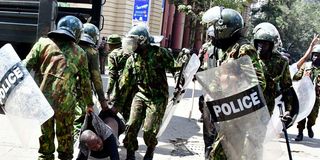
Police beat a demonstrator at a previous protest.
Photo credit: Nation Media Group
“Police officials at times resisted investigations and detained some human rights activists who registered complaints regarding government abuses,” explains the report. “Human rights organisations reported that police used disciplinary transfers of officers and other methods to hide their identities and frustrate investigations into their alleged crimes.”
On extrajudicial killings, the report states there were “numerous reports that the government or its agents committed arbitrary or unlawful killings during the year, particularly during youth-led, nationwide Gen Z demonstrations in June and July to protest against proposed tax increases”.
Last year, especially in June, anti–Finance Bill 2024 protests turned bloody, forcing President William Ruto to abandon the ambitious yet contentious legislation.
The State-funded Kenya National Commission on Human Rights (KNCHR) recorded 60 deaths during the protests.
Citing varied figures of casualties, the report notes rights groups alleged that authorities significantly underestimated the number of unlawful killings by security forces.
The report also states that government officials publicly and privately attempted to limit media coverage of the protests.
A police officer aims his gun at protesters on Old Namanga Road in Kitengela during the Saba Saba protests on July 7, 2025.
Photo credit: Billy Ogada | Nation Media Group
“President William Ruto called on the media to report responsibly during the protests, claiming several media houses ‘glorified anarchy’ by providing selective live coverage of the demonstrations,” the report says.
It also states “reports of enforced disappearances by or on behalf of government authorities”, with human rights organisations alleging that “security forces were culpable of enforced disappearances”.
The Independent Medico Legal Unit reported 69 enforced disappearances during the Gen Z protests, while the KNCHR documented 82 cases since June, with 29 people still missing as of December.
The report says, in August last year, “individuals who identified themselves as police officers” arrested human rights defender Bob Njagi and brothers Jamil and Aslam Longton in Kajiado County for planning protests. They were held incommunicado for 32 days.
The Defenders Coalition reported 105 human rights activists were abducted or went missing after posting content of police violence or being seen at Gen Z protests.
“Those released said they were warned by individuals believed to be police officers not to post protest-related content on social media,” the report says.
Arbitrary arrest and detention
Although the law prohibits arbitrary arrest and detention, the report notes “the government did not always observe these requirements.” It adds: “The law provided police with broad powers of arrest. Police officers were able to make arrests without a warrant if they suspected a crime had occurred, was happening, or was about to occur.”
The Constitution requires arrested persons to be taken to court, charged, informed of the reason for their detention, or released within 24 hours. However, the report observes that in many cases, authorities failed to meet these time limits.
“While authorities generally released detainees held longer than the prescribed period, some cases did not result in an acquittal,” it says.
A protester is cornered by anti-riot police officers during Saba Saba protests in Kangemi, Nairobi on July 7, 2025.
Photo credit: Reuters
The report also finds that although the law grants pretrial detainees access to family and lawyers, relatives often complained that access was only allowed after paying bribes.
“When detainees could afford counsel, police generally permitted access to attorneys. The Law Society of Kenya noted cases where they could not locate or were not allowed access to arrested protesters,” the report states.
Lengthy pretrial detention was “a serious problem and contributed significantly” to prison overcrowding. More than 39 per cent of inmates last year, the report says, were awaiting trial. In some cases, defendants were held longer than the maximum sentence for their alleged crime.
The government claimed that the average pretrial detention lasted 14 days, but “there were reports many detainees spent two to three years in prison before their trials were completed,” partly due to police failing to transport detainees to court.
The Constitution prohibits torture and cruel, inhuman, or degrading treatment or punishment, yet the report cites credible evidence of such practices by security officials. Beatings, painful restraint, and electric shocks were the most common methods used by the police.
The report says police violence was especially prevalent in informal settlements and “often involved arrests and beatings of poor, young men profiled as criminals”.
The report also highlights other rights concerns, including violations of labour laws. While the Constitution allows trade unions to operate without government interference — and authorities generally respected this — enforcement was inconsistent.
Anti-riot police engage protesters in Mlolongo on July 19, 2023, during anti-government demonstrations.
Photo credit: Wilfred Nyangaresi | Nation Media Group
“Penalties for labour law violations were sometimes applied to violators but were not commensurate with those for similar violations. The government enforced the decisions of the Employment and Labour Relations Court inconsistently, and many employers did not comply with reinstatement orders,” the report notes.
At the same time, the State-funded KHRC yesterday sounded the alarm on the shrinking civic space and arbitrary arrests of human rights defenders.
In their latest report on the assessment of the protection of human rights defenders, KHRC identified rising cases of extrajudicial executions, abductions, misuse of force and firearms by the police, arbitrary arrests, and shrinking civic space.
The report dubbed: “The right to defend rights: An assessment of the protection of human rights defenders in Kenya (2020-2022)”, KHRC listed the above as key concerns.
“Between 2020 and 2022, a minimum of seven human rights defenders were killed or disappeared, while arbitrary detentions totalled 134 cases, mostly uninvestigated. Defenders working on sensitive issues, notably land rights, corruption, sexual orientation and minority protections, were disproportionately targeted by acts of intimidation, surveillance and violent reprisals,” KHRC says.
It adds that the report paints a distressing picture of a shrinking civic space where State mechanisms fall short of providing consistent and proactive protection.