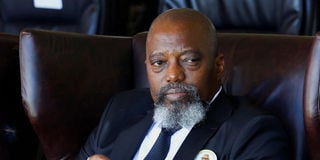
Congolese authorities have banned local media from covering former President Joseph Kabila and his party, categorising the two in the same pool as the M23 rebel group.
The decision was announced on Saturday by Christian Bosembe, chairperson of the supervising council for media and communications, known in French as Conseil supérieur de l'audiovisuel et de la communication (CSAC). The Council jas sweeping powers to licence media outlets and accredit journalists in the Democratic Republic of Congo.
It means reporters covering activities or comments by Kabila or his Parti du Peuple pour la Reconstruction et la Démocratie (PPRD), or relaying statements or interviews with former president Joseph Kabila, risk losing their licences.
"I am going to announce to all journalists and those who are active on social media that from today, journalists and media managers are forbidden to broadcast, comment on or report news linked to the PPRD, or to receive its leaders.
"It is forbidden to relay comments or interviews with former president Joseph Kabila. This is a major decision... This is not censorship: no rights have been violated. Television must not be used as a forum for subversion," Bosembe told a Kinshasa radio station.
Bosembe explained that this was a precautionary measure ostensibly to curtail the moves of Kabila who jas recently aligned with the M23 and its political grouping, Alliance Fleuve Congo (AFC).
Kinshasa had already proscribed M23 as a terrorist movement and forbade media outlets from reporting on their moves. However, Kinshasa has gone on to accept peace talks with the M23, mediated by Qatar, an about-turn from months ago when officials said they wouldn't negotiate with terror merchants.
The latest CSAC decision was already causing uproar. Journalists denounced the censorship. The Union nationale de la presse du Congo (UNPC), the country's self-regulatory authority for journalist said that: "In order to remain rational and objective, regulation should always be carried out a posteriori and not a priori.
Prior regulation is censorship without a name. Journalists and the media cannot put up with censorship and the resulting inquisition," read a statement signed by UNPC chairman Kamanda wa Kamanda.
"The right of the public to information and freedom of the press are guaranteed by the Constitution, even if the Union admits that in times of war, restrictions may exist, and these are understandable," noted Kamanda wa Kamanda, who went on to call on Congolese journalists to "show restraint and serenity in the face of this authoritarian drift towards solitary regulation". He urged journalists to redouble their professionalism in the exercise of their profession.
Faced with a general outcry, the CSAC chairperson clarified the policy as meant to reduce cheering subversion.
"We have not forbidden you to quote the name of the former president. What we are banning is the glorification of crime."
The CSAC had also banned Congolese journalists from debating war operations, "unless they have an expert with them in the debate."
The CSAC chairperson's precautionary measure came against a backdrop of strong reactions to Joseph Kabila's presence in Goma and to the former president's latest public speech, in which he severely criticised his successor, President Félix Tshisekedi. In particular, Joseph Kabila criticised the "endless intoxication of power".
The former president's immunity has been lifted by the Senate. He could face a trial by military court. His party, the PPRD, has been suspended. The Minister of the Interior and Security, Jacquemain Shabani, had applied to the court to have the party dissolved.