Premium
Haitian gangs tap into tech to sustain terror
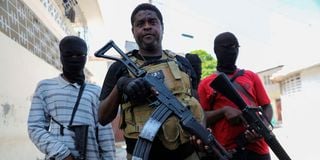
Former police officer Jimmy "Barbecue" Cherizier, leader of the 'G9' gang alliance, flanked by fellow gang members in Port-au-Prince on March 5, 2024.
Haitian gangs may be under US sanctions, essentially barring any corporate bodies or individuals from dealing with them.
Yet their adoption of technology has sometimes been better than local security agencies.
Their use of latest inventions to monitor enemy lines and convey propaganda has piled the challenge faced by the Kenya-led Multinational Security Support (MSS) Mission.
The latest data from the UN indicated that more than 1500 people have been killed in gang-related violence over the last four months and that there has been a rise in crime over the last year compared to the last three.
Earlier in May, the US government fingered gang leader Jimmy Cherizier, also known as ‘Barbecue’ and his Viv Ansam coalition of criminal gangs.
The group was designated a terrorist group, which means any US entities trading with the group would face charges.
Also designated was Gran Grif gang led by Luckson Elan and which had fueled most of the violence in the last three years.
It is Viv Ansam, formed just months before the MSS Mission began, that has utilised its tech prowess.
“Organised crime in Haiti is adapting to technological change,” the UN Office on Drugs and Crime wrote in a report published in May 2025.
“Over the past year, criminal groups have increasingly used commercial drones to track police movements, gather intelligence and coordinate activities.”
Here are some of the ways gangs have embraced the use of technology in Haiti:
Use of social media for propaganda
In November 2024, on the video-hosting platform TikTok, Barbecue issued a command asking gangs to attack media personalities.
He even named some of the journalists he wanted his followers to capture, including four prominent radio reporters and popular show hosts. “Journalists defending the elite classes needed to be silenced,” he said.
There has been an increase in the use of social media among gangs in Haiti, who use its convenience to quickly pass on information.
For the past few months, TikTok has been their focus. Viv Ansanm routinely host TikTok live sessions to discuss their abductions, flaunt threats, and broadcast demands that reach thousands of followers.
Another gang leader, Johnson Andre, also known as "Izo," has been using rap videos to expand his control and send a message throughout Haiti.
Alongside his ‘5 Seconds Gang,’ Izo has been recruiting more foot soldiers and is responsible for sharing professional, well-captured videos that show his gang terrorising people.
In the videos, he raps about killing police officers, shows off new military-grade weapons, and ridicules Haitian politicians. He also shares such images and videos on his X (formerly Twitter) account.
In March 2024, the Izo-led gang freed prisoners from the Port-au-Prince prison, where 3,500 inmates escaped. He then shared videos of the event on his official social media accounts.
Use of drones to conduct surveillance
When they attacked the Port-au-Prince prison in March 2024, gang members used drones to track the movements of police armored vehicles in real time and anticipate the actions of security forces.
Also Read: Why Kenya could extend Haiti mission
Jean-Masner Coulanges, a police officer who survived an attack on a hospital in Port-au-Prince on December 24, told the media that gangs routinely track officers.
“They track us and make our lives difficult… drones have changed everything,” he said in the report, adding that he realised drones were watching him before he came under fire from attackers, which led to the death of his colleague.
Mr Coulanges said that since he was stationed at the Port-au-Prince police department, he was used to seeing drones flashing across the night sky.
Use of CCTV to protect strongholds
Gangs also use drones and CCTV cameras to protect their strongholds. For example, Izo often posts videos and photos watching operations within his base, known as Unité Village de Dieu (UVD), or “Village of God Unit.”
In 2024, the base was fitted with CCTVs that capture every corner of the area. It is also located two kilometres from the General
Hospital in Port-au-Prince, which he also keeps under surveillance.
With the help of drones, he causes chaos at will and usually brags that he is the only one who can decide when hospitals should operate and when journalists can freely do their jobs.
“We’re attacking them right now… They came to the General Hospital to put on a show. We’re laying traps for them,” he says in a video shared on his TikTok account.
He warns the Haitian authorities not to open the hospital without consultation, saying that only Viv Ansanm is allowed to give the nod before anything happens in Port-au-Prince.
Walkie-talkies
Gang members in Haiti also use radio call devices to communicate with each other and don't hesitate to post images on social media, brandishing them or showing the devices attached to their belts.
The gangs, as well as other actors in possession of adequate equipment, regularly listen to police radio communications, which poses a serious threat to the integrity of operations, according to a UNDOC report.
In almost every successful raid conducted by the gangs, they use communication devices to pass information and outsmart officers.