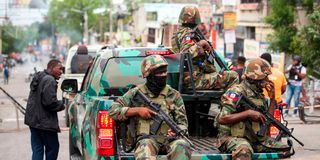
The security situation in Haiti has worsened over the last four months with 1,520 people killed in what indicates the mounting challenge faced by an international security mission led by Kenya.
The new revelations came as the US closed its embassy in Porto-Au-Prince following a deadly gunfire exchange in the Tabarre area. Washington also issued a travel advisory to US nationals, cautioning against travelling to Haiti.
The alert also asked US Government officials to suspend all official travel outside the diplomatic premises, urging people to avoid the area completely.
The rising violence came even as the Kenyan-led Multinational Security Support (MSS) Mission completed a year since first troops deployed.
Members of the first contingent of Kenyan police stand in formation after arriving in the Caribbean country as part of a peacekeeping mission, in Port-au-Prince, Haiti June 26, 2024.
Photo credit: File | Reuters
The United Nations Integrated Office in Haiti (BINUH) says that armed violence, human rights abuses and population displacement for the last four months have been on an upward trajectory, as overwhelmed officers of the MSS mission struggle.
Ulrika Richardson, the Acting Head of BINUH and UN Resident and Humanitarian Coordinator said this week there were also reports of new massive population displacement.
“Gang attacks in the Artibonite and Centre departments, and in the capital, continue to cause serious human rights violations and exacerbate an already dire humanitarian crisis, leading to massive population displacement with dramatic consequences for women and children in particular,” said Richardson.
She said that 609 other people were injured in armed violence and most of them hailed from Port-au-Prince which is the capital city of Haiti.
Artibonite and Centre areas also contributed a significant number of displaced people in the gang infested country.
In the same period, there were at least 185 kidnappings that were reported and 628 victims of sexual violence.
“Abuses by criminal groups caused more than 24 per cent of those killed or injured during the quarter. Gang members continued to resort to murders, gang rapes, and kidnappings to maintain their control over populations living in areas under their influence. Cases of sexual slavery, sexual exploitation, and child trafficking and exploitation were also documented,” BINUH’s spokesperson Mathias Gillmann said in a statement.
During the same period, 64 per cent of those killed or injured were killed during security force operations against criminal groups, more than a third of them during strikes using explosive drones.
Gillmann faulted some security operations for causing some of the deaths. This according to BINUH affected 15 percent of the victims.
However, operations were just as risky for members of security teams on the operations, with some dying in combat. The Kenyan government has so far confirmed the death of one officer identified as Samuel Tompoi Kaetuai who was shot dead in February 2025 and insists that another officer Benedict Kuria cannot be accounted for.
Kenyan security officers and their colleagues, who form part of the MSS Mission, could have to battle the escalating violence in spite of persistent under-equipment.
A man holds placards near a burning barricade during a protest against gang-related violence and to demand the resignation of Haiti's transitional presidential council, in Port-au-Prince, Haiti, May 15, 2025.
Photo credit: Jean Feguens Regala
The gunfire near the US Embassy was viewed by local authorities as a retaliation to the arrest of former Haitian senator Nenel Cassy who is accused of supporting gangs in the Caribbean based nation.
Other charges against him include; conspiracy against state security, financing criminal organisations, complicity in murder, and criminal association.
Since January, BINUH says that over 1.3 million people have been displaced due to the ongoing fights between police and gangs.
One emerging problem in Haiti is lack of accountability for crimes committed. In April, Haiti issued a decree creating two specialised judicial units to address mass crimes, including sexual violence and financial crimes. Judicial authorities also organised criminal trials in several jurisdictions across the country, while the police strengthened the capacity of their specialised units to combat sexual violence.
The UN called upon the Haitian government, with the support of the international community, to ensure that it strengthens the fight against gangs, “while strictly respecting human rights and standards on the use of force.”
“The international community is also urged to support the full deployment of the Multinational Security Support (MSS) Mission and to intensify the fight against arms trafficking,” it said.
June marked a year since Kenya deployed police troops to the MSS mission in Haiti and during the period the highest number of civilian deaths and displacement was recorded compared to the past three years.
In fact, by October 2, the mandate of the MSS itself could come to an end, unless the UN Security Council decides otherwise.
This was a mission the UN and Haiti banked on to tame gangs in the Caribbean country. President William Ruto then offered to send 1,000 Kenyan officers to lead the mission.
Kenya has been lobbying for the renewal of the mandate of the MSS and more funds for the mission it says is yet to complete its job.
MSS, approved by the UN Security Council, is not a UN peacekeeping mission. It is supposed to draw funding from donors. The money has been hard to come by.