Benni McCarthy’s professional loyalty to Kenya has placed the South African football icon at the centre of a rivalry increasingly playing out beyond the pitch. When he explained last week that his allegiance lay with the country that employs him to coach the national men’s football team, Harambee Stars, he was outlining a familiar obligation in international football.
The timing, though, may have fed another narrative: it came as Kenyans and South Africans exchanged verbal tackles on social media.
The former Bafana Bafana striker now occupies an intriguing position. The Harambee Stars and Kenyans look to him to improve their national team while South Africans wait to see how one of their most recognisable football exports fares against the country that first celebrated him.
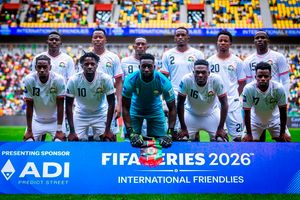
South Africa players during training at Estadio Hidalgo in Pachuca, Mexico on June 3, 2026.
Photo credit: Reuters
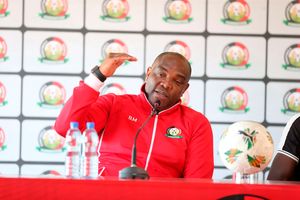
At a press conference, the coach was realistic about Kenya’s chances, admitting it ranks lower than established names on the continent.
On X, the exchanges moved through sporting achievements, geography and national pride, producing a contest in which a country’s name can become a weakness, and Fifa World Cup qualification can be dismissed with a reminder that neither side has won the trophy.
Football supplied an interesting opening when an account named Kuwa Strong wrote: “You qualified for Fifa World Cup, but we still have the same number of World Cup trophies.” This was in response to South Africans bragging that they had just returned from the 2026 Fifa World Cup hosted by Canada, the United States and Mexico. At that World Cup, South Africa had also become the butt of jokes after playing in a tournament while anti-migrant protests simmered back home. One joke was, “they should return home to protect their jobs,” in reference to one of the arguments used to demand the expulsion of foreigners: job scarcity.
Bafana Bafana would remain in the tournament until the second round, though.
Yet the banter also discarded the distinction between qualifying and staying home, presenting the absence of a title as a shared outcome and therefore a convenient equaliser.
For the South African football commentator known on X as Real Tshemedi, Tshemedi Molopo, that comparison captured the humour of an exchange whose next chapter he expects to unfold around the countries’ forthcoming football encounters.
“What’s been entertaining is the fact that both nations have taken it to the next level,” he told The East African. “I love the part where they said both countries have the same number of World Cup trophies even though South Africa recently came back from a World Cup.”
As a football follower, he found the joke particularly appealing, although its simplicity also demonstrated how online participants can change the terms of an argument whenever the opposing side appears to have gained an advantage.
South African account @ndusibeko7 offered a confident warning: “Kenyans want a twar with South Africa. It won’t end well for them.”
The “twar”, retaining its name from the platform’s former identity as Twitter, wouldn’t end just because one participant announced the other wouldn't win.
Kenyan users found one in South Africa’s name, and the account manjaymoh254 suggested the southern African country should first acquire a proper name rather than expect Kenyans to argue about “a compass direction towards the Atlantic Ocean.”
An aerial view of a section of the Nairobi Expressway and the under-construction Talanta Sports City Stadium in Nairobi, which will be one of the venues of the 2027 Africa Cup of Nations tournament.
Photo credit: File | Nation Media Group
South African users countered with their country’s record of hosting major international sporting events, contrasting those achievements with Kenya’s shared hosting role for Afcon 2027 alongside Uganda and Tanzania.
Molopo says South Africans are watching with “a hawk’s eye” to see if Pamoja is successful, with concerns over the three East African countries’ readiness for next year’s Afcon.
He believes the exchanges have created an entertaining backdrop to the football, particularly because Kenya are led by a South African whose comments can be claimed, interpreted and repurposed by either camp.
“We’re going to have a field day here come the first fixture (2027 AFCON qualifier) and obviously the second fixture as well,” he said. “I just hope the Kenyans will win this one because, if they don’t, they’ve got to face the full wrath of South Africans.”
Bafana Bafana and the Harambee Stars face off in back-to-back clashes next month in Johannesburg and Nairobi.
He delivered the warning in the spirit of the contest, anticipating the replies that would follow a Kenyan defeat rather than suggesting South African supporters would suddenly become sympathetic to their opponents.
Molopo also felt that some of McCarthy’s assessments had inadvertently given South Africans material, even though the coach intended to explain his team’s circumstances rather than endorse the opposing camp.
“South Africans, we took that as an extra ingredient,” he said. “We’re obviously going to use it against the Kenyans.”
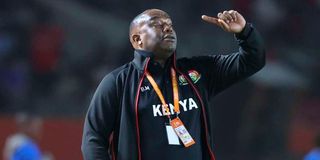
Harambee Stars coach Benni McCarthy during the team's training at Utalii Sports Club on September 1, 2025. Kenya is preparing for Group F World Cup qualifiers matches against The Gambia and Seychelles
Photo credit: Chris Omollo | Nation Media Group
McCarthy’s September explanation of his allegiance provided a separate talking point, with the coach saying: “My country didn’t employ me.”
His position was professionally straightforward, but in an online rivalry where almost any statement can be turned into ammunition, the distinction between national affection and employment offered considerable room for competing interpretations.
The exchange took a more serious turn when McCarthy raised concerns about work documentation. He disclosed in September that he and members of his technical team lacked the required work permits, which affected their ability to remain in Kenya between international assignments.
Tshepo Nkoane introduced South Africa’s migration debate, arguing that the coach’s approach contrasted with that of some foreign nationals living in Mzansi.
Nkoane’s post came against the backdrop of an increasingly charged immigration debate in South Africa, where the March and March movement has organised demonstrations demanding stronger enforcement and the deportation of undocumented foreign nationals, while accusing the government of failing to address citizens’ concerns about employment and pressure on public resources.
South Africa’s Department of Home Affairs said in April that deportations over the preceding two financial years had reached 109,344 by March 31, 2026, a cumulative increase of 46 percent.
Tensions have recently centred on asylum applications, with protesters, including members of March and March, blocking access to Home Affairs offices in Durban, showing how disputes over immigration documentation have become a flashpoint well beyond social media.
“Benni and his technical team don’t want to be illegal immigrants in Kenya even though they have no visas. They leave after games unlike some Africans in South Africa who want to live here without visas,” Nkoane wrote.
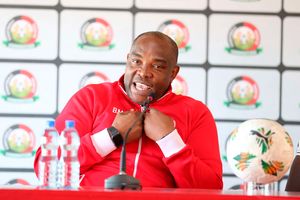
Harambee Stars head coach Benni McCarthy addresses a pre-match press conference in Nairobi on September 25, 2026.
Photo credit: Chris Omollo | Nation Media Group
In McCarthy’s case, the Football Kenya Federation acknowledged the documentation concerns in September and said it was working with government agencies to process the permits, while maintaining that the technical team’s responsibilities extended beyond national camps to monitoring domestic football.
That backdrop gives immigration comparisons a significance beyond the original football jokes, bringing questions of belonging and legal status into an exchange many participants initially approached as entertainment.McCarthy will have results to pursue, while those following the contest online will have another assignment, remembering who said what, preserving the receipts and ensuring that even after the football produces a final score, the argument remains available for extra time.