Ugandans on Saturday awaited the final tally of presidential elections, where incumbent Yoweri Museveni retained power to extend his four-decade rule.
Yet the vote, instead of offering certainty, stirred fears of post-election violence, particularly in the capital Kampala, and unsettling neighbouring Kenya, Uganda’s largest trading partner.
According to the Electoral Commission chairman, Justice Simon Byabakama, Mr Museveni, 81, polled 7,944,772 votes, representing 71.61 per cent of the valid votes cast in a country where the majority of the voters have only seen one president.
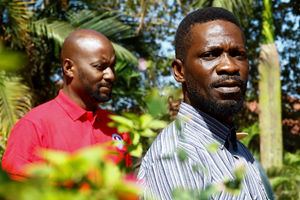
Ugandan Presidential candidate Robert Kyagulanyi, also known as Bobi Wine, of the National Unity Platform (NUP) party, prepares to receive international elections observers at his home in Magere ahead of the general elections, in Kampala, Uganda, January 14, 2026.
Photo credit: Reuters
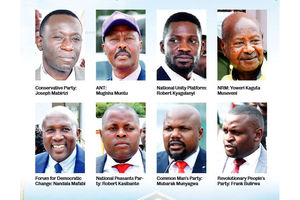
Mr Museveni’s closest challenger, Mr Robert Kyagulanyi of the National Unity Platform (NUP), trailed with 2,741,238 votes, representing 24.72 per cent of the total ballots cast.
Six other candidates shared the remainder. In Kampala, shops stayed shut as traders avoided the streets, while disputes flared over parliamentary outcomes.
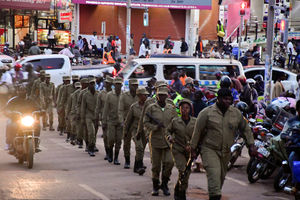
And cargo flows slowed sharply as election-related security measures disrupted cross-border trade. An internet shutdown and cautious delays by transporters left hundreds of trucks stranded at entry and exit points, raising fears of shortages and wider regional impact.
The Uganda Communications Commission (UCC) cited risks of misinformation and incitement when ordering the suspension. But the blackout, beginning at 6pm, quickly disrupted customs and tax operations. Uganda, a transit hub for Kenya, South Sudan, Tanzania, Rwanda, Burundi and the Democratic Republic of Congo, saw re-exports and transit cargo pile up at inland depots and border posts.
URA Commissioner for Customs Management Services, Hajj Asadu Kisitu, confirmed operations had been interrupted as documentation normally filed electronically could not be processed. While URA itself was exempted, ordinary transporters and clearing agents were not. UCC later said those excluded could appeal, but offered no timeline.
Mercy Ireri, CEO of the Kenya Transporters Association, said members had generally been assured of security during elections but were cautious this time. “We are aware that after the ballot has been cast, insecurity may arise,” she told the Nation. “Uganda is our biggest trading partner. About 85 per cent of goods from the Port of Mombasa are destined for Uganda. That tells you how important Uganda is to us.”
As a landlocked country, Uganda relies heavily on Kenya for imports and transit cargo. Kenyan truck drivers also use the route to South Sudan and the DRC. “You never know whether there will be disputes afterwards,” Ireri added. Under Ugandan law, those unsatisfied with results can petition the Supreme Court. In 2021, Bobi Wine challenged Museveni’s victory but withdrew, citing unfairness. The court nonetheless upheld Museveni’s win.
Uganda remains vital to Kenya as its top African trading partner, a destination for Kenyan investment in banking and services, and a driver of East African integration. Shared goals in infrastructure, security and regional growth are reinforced by cross-border movement of people and goods. Trade volumes have risen annually. Kenya exports manufactured goods such as cement, palm oil and iron and steel, while Uganda exports maize, tea, coffee and ceramics. Recent data shows growing diversity, with significant flows in both directions.
Ugandan Electoral Commission Chairperson Justice Simon Byabakama announces final presidential results following the general elections at the Tally Centre in Lubowa, Wakiso district near Kampala, Uganda, January 17, 2026.
Photo credit: Thomas Mukoya | Reuters
Uganda and the United States were Kenya’s top export destinations in August 2025, according to the Kenya National Bureau of Statistics (KNBS). Exports to Uganda were valued at Ksh11.0 billion, while shipments to the US stood at Ksh6.3 billion. Pakistan followed with Ksh6.0 billion. Provisional 2024 data shows Kenya’s exports to Uganda at $936.43 million (Ksh120 billion).
Trade ties have been prioritised by both Museveni and Kenyan President William Ruto, prompting state visits last year. In November, Kenya’s Trade Cabinet Secretary Lee Kinyanjui hosted a Ugandan delegation led by Minister Wilson Mbadi for a three-day mission on Kenya’s Special Economic Zones (SEZ) model. This followed Museveni’s mid-2025 visit to Nairobi. The zones offer tax incentives, subsidised power, favourable land leases and industrial infrastructure. Uganda is also expanding its industrialisation agenda, with 15 free zones under development.
According to the Northern Corridor Transit and Transport Coordination Authority (NCTTCA) mid-2025 report, transit cargo through Mombasa grew 16 per cent from 6.36 million tonnes in 2024 to 7.37 million tonnes in the first half of 2025. Uganda remained the dominant destination, accounting for 69.34 per cent of the total, with a 33 per cent increase to 5.1 million MT. Burundi and Rwanda volumes grew by 42 per cent and 16 per cent respectively, while South Sudan and DRC volumes fell by 19 per cent and 8 per cent.
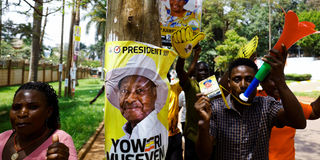
Supporters of Ugandan President Yoweri Museveni celebrate as the Ugandan Electoral Commission (EC) Chairperson Justice Simon Byabakama announces the final presidential results, following the general elections at the Tally Centre in Lubowa, Wakiso district near Kampala, Uganda, January 17, 2026.
To support increased truck movement, the Kenya Ports Authority (KPA) last year prioritised modernisation through automation, digital transformation and major infrastructure investments aimed at reducing delays and enhancing efficiency.
Still, fears mounted that shortages of essentials such as petrol could emerge if cargo movement did not resume. Kenneth Ayebare, head of logistics at the Uganda Private Sector Foundation, said Ugandan trucks might begin collecting cargo left at the border for domestic deliveries, though transit goods remained uncertain.