Nairobi has firmly rejected accusations by the Sudanese Armed Forces (SAF) that Nairobi is responsible for fuelling the conflict in Sudan, dismissing the claims as unfounded and misleading.
In a strongly-worded statement on Tuesday, the Ministry of Foreign Affairs refuted a circular issued by SAF to diplomatic and consular missions worldwide, denouncing it as a baseless attempt to shift blame amid the ongoing crisis.
"The government of the Republic of Kenya has taken note with concern of the circular note by Sudan SAF administration addressed to all Diplomatic and Consular Missions in various capitals, shifting blame to Kenya for the tragic and unending conflicts that have engulfed that country for over two years," part of the statement reads.
“While it is not in Kenya's interest to engage in needless exchanges, especially on a matter so grievous and intractable, it is nonetheless incumbent to put the record straight and to urge people and nations of goodwill to disregard those tirades as baseless.”
Reiterating its commitment to regional peacebuilding, Nairobi emphasised that it had acted within the Intergovernmental Authority on Development (IGAD) framework and other mechanisms to help resolve the crisis.
“To find a negotiated settlement, Kenya has met leaders of the two main warring sides in Nairobi, simultaneously and at separate intervals, under its unrivalled credentials for peaceful mediation,” the statement adds.
At the same time, the government addressed recent claims relating to a gathering of the Sudanese opposition in Nairobi, at which a political roadmap was adopted by the RSF and other opposition groups.
“The convening of this dialogue forum in our capital, Nairobi, or elsewhere in Kenya, neither equates to endorsing the outcome of the forum nor constitutes the formation of an exile government, as has been alleged,” said the Foreign Office.
With the conflict in Sudan still unresolved, Nairobi urged key international stakeholders to support a negotiated settlement.
“Kenya, therefore, urges key players in the conflict in Sudan to find a pathway to peaceful resolution and end the bloodletting.”
“Indeed, the international community has a duty under the UN Charter to protect human life, property and help silence the guns,” the foreign ministry stated.
In March, Kenya’s decision to host the Sudanese paramilitary group, the Rapid Support Forces (RSF), in Nairobi in February was met with significant backlash.
During the series of meetings held in Nairobi in the midst of Sudan’s gruelling civil war, RSF leaders signed a charter for the formation of a “parallel government” in Sudan, a move that has escalated tensions with Khartoum.
In response, the Sudanese government recalled its ambassador from Kenya, issuing a strong diplomatic rebuke over Nairobi’s engagement with a faction accused of war crimes and fuelling instability in Sudan.
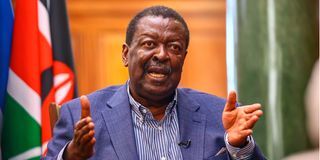
Last month, Prime Cabinet Secretary Musalia Mudavadi defended the country’s involvement in the fragile peace talks in Sudan, denying allegations that Nairobi is supporting a parallel government led by RSF.
Speaking at the Antalya Diplomacy Forum in Turkey, Mr Mudavadi responded to mounting criticism of Kenya’s dealings with the RSF, which launched a controversial charter with allied civilian groups that some claim is a blueprint for a breakaway government.
“What happened in Nairobi was a conversation among Sudanese civilians and political groups, including those aligned to RSF. They had their own discussion, yes, but if you look at the Charter, there is nowhere that a parallel government is declared.”
His remarks follow backlash over a March 4 meeting in Nairobi, where RSF-linked groups launched a charter that critics say could deepen Sudan’s political fracture.
The African Union’s Peace and Security Council warned that Kenya’s involvement risked further destabilising the country.