Trucks stuck at Busia border as cargo scanner breaks down
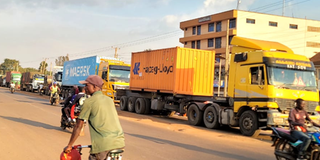
Trucks queue at Busia border after a cargo scanner broke down.

What you need to know:
- The non-intrusive inspection unit is used by customs officers to scan trucks and detect undeclared goods
Several trucks are stuck at the Busia border after the cargo scanner broke down on Thursday.
The breakdown of the non-intrusive inspection unit, which occurred about 3am, has caused a queue stretching nearly five kilometres into Kenya.
The non-intrusive inspection unit is used by customs officers to scan trucks and detect undeclared goods, contraband and concealed items without opening the cargo.


Sulaiman Nakasula, a truck driver transporting plastics to the Democratic Republic of Congo, told the Daily Monitor that he arrived on the Kenyan side of the border at 6am but has since been stuck in the queue.
"I have been held here for nearly 24 hours. I arrived at the border yesterday at 6am and have since been stuck in the queue," Nakasula said.
He said although they had been informed about the breakdown of the cargo scanner, they had not been updated on when the security unit would be repaired.
Nakasula, like other truck drivers, said the delay caused by the broken scanner was increasing transit time and the cost of doing business. He said he would by now have arrived in the Democratic Republic of Congo and delivered his consignment, mainly plastics.
"Our importer is calling me asking why I have delayed delivering the cargo, but I am telling him that we are waiting for the scanner to be repaired," Nakasula said.
All trucks arriving in the country from Kenya have to pass through the cargo scanner before they are cleared to proceed.
The breakdown is causing delays and theft of cargo from trucks at one of the busiest borders in the region.
Busia border lies along the Northern Corridor, a major route for cargo from the Port of Mombasa to landlocked EAC countries, including Uganda, the Democratic Republic of Congo, South Sudan, Rwanda and Burundi.
On average, the border handles between 750 and 1,000 trucks daily and is a major entry point for fuel destined for Uganda and other regional countries.
Middy Amullen, a border official, said the queue had stretched nearly five kilometres into Kenya following the breakdown of the security scanner.
"I have just returned from Kenya, and the queue is long. It is stretching nearly past Korinda along the Busia-Kisumu Highway," Amullen said.
Amullen said the border team had provisionally agreed to allow trucks carrying perishables and inflammable goods to enter the country without being scanned.
"They fear that if we continue holding up trucks carrying perishables, the goods will spoil. We also fear that the fuel could cause a fire, which is why the trucks have been allowed to proceed without going through the scanner," Amullen said.
Mustafa Mabanja, a clearing agent handling fresh agricultural produce from Kenya, said the scanner broke down shortly after 3am, leaving trucks carrying both perishable and other cargo stranded at the border.
"The scanner went off yesterday at 3am, and since then, trucks have been held up," Mabanja said.
Mabanja said exporters dealing in perishable goods, especially tomatoes, Irish potatoes and other produce, were at risk of losing their goods as the cargo remained held up at the border.
He said trucks carrying perishables had been stuck in the queue for hours, warning that the goods could already have spoiled.
The Uganda Revenue Authority (URA) had deployed two scanners at the Busia border — a mobile scanner and a larger fixed scanner — but both are currently non-functional.
"We have two scanners here at the border, a mobile scanner to handle emergencies and a bigger scanner. Unfortunately, both have broken down," a source at the border said.
The main scanner, a non-intrusive inspection unit, was procured by the Ugandan government from China to help curb fraud and enhance security.
URA technicians are working around the clock to repair the scanner. Sources said authorities had allowed trucks carrying perishable goods to enter the country without being scanned.