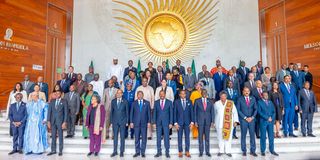
African and Caribbean countries are building a coalition to strengthen their push for reforms at the United Nations, seeing a united front as better.
They gathered in the Ethiopian capital Addis Ababa on Sunday to discuss issues affecting both regions, especially as they are historically and culturally connected.
Ethiopian Prime Minister Abiy Ahmed said the world must now respond to current realities, including the voices of African and Caribbean countries who he said had been neglected for long.
“The world is changing,” Dr Abiy told an audience at the African Union headquarters.
“In this new era, we cannot speak in fragments. We must speak as one. That is why the AU-Caricom partnership matters,” he said, referring to the continental blocs of both regions.
Abiy was speaking at the Second Africa-Caricom Summit, which brings together leaders of the two regions. They met under the theme: Forging Stronger Relations Between Africa and the Caribbean.
Kenya’s President William Ruto said, "The unity of the two regions will give a powerful voice to countries here to demand urgent reforms, especially in the global lending institutions to “make it just and inclusive.”
His argument on reforming credit structures is that a stronger International Monetary Fund, easier conditions on special drawing rights and support to regional lenders could boost economies.
“We [Africa and Caricom] stand today as a bloc of developing nations determined to secure a prosperous future for our people,” said Dr Carla Barnett, the Caricom secretary-general.
The Caricom is a grouping of 21 countries: 15 member states and six associate members. They often trace their cultural roots to Africa. Its members include countries like Haiti, Antigua and Barbuda, Bahamas, Domican Republic, Jamaica and Barbados.
While leaders spoke generally of reforming the multilateral system, the biggest headache has often been how to change the working of the UN to suit the poor.
Africa and allied countries have, for the last 20 years, been pushing to reform the UN Security Council, the most powerful organ of the UN. Its five permanent members have remained the same since the founding of the UN in 1945, holding a veto they sometimes politically whip other countries with.
And Angolan President João Lourenço, also the AU chairperson, said the 15-member council must start reflecting the reality of today's world. He argued that the UN has been captured by the geopolitical interests of members of the council, making it unable to work for the people.
African leaders have been speaking for years about the inadequacies of the UN. But now, it seems that without unity of number, there won’t be movement.
Last year, UN itself admitted its shortcomings. UN Secretary-General António Guterres called for urgent reform of the Security Council, criticising its outdated structure and lack of representation for Africa, which he argued undermines the body’s credibility and global legitimacy.
The Angolan leader said countries in Africa and the Caribbean are the most affected by major global changes, climate crisis, food and energy insecurity, geopolitical instability and forced migration to extreme economic pressures. As such, they should have a say in decisions.