At least a dozen attacks by armed gangs have disrupted political rallies, church services, public participation forums and most recently, the Ol Kalou parliamentary by-election in just a few months.
Most have targeted opposition leaders or critics of the government.
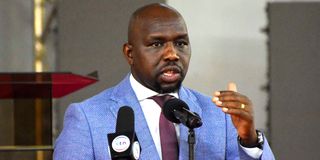
In almost every case, Interior Cabinet Secretary Kipchumba Murkomen, Inspector-General of Police Douglas Kanja and the Director, Directorate of Criminal Investigations (DCI) Mohammed Amin have vowed to hunt down not only the attackers, but also those recruiting, financing and directing them.
Yet as fresh violence erupts, many of those earlier investigations appear to have stalled, raising fresh questions about whether the State is willing or able to dismantle the networks behind Kenya’s growing political militias.
Inspector-General of Police Douglas Kanja.
Photo credit: File | Nation Media Group
An examination by the Nation shows a recurring pattern where violence erupts, senior security officials promise swift investigations and arrests, detectives announce they are pursuing sponsors, then little is publicly heard about the cases until another attack thrusts political violence back into the national spotlight.
The latest assurances followed last week’s violence during the Ol Kalou parliamentary by-election, where masked men travelling in high-end vehicles allegedly intimidated voters, fired gunshots and lobbed tear gas near polling stations despite heavy police deployment.
Yesterday, Nation reached out to CS Murkomen, IG Kanja and Mr Amin seeking updates on the progress of investigations into the violence and goon attacks, including those witnessed during the Ol Kalou vote.
Specifically, Nation asked how many suspects had been arrested, whether any political sponsors had been identified or charged, what became of the investigations into the Ol Kalou violence, and whether police had traced or questioned the owners of vehicles whose registration numbers were published by media houses after they were allegedly used by goons.
Shock as armed masked men show up, teargas Ol Kalou residents
None of the three had responded by the time of publication, although Mr Murkomen and Mr Kanja separately addressed the issue in public forums yesterday.
Speaking during an interdenominational fundraiser at Kwanza Girls High School in Trans Nzoia County, Mr Murkomen said detectives had opened investigations into the violence and would pursue not only those caught on camera, but also those suspected of financing and organising the attacks.
“The DCI has opened an investigation file to establish who these individuals are, the crimes they committed, whom they harmed, and why they were there, so that appropriate legal action can be taken. Kenyans can help us by recording statements as witnesses. Let us go beyond cameras and videos to ensure all those implicated in political violence are punished,” Mr Murkomen said.
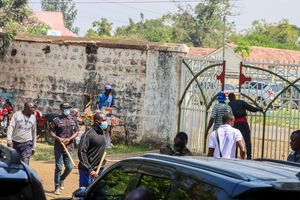
Angry residents chase away vehicles carrying hooded gunmen who attempted to force their way into at AC Primary School polling station during the Ol Kalou by-election on July 16, 2026.
Photo credit: Boniface Mwangi | Nation Media Group
He asked residents of the areas affected by political violence to record statements and help investigators identify those responsible.
The CS also announced what he described as the second phase of intelligence-led operations against organised criminal gangs.
“We are now going to do round two with full force, targeting those involved in robberies and political violence,” Mr Murkomen said.
Yesterday, IG Kanja again underscored the importance of security.
“Security is a very important pillar that underpins every other sector of our development. Social and economic progress heavily depends on a secure environment. I have said many times that security is a shared responsibility. The police cannot do it alone. We must work closely with communities to ensure the country remains safe and secure. Members of the public must cooperate with law enforcement agencies to eliminate crime and strengthen security at the grassroots level,” Mr Kanja said at Nyeri’s Mbiriri Comprehensive School.
In April, he had described politically sponsored violence as a direct threat to national security.
“We further reiterate that the alarming surge in political violence and thuggery instigated by leaders across the political divide, through the use of goons and criminal gangs, constitutes a direct threat to national security and will not be tolerated,” Mr Kanja said.
And NPS spokesperson Muchiri Nyaga said: “I am certain that the IG and the CS Interior have communicated on the government’s steadfastness in firmly addressing the goons question.”
Despite those assurances, organised attacks have continued to spread.
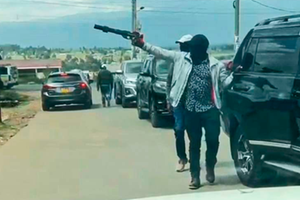
The most recent flashpoint was the Ol Kalou by-election. Masked men travelling in high-end vehicles allegedly disrupted voting, intimidated residents, fired gunshots and lobbed tear gas near polling stations, triggering widespread concern over how such a coordinated operation unfolded despite heavy police deployment.
A screengrab of a video shows hooded men brandishing guns and hurling tear gas canisters at residents and journalists during the Ol Kalou by-elections on July 16, 2026.
Photo credit: Pool
Responding later that evening, Mr Murkomen defended the security arrangements, but admitted that the allegations required investigation.
“The Inspector-General of Police deployed enough officers to provide security in Ol Kalou. These allegations of some other persons causing havoc in Ol Kalou must be investigated thoroughly, and anyone found culpable must be arrested regardless of what they were doing and who deployed them to Ol Kalou,” he said.
The following day, after the Democracy for Citizens Party (DCP) candidate Sammy Kamau Ngotho defeated UDA’s Samuel Muchina, the CS dismissed allegations that parallel security structures had operated during the poll.
“Those making noise for us, when they win, then the elections were good; when they lose, the elections become bad. They must be forthright, whether they lose or win. I assure the country that there is no parallel system of security in this country,” Mr Murkomen said.
“There is only one Inspector-General of Police, and there is one National Police Service which is accountable to Kenyans.”
Nation Media Group investigations identified registration numbers of several vehicles allegedly used to transport men involved in the violence. Among them was a black Toyota Land Cruiser linked to Kiambaa Member of Parliament John Njuguna Wanjiku, alias Kawanjiku.
The findings appeared to provide investigators with a clear starting point—tracing vehicle ownership, identifying drivers, reconstructing movements and following the financial trail behind the operation.
On Sunday, Mr Njuguna refuted claims circulating on social media linking him to hooded goons who allegedly caused disturbances in Ol Kalou. Speaking in Kiambu County, the MP said he was serving as an agent at the AC polling station when he was caught up in skirmishes at a road that had been barricaded by youths allegedly protecting the interests of their preferred candidate.
Meanwhile, the police are investigating two deaths linked to recent political violence in Nyandarua and Laikipia counties.
Detectives say they have identified some suspects involved in the Ol Kalou violence and believe many of them were ferried from outside the county.
Nyandarua County Commissioner Abdirisack Jaldesa has appealed to victims to record statements, saying investigations have been hampered by lack of cooperation.
In the neighbouring Laikipia, police said six suspects arrested after violence disrupted the Linda Mwananchi rally in Nyahururu were not local residents. They are alleged to have been transported from Nakuru County.
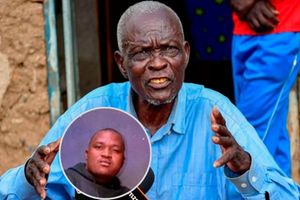
On July 3, Linda Mwananchi supporter Vincent Osiemo, popularly known as Mapinduzi, died after sustaining severe head injuries during an attack on the opposition leaders’ convoy at Keumbu Market in Kisii County.
Vincent Osiemo.
Photo credit: Pool
The Linda Mwananchi leaders were travelling from Kisii town to Keroka when they were ambushed by suspected hired goons armed with stones and clubs. Several people were injured while vehicles belonging to opposition leaders, including presidential hopeful Mr David Maraga, were damaged.
Political temperatures have also risen in Trans Nzoia County. Chaos erupted during a meeting attended by Co-operatives Cabinet Secretary Wycliffe Oparanya and Senator Allan Chesang, forcing anti-riot police to disperse rival groups with tear gas.
The incident came days after another confrontation involving Trans Nzoia Governor George Natembeya, raising concerns that organised violence is becoming an increasingly common feature of political mobilisation.
The attack marked a significant escalation, targeting a church hosting a civic forum rather than a political rally. Four days later, CS Murkomen promised swift action.
“The DCI is already analysing CCTV footage. One suspect has been arrested, and others are being pursued,” he said.
Five suspects were later charged with conspiracy to commit a felony, robbery, theft, and threats to life.
While the arrests were welcomed, they also revived concerns about whether investigations would stop with the culprits being captured on camera.
CS Murkomen acknowledged the scale of the challenge. While appearing before a parliamentary committee in April, he said more than 100 suspected gangs were operating across Kenya.
Many, he said, had evolved into sophisticated criminal organisations involved in extortion, illicit brews, drug trafficking, land disputes and political violence.
CCTV footage shows Vihiga Senator Godfrey Osotsi being attacked by a group of assailants at a coffee shop in Kisumu on April 8, 2026.
Photo credit: Video Grab
“On the Osotsi issue, the DCI circulated the pictures. Three of them presented themselves. The rest, 13 or 14, fled the country, but the IG and the DCI are on their trail,” Mr Murkomen said.
In January, worshippers fled after tear gas was thrown into St Peter’s ACK Church in Witima, Othaya, Nyeri, during a service attended by DCP leader Rigathi Gachagua .
Residents scamper for safety after tear gas canisters were lobbed at Witima ACK Church in Nyeri County during a Sunday service that was attended by Rigathi Gachagua on January 25, 2026.
Photo credit: Pool
The National Police Service announced investigations, with IG Kanja directing the Internal Affairs Unit to establish what had happened. No public update has since been released.
Kenya’s experience with election-related violence suggests these incidents are rarely spontaneous. Research by Odipodev in 2025 found that unemployed youths can be recruited for as little as Sh500, or even up to Sh2,000, depending on the assignment.
Recruiters rely on mobile phones, mobilisers and cash payments, enabling financiers to remain insulated from direct involvement.
For politicians seeking to intimidate rivals or influence political events, the cost of assembling a disruptive crowd is often small compared with the political advantage it can generate.
For many unemployed young people, the money represents an opportunity that poverty makes difficult to refuse.
Government officials insist they understand the threat, investigators say they are following leads as security agencies promise arrests.