Premium
AU asks African states to promote press freedom, guarantee safety of journalists
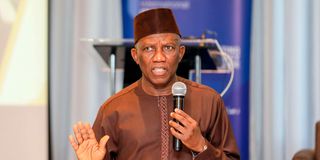
African Union Commission Commissioner for Political Affairs, Peace and Security Ambassador Bankole Adeoye speaks during Africa Union roundtable to mark World Press Freedom Day in Nairobi on May 3, 2025.

What you need to know:
- The media, Ambassador Adeoye said, plays a critical role in informing and educating polities on socioeconomic, political and governance issues.
- KUJ Secretary General Erick Oduor said the region has recorded a worrying trend where authorities have unleashed crackdown on journalists.
African Union has called on member states to continue “to guarantee freedom of expression, freedom of opinion and ensure the protection and safety of journalists is assured.”
At the same time, the continental body called on journalists to safeguard democracy and report responsibly.
Speaking during a roundtable to commemorate the 32nd edition of World Press Freedom Day on Saturday in Nairobi, Ambassador Bankole Adeoye, the AU Commissioner for Political Affairs, Peace and Security, emphasized the importance of safeguarding press freedom across the continent where the AU launched a programme on Democracy, Media and Socialisation.


“In the spirit of Agenda 2063: Let us continue to work together to promote democracy, good governance, and peace dividends on our beloved continent,” Ambassador Adeoye said, urging partners in shaping and advancing Africa’s democratisation, peace, development and prosperity trajectory.
“The press must be champions of the freedom from want... The press should join hands with the AU in championing democracy, effective governance and most importantly the right to development.”
Agenda 2063 is the African Union’s strategic framework for the socio-economic transformation of the continent over a 50-year period (2013–2063). It was adopted in 2015 as a blueprint to accelerate Africa’s growth and development.
He also called on journalists to “safeguard democracy and responsible reporting, digital citizens to verify the accuracy of the information they are exposed to.”
“Our niche as the AU is to ensure that the fundamental freedoms associated with the freedom of speech and freedom of expression--are promoted and protected everywhere in the African Continent.”
In line with the democratic principles of inclusivity, accountability, justice, human rights, freedom and dignity, the media, Ambassador Adeoye said, plays a critical role in informing and educating polities on socioeconomic, political and governance issues that significantly impact their lives and livelihoods.
Furthermore, he said, responsible and ethical journalism is essential in the age of digital media plurality and “citizen journalists”, and presents tremendous opportunities for and challenges to ethical and fact-based reporting and information sharing, especially in increasingly polarised and conflict-affected societies.
Themed “Reporting in the Brave New World: The Impact of Artificial Intelligence on Press Freedom and the Media” the commemorations aims to galvanise the collective efforts to harness the benefits of artificial intelligence in improving the accuracy and timeliness of news reporting while addressing serious threats posed and exacerbated by artificial intelligence technology, such as propaganda, biased algorithms, disinformation, misinformation, hate speech, and deepfakes, among others.
“We gather here to reflect on the state of the media as we mark this year’s World Press Freedom Day. It’s a day we look at the milestones the Fourth Estate has made over the past one year and challenges the sector is facing,” said the Kenya Union of Journalists Secretary General Erick Oduor.
“In most cases, journalists have found themselves in the receiving end as they carry out their duties, with charges against them being telling the truth.”
While adversarial relationship between authorities and the media is expected accountability is a difficult subject to many, Mr Oduor said.
“We must say no to assault, harassment and intimidation. This important role of holding power to account should not subject these men and women of the Fourth Estate to any form of attack or harm.”
Speaking in his capacity as the President of Federation of Eastern Africa Journalists, Mr Oduor said the region has recorded a worrying trend where authorities have unleashed crackdown on journalists, in some cases leading to shutdown of media houses.
On his part, President of the Federation of African Journalists (FAJ) Omar Faruk Osman said there was no better time to reflect on the role of the media in democracy and society than today, World Press Freedom Day.
Across Africa, Mr Omar said, journalists continue to work in hostile environments, particularly in states undergoing democratic backsliding, political crises and constitutional instability.
“In these contexts, press freedom is often the first casualty. Journalists are subjected to threats, arbitrary arrests, and surveillance and, in some instances, institutional bans,” he said.