Auditor-General Nancy Gathungu has flagged the National Treasury for evading parliamentary approval in the securitisation of the proceeds from the Roads Maintenance Levy Fund (RMLF) to cover Sh175 billion advanced to the government to settle pending bills at the State Department for Roads.
Ms Gathungu, in an audit on the accounts of the National Treasury for the fiscal year 2024/25 before parliament, also faulted the Treasury’s failure to categorise the advanced amount as part of the country’s public debt.
She noted that not even the much-needed supporting documents to demonstrate the approval of the securitised financing were provided to the auditors during the audit process, raising transparency doubts.
“The securitised financing was not disclosed or approved as public debt, and no evidence was provided of parliamentary approval for the creation of such financial obligations,” the audit says.
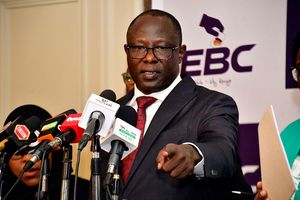
Auditor-General Nancy Gathungu.
Photo credit: File | Nation
Securitisation is a financial innovation where assets are pooled and converted into securities for investments, which can be part of a public debt if it involves government-issued securities.
National Treasury Cabinet Secretary John Mbadi, at a previous meeting with the MPs, revealed that “securitisation is off the government’s budget financing mechanisms and cannot be part of the country’s public debt.”
Notably, the absence of a sovereign guarantee for the funds advanced for the capital projects means that the government is not directly backing the debts.
“We are selling a right, which means we can receive the receivables in advance towards the projects. That is what we are doing with this securitisation,” said CS Mbadi.
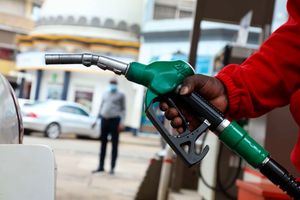
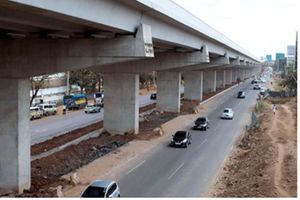
In October 2024, the National Treasury granted approval for a road infrastructure loan facility of up to Sh175 billion to be covered by the securitisation of Sh7 out of every Sh25 collected from every purchase of a litre of petrol and diesel at the station under the RMLF.
The securitised financing was recognized as the sale of future cash receivables through the Kenya Roads Board (KRB), with the funds applied to settle the pending bills and other obligations at the State Department.
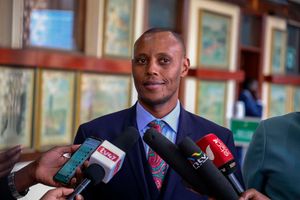
John Mbadi, the Cabinet Secretary for National Treasury and Economic Planning.
Photo credit: File | Nation Media Group
According to the audit, the arrangement ring-fenced the future public revenues from the fund for debt servicing purposes and restricted the board’s discretion over the revenues.
However, Ms Gathungu reveals that the failure to disclose the securitisation as a public debt and the failure to involve the MPs went against the provisions of the constitution and the Public Finance Management (PFM) Act.
Article 214 of the constitution provides that public debt “means all financial obligations attendant to loans raised or guaranteed and securities issued by the national government.”
Section 2 of the PFM Act defines public debt as any obligation requiring repayment from public funds.
Further, sections 50 and 58 of the PFM Act require cabinet and parliamentary approval before the national government incurs public debt.
The Sh7, which is the sole collateral for the investors’ money advanced to the government to settle the pending bills, is expected to be collected for the next seven years.
At a meeting with the MPs, CS Mbadi revealed that the government has not decided yet whether to provide a sovereign guarantee for financiers of capital projects in the country under the securitisation arrangement.
“You securitise and sort out the historical bills; we don’t intend to continue incurring those historical bills. We should now be budgeting properly and paying contractors when the certificates are ready,” the CS said.
This raises fears that the financiers risk losing out should there be under collection or a change of plan from the government.
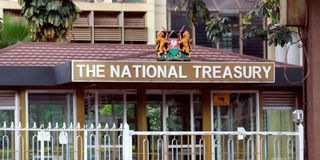
The National Treasury Building in Nairobi.
Photo credit: Pool
Kiharu MP Ndindi Nyoro warned that “should the collections dip, the lenders will be forced to carry their own cross.”
“We are talking of a situation where the financiers are forced into taking a haircut in the event the government says it can no longer support the repayments of the funds advanced,” says Mr Nyoro.
Ceteris paribus, Mr Nyoro says, the securitisation arrangement could potentially increase Kenya’s costly debt beyond the current Sh12.4 trillion.
The Kiharu MP noted that Ghana accumulated debts “in a similar manner Kenya is doing, but when it came to repayment, it only committed to settling a certain percentage,” with the financiers forced to shoulder the balance.