A company linked to a Member of Parliament is among firms that have lost out after the government awarded a nearly Sh5 billion contract to upgrade part of Mombasa Road to China Road and Bridge Corporation (CRBC).
Disclosures by the public procurement authority show that CRBC signed a contract worth Sh4,981,338,499.71 with the Kenya National Highways Authority (Kenha) to undertake capacity enhancement, landscaping and beautification works from the James Gichuru Road junction to Jomo Kenyatta International Airport.
Under the earlier plan, Shovels and Trowels Ltd and Wolf Paving Ltd were to undertake the works.
Shovels and Trowels, owned by Yvonne Chepkirui Kones — the wife of Belgut MP Nelson Koech — had been awarded a Sh1.19 billion contract to rehabilitate the stretch between the James Gichuru Road junction and Ole Sereni, which links to the Nairobi Southern Bypass interchange.
Wolf Paving , whose registered directors are Cynthia Wanjiru Kanyanja and Dennis Nyamu, had been contracted at Sh1.86 billion to upgrade the section from Ole Sereni to Athi River, passing Jomo Kenyatta International Airport.
However, the entire project has since been consolidated under CRBC, the Chinese contractor that built the Nairobi Expressway.
Kenha awarded the contract to CRBC on December 18 last year using the Specially Permitted Procurement (SPP) method, which allows direct procurement under limited circumstances.
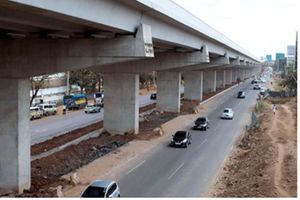
Motorists on a section of Mombasa Road.
Photo credit: File I Nation Media Group
The contract covers widening and improvement of the road as well as landscaping and beautification works aimed at making the corridor cleaner, greener and more visually appealing.
Kenha formally signed the contract three days after CRBC had already begun preliminary works following a directive from President William Ruto .
The roads agency did not respond to queries on why the contract was awarded through SPP instead of competitive bidding.
Under procurement law, the SPP method can only be used in specific circumstances, including emergencies, national security considerations or where only one supplier can provide the required service. Procuring entities must provide clear justification for using the method.
Efforts to obtain the procurement notice and justification from the National Treasury were unsuccessful, raising questions about whether all procedural requirements were met. CRBC had previously been earmarked to undertake the rehabilitation during the administration of former president Uhuru Kenyatta, at an estimated cost of Sh9 billion.
In May 2022, then Transport Cabinet Secretary James Macharia said the government preferred the expressway contractor to rehabilitate the old road.
“We are going to enhance the old road, all the way from Mlolongo to Westlands, to make sure that motorists who do not use the expressway also have a more beautified and enhanced road,” Mr Macharia said at the time. “We are finalising a contract of Sh9 billion to make sure we beautify the old road. It makes sense to have the contractor who was doing the expressway rehabilitate the old road.”
After taking office, however, the government of President Ruto in May 2023 awarded the rehabilitation works to the two local firms, with the project expected to be completed within 18 months.
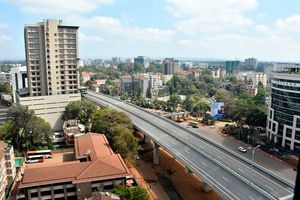
The road section has since remained in poor condition, with damaged lanes contributing to traffic congestion along the corridor. Parts of the road were affected during the construction of the 27-kilometre Nairobi Expressway, inconveniencing motorists and pedestrians along the busy transport route.
An aerial view of the Nairobi Expressway.
Photo credit: Francis Nderitu | Nation Media Group
Funding for the upgrade will come from the securitisation of the Roads Maintenance Levy (RML). Acting Kenya Roads Board director-general Martin Agumbi said last year that Sh21 billion raised through the securitised fund had been allocated to critical road projects.
Of this amount, about Sh4.5 billion was earmarked for the rehabilitation of the lower section of the expressway corridor from Mlolongo to Westlands.
Kenya securitised Sh7 from every litre collected through the levy to raise commercial loans aimed at clearing pending bills and financing priority road works. The RML currently stands at Sh25 per litre of petrol and diesel. The project cost has since risen to nearly Sh5 billion.
The transfer of the contract from local firms to the Chinese contractor has reignited debate over the role of domestic contractors in major infrastructure projects. Critics argue that some local firms lack the technical and financial capacity to deliver large projects and often win tenders through political connections.
Local contractors, however, say they face financing constraints and compete at a disadvantage against state-backed foreign companies that benefit from cheaper capital.