The cost of constructing Nairobi’s Talanta Sports City has been inflated by Sh10.85 billion, Auditor-General Nancy Gathungu has revealed.
In a new report, Ms Gathungu questions the unexplained price variation for construction of the 60, 000-seater stadium in Nairobi, saying the method of tender award violated procurement laws and that the Attorney-General’s clearance was never sought before the award of the contract.
The audit notes that the National Treasury had approved project funding of Sh35 billion, to be drawn from the Sports and Arts Social Development Fund (SASDF) with a six-year payment plan.
“This is against a contract amount of Sh45.85 billion, resulting in an unsupported price variation of Sh10.85 billion,” the audit states. The findings, in an audit on the accounts of the Ministry of Defence for the 2024/25 financial year before Parliament, puts Defence Principal Secretary Patrick Mariru on the spot.
Auditor-General Nancy Gathungu.
Photo credit: Dennis Onsongo | Nation Media Group
The report further warns that late payments to the contractor will attract an interest of three per cent above the Central Bank of Kenya average base lending rate on the first day the payments become due, further escalating the project cost.
It also raises doubts over the financial probity of the project as it reveals that details of the funding model were not provided to the auditors, with Ms Gathungu noting that only a special audit will determine the value for money.
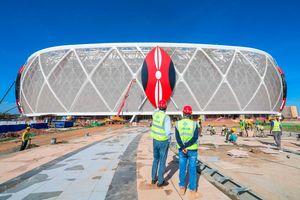
Construction work at the 60,000-seater Talanta Stadium in Nairobi on January 23, 2026.
Photo credit: Sila Kiplagat | Nation Media Group
Changes in the funding model were aimed at ensuring that the project was funded to completion according to the audit report. However, the full details of the model “have not been provided hence the need for a special audit to determine the true value for money in the achievement of the project”.
The Sh10.85 billion by which the cost of the project has reportedly been inflated is enough to construct 9.5 kilometres of the 175-kilometre Rironi-Mau Summit dual carriageway at a cost of Sh1.14 billion per kilometre.
The amount is also enough to finance 4.8 million learners in primary school or 487,000 secondary school students for an entire year based on the current government capitation rates. It costs the government Sh2,238 a year to finance the education of a learner in a public primary school and Sh22,244 to educate a student in a public secondary school for a year.
If the funds were allocated for junior school learners, at least 721,000 would be covered at the rate of Sh15,042 each.
The Talanta Stadium project is financed through a bond listed on the Nairobi Securities Exchange and serviced through the SASDF, with payments estimated at about Sh3.4 billion every six months.
The audit findings come against the backdrop of claims by Kiharu MP Ndindi Nyoro that by the time the cost of the football facility is fully settled, the country would have paid in excess of Sh100 billion. Mr Nyoro once chaired the Budget and Appropriations Committee of the National Assembly before he was kicked out over political differences with President William Ruto .
The audit report states that the Ministry of Defence entered into a two-year contract with a foreign contractor on May 26, 2024 for the design, building and equipping of Talanta Sports City at a cost of Sh45.85 billion but “clearance from the Attorney-General for the award of the contract was not provided for audit”. At the time, Mr Justin Muturi was the AG.
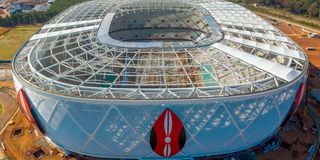
An aerial view inside the under-construction 60,000-seater Talanta Stadium in Nairobi on January 23, 2026.
Photo credit: Sila Kiplagat | Nation Media Group
Section 134 of the Public Procurement and Asset Disposal Act states that an accounting officer of a procuring entity shall ensure that all contracts of a value exceeding Sh5 billion are cleared by the AG before they are signed. The law adds that each Cabinet secretary “shall regularly inform the Cabinet and National Treasury of all government contracts exceeding Sh5 billion”.
“Talanta Sports City contracting is one of those greatest heists to ever happen under the Kenya Kwanza regime,” he claimed.
“The Ministry of Defence was specifically used for this direct procurement method regardless of what the law says. I remember raising the matter with then Sports CS Ababu Namwamba, why the procurement function was being taken away from his ministry,” said Mr Muturi, “Mr Namwamba did not respond to me.”
“But I was later informed that it had been decided that the legal department at the Ministry of Defence was best suited to deal with the matter. I told them that this is against the procurement law, which requires the clearance of the Attorney-General for any contract above Sh5 billion,” the former AG added.
The Ministry of Sports, Culture and Social Services transferred the procuring responsibility and “a total of Sh2.01 billion to the Ministry of Defence”. But a review of documentation provided for the audit, the report says, revealed “unsatisfactory matters”.
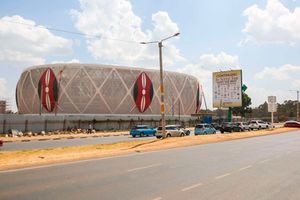
The Talanta Stadium in Nairobi that is under construction in this picture taken on February 8, 2026.
Photo credit: Billy Ogada | Nation Media Group
“The contract was awarded through a direct procurement method which did not meet competitive procurement and direct procurement criteria demanded by the Public Procurement and Asset Disposal Act of 2015,” the audit report states.
The law stipulates that open tendering shall be the preferred procurement method for procurement of goods, works and services. It further states that a procuring entity may use a direct procurement method subject to satisfying the set conditions. These include if the goods, works or services are available only from a particular supplier or contractor or a particular supplier or contractor has exclusive rights.
Other conditions for direct procurement are if there is war, invasion, disorder, natural disaster or there is an urgent need that cannot await the rigours of open procurement.
The audit report reveals that the project implementation report as at June 1, 2025, indicated that the project was at 44.54 percent completion, with 15 months to the expected completion date.
Cumulative payments to the contractor amounted to Sh2 billion, about 4.5 percent of the contract sum, potentially exposing the taxpayers to interest charges for late payment as per the contract provision.
Defence Principal Secretary Patrick Mariru.
Photo credit: Lucy Wanjiru | Nation Media Group
The report further states that a deed of assumption of payment obligations was signed on July 22, 2025 between the government of Kenya represented by Defence Principal Secretary Patrick Mariru, Sports Kenya and a Trustee, transferring the duty and obligation of making subsequent payments to the Trustee. The contractor also signed a consent agreeing to the transfer of duty and obligation of making subsequent payments to the Trustee on behalf of the ministry.
Yesterday, the Nation contacted Mr Mariru seeking his comments on the audit findings but he had not responded by the time of going to press.