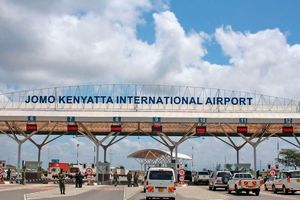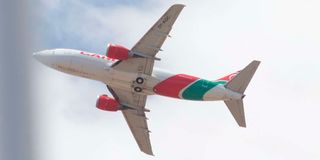
A Kenya Airways plane takes to the skies after taking off from Jomo Kenyatta International Airport, Nairobi, on September 1, 2026 as aviation workers resumed work.

The negotiations to end the aviation workers’ strike were expected to take about three hours, but they stretched on for 15, with the government and the workers' union trading demands late into the night as pressure mounted to reopen the country’s major airports.
By the time the two sides finally signed a return-to-work agreement at about 5am on Tuesday, President William Ruto was preparing to leave for Zambia to attend President Hakainde Hichilema’s inauguration, having been drawn into the negotiations.
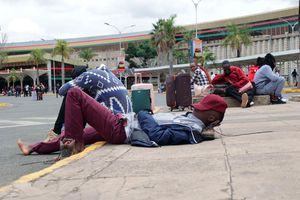
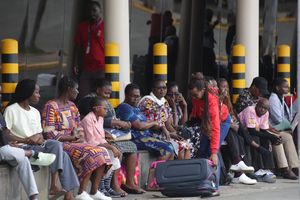
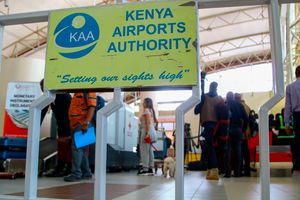
The disruption at Jomo Kenyatta International Airport (JKIA), Moi International Airport in Mombasa, Kisumu International Airport and Eldoret International Airport had paralysed domestic and international flights, with airlines forced to cancel, delay or reschedule flights.
The disruption prompted President Ruto to direct the relevant ministries to find a solution, leading to a high-level meeting at Transcom House convened by Roads and Transport Cabinet Secretary Davis Chirchir.
The meeting was attended by Kenya Aviation Workers Union (Kawu) officials, Labour Cabinet Secretary Alfred Mutua, Central Organisation of Trade Unions Secretary-General Francis Atwoli, Salaries and Remuneration Commission (SRC) officials and principal secretaries from the two ministries.
From the outset, however, the Nation learnt that the union maintained that it would not accept a deal that failed to address its main grievances, which included improvements in working conditions and the removal of Kenya Airports Authority (KAA) Managing Director Moses Wekesa and his entire board. Union officials also demanded the conclusion and signing of a pending collective bargaining agreement (CBA) with the Kenya Civil Aviation Authority (KCAA).
According to officials who took part in the negotiations, the talks quickly became a series of difficult compromises, with the government pushing for an immediate end to the strike while the union insisted that its demands had to be met first.
By late in the night, most of the union’s demands had been resolved, leaving the removal of Mr Wekesa as the most difficult outstanding issue. The government argued that dismissing the MD would expose it to legal challenges because he had been appointed for a three-year term and had served for only about six months. The disagreement threatened to delay the final agreement, forcing the matter to reach the highest level of government.
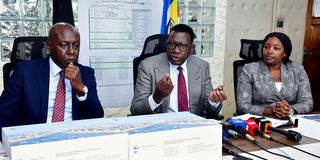
From left: Kenya Airports Authority Managing Director Moses Wekesa, Transport Cabinet Secretary Davis Chirchir and Aviation and Aerospace Development Principal Secretary Teresiah Mbaika during a press briefing at Transcom House.
According to Kawu communications official Daniel Yatich, President Ruto called the negotiators at around 4am.
“It reached a point where the president himself called. He said that he would face legal challenges if they remove him and that Mr Wekesa had a valid contract of three years,” said Mr Yatich.
The intervention did not immediately resolve the dispute, with the union maintaining that it did not want Mr Wekesa included in the return-to-work agreement.
“He [President Ruto] didn’t want to travel to Zambia when the space was closed. We continued with push and pull and give and take, and he asked that we give him time to find someone who would sign the return to work formula,” Mr Yatich said.
Mr Wekesa remained largely on the periphery of the negotiations and was not present when the agreement was eventually signed or when the union briefed the media.
The breakthrough came shortly before dawn, bringing the two-day strike to an end.
The other major dispute involved the CBA between Kawu and KCAA, particularly on allowances and salary adjustments, with SRC agreeing to withdraw its earlier guidance issued through a July 28 letter.
Under the new arrangement, union members will receive a 1.5 per cent salary adjustment for each year covered by the three-year 2025–2027 CBA, while SRC issued new parameters to guide negotiations and allow the union and KCAA to resume discussions immediately. The parties are expected to meet in Naivasha to negotiate allowances and other outstanding issues.
“We agreed that if our allowances go beyond what SRC had advertised, it will be forwarded to the commission and it will have to approve it,” Mr Yatich said.
Read: From 'flight is coming' to never: Aviation workers strike hits local, international travellers hard
On Kawu’s dispute with Jambojet over recognition and collective bargaining, the parties agreed to await the outcome of a case pending in court, with the return to work agreement stating that both sides would abide by the court decision.
Jambojet also committed to comply with all applicable legal and procedural requirements relating to trade union recognition with Kawu.
The negotiations also took a political turn, with the 2027 General Election and President Ruto’s efforts to consolidate support in Western Kenya featuring in discussions, according to a source who was present. The source said that the demand for Mr Wekesa’s removal was considered against the president’s political interests in Western Kenya, where he is seeking to consolidate support.
The two-day disruption of air transport prompted criticism from the Kenya Association of Air Operators (KAAO), African Airlines Association (AFRAA) and Kenya Tourism Federation, which said the strike had exposed shortcomings in the country’s preparedness for disruption of aviation services.
In a joint statement, the organisations said labour disputes affecting aviation should be accompanied by tested contingency plans, timely communication and coordinated action to protect passengers and the wider economy.
They cited Safety First Regulation 40 of the Kenya Civil Aviation (Air Traffic Services) Regulations, which requires the air traffic services authority to develop and publish contingency plans for actual or potential disruption and coordinate with affected airspace users and neighbouring authorities.
The organisations said the February industrial action should have provided sufficient warning for authorities to prepare for another disruption, arguing that operators had not been properly briefed on an activated contingency plan.
They further complained that the delayed issuance of the relevant notice to air mission (Notam) reduced the time available for airlines to revise flight plans, fuel requirements, alternative airports, crew rosters and passenger arrangements.
“Safety cannot be improvised. Operators, crews and passengers should not carry the burden of a foreseeable disruption when timely notices, tested contingency measures and coordinated airport response should have been in place,” said KAAO Chief Executive Officer Liz Aluvanze.
AFRAA said the disruption had implications beyond Kenya because of Nairobi’s position as a regional aviation hub, and affected connectivity, trade and travellers across the continent.
Follow our WhatsApp channel for breaking news updates and more stories like this.