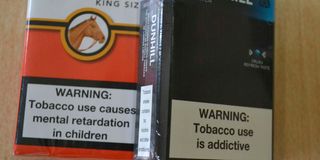
Health warning on some of cigarettes packets.

Manufacturers and importers of tobacco goods will be required to ensure at least two graphical health warnings are on the packaging material conspicuously displaying the harmful effects of tobacco use.
This as the government moves to reduce the costs incurred in the treatment of diseases caused by the smoking of tobacco products like cigarettes and consumption of nicotine pouches.
The Tobacco Control Regulations 2025, before the Delegated Legislation committee of the National Assembly, seek to breathe life into the Tobacco Control Act of 2007 that sought to regulate and to a certain extent, curb the consumption of cigarettes in the country.
Other than designating the Tobacco smoking zones, which has not prevented smoking in the public spaces, the Act has largely remained unimplemented.
Health Cabinet Secretary Aden Duale told the committee chaired by Ainabkoi MP Samuel Chepkong’a the graphical health warnings are meant to deter Kenyans from consuming cigarettes and other tobacco products, whose effect he said, causes nine of the 10 cancer related diseases.

Health Cabinet Secretary Aden Duale (Centre) Public Health PS Mary Muthoni (left) and Health Director-General, Dr Patrick Amoth, appear before National Assembly Health Committee at Parliament buildings Nairobi on May 15, 2025.
“Public health supersedes anything including businesses. If we believe the business injures public health, we will close it. When we do this, we control the costs related to treating diseases related to Tobacco use,” said CS Duale.
He added that some manufacturers and dealers in tobacco are not happy with the proposed graphics.
CS Duale revealed how he has been frustrated by litigations in court from confiscating shipments into the country of tobacco products laced with hard drugs, largely from China.
“The DCI has been able to confirm that some of these tobacco products are laced with hard drugs. We want to protect the future generation though on some occasions some people have gone to court but they will stop me,” said CS Duale.
Advertising
The tobacco control law was enacted to control the production, manufacture, sale, labelling, advertising, promotion and sponsorship of tobacco products to provide for the Tobacco Control Board to regulate smoking in specified areas.
The law states that the Cabinet Secretary in charge of Health, may, by notice in the gazette, prescribe that the warning, required be in the form of pictures or pictograms.
This is provided that such notice shall come into operation upon expiration of nine months from the date of its publication.
CS Duale told the committee that the World Health Organization (WHO) data shows that Tobacco use is one of the biggest threats to public health with 8 million deaths related cases reported globally every year with 1.2 million others from passive smokers.
Tobacco consumption, in any form, poses severe health dangers, impacting nearly every organ in the body.
Smoking is a leading cause of lung cancer and other respiratory diseases and it also increases the risk of heart disease, stroke, and various cancers, including those of the mouth, bladder, and pancreas.

A man lights a cigarette.
The consumption of tobacco also leads to reproductive issues both in male and female like reducing the quality of spermatozoa, erectile dysfunction, ovum quality issues and difficulty in achieving sexual activity.
There are also issues like vision impairment and even dementia with pregnant mothers who smoke running the risk of preterm delivery.
The government has tried to control the consumption of tobacco products through a punitive taxation regime- excise duty, uniform excise duty and VAT- but has not achieved the desired results.
Director-General for Health at the Ministry of Health Dr Patrick Amoth, who accompanied CS Duale, noted that consumption of tobacco in the country had increased due to lack of a stringent regulatory framework.
Health hazards
“The global north has imposed stringent regulations against tobacco consumption causing the manufacturers and other sector players to move to the global south where regulations are not stringent enough,” said Dr Amoth.
Section 21 of the Tobacco Control Act states that no person shall manufacture, sell, distribute, or import a tobacco product unless the package containing the product displays, in the prescribed form and manner and the health hazards or effects arising from the use of the product or from its emissions.
In compliance with the law, the manufacturers and the importers shall ensure that the tobacco products are packaged in materials that have at least two warning labels of the same health messages, in both English and Kiswahili.
Clear wrapping
The warning shall consist of not less than 30 percent of the total surface area of the front panel and 50 percent of the total surface area of the rear panel, and both located on the lower portion of the package directly underneath the cellophane or other clear wrapping.
The package shall bear the word "WARNING" appearing in capital letters and all text shall be in conspicuous and legible 17-point type.
This is unless the text of the label statement “would occupy more than 70 percent of such area, in which case the text may be of a smaller but conspicuous type size, provided that at least 60 percent of such area is occupied by the required text.”
The law further requires the packaging material to bear text that is black on a white background or white on black background in “a manner that contrasts by typography, layout or colour with all other printed material on the package.”
“All the warning labels shall be randomly displayed in each 12th month period on a rotational basis and in as equal a number of times as is possible, on every successive 50 packages of each brand of the product and shall be randomly distributed in all areas within Kenya in which the product is marketed,” the law states.

According to the Kenya Tobacco Control Data Initiative, tobacco use causes about 12,000 deaths annually in the country.
In 2004, Kenya signed the WHO framework convention on tobacco control (FCTC), developed in response to the globalization of the tobacco epidemic and in 2007 it domesticated the convention with the enactment of the Tobacco Control Act.
Article 11 of the WHO-FCTC requires each party to adopt and implement effective measures to prohibit misleading tobacco packaging and labelling, ensuring that tobacco product packages carry large health warnings and messages describing the harmful effect of tobacco use.
The 2007 Act, which domesticated the WHO-FCTC through the