The fast-tracked burial of former Prime Minister Raila Odinga has marked not only the end of an era in Kenyan politics — but also a quiet cultural revolution among the Luo community.
Traditionally, Luo funerals are elaborate, often stretching over a week or more as mourners gather. The ceremonies are usually marked by costly feasts held over many days before the final send-off.
“We have decided to move with speed in accordance with the family’s wishes and the late Prime Minister’s desire to be buried within the shortest time possible,” Deputy President Prof Kithure Kindiki told reporters at the DP’s official residence in Karen, Nairobi.
According to the DP, who is also the National Funeral Committee Chairperson alongside Siaya Senator Oburu Oginga, Mr Odinga’s family, represented by Dr Oginga and other members, held consultations with their lawyer and relayed the message that it was the former premier’s personal wish to be interred within 72 hours of his death.
“The government and the committee shall fully respect and honour that wish,” Prof Kindiki said.
The usual processions, overnight vigils, and lavish spending were replaced by a calm, tightly coordinated service.
It was as if the man who had spent decades pushing for political and social reforms was using his final act to challenge deep-rooted traditions that had, in his view, held his community back.
“Baba always preached simplicity and purpose,” said Dr Oginga. “Even in death, he wanted to show that our culture must evolve — that dignity is not in extravagance but in meaning.”
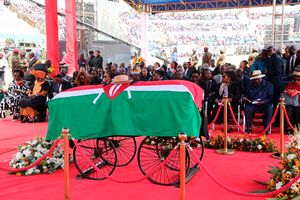
The body of former Prime Minister Raila Odinga at Jomo Kenyatta Stadium, Kisumu on October 18, 2025 during the public viewing.
Photo credit: Sila Kiplagat | Nation
In Luo culture, burials have long been both a social and economic statement. Families often fall into debt to meet cultural expectations — slaughtering cattle, building temporary structures, and hosting multitudes.
Mr Odinga’s restrained farewell may, therefore, signal a generational shift toward moderation, practicality, and modern values.
In a region where inheritance conflicts and cultural rigidity have delayed development, the ODM leader’s decision seemed to urge the community to rethink old customs in favour of equity and progress.
Speaking in May, Mr Odinga said he admired the Muslim way of interring the departed.
“Funerals have become an industry and it is impoverishing our people. Every day, every week, people are involved in endless planning of expensive funerals. Our Muslim brothers send off their loved ones hours after death. In our case, it takes even a month before one is buried. We must change this,” he said, and it is now clear that he meant every word.
Elders see in this a reflection of broader societal changes across Kenya — where urbanisation, education, and economic strain are reshaping how communities handle traditions once considered sacred.
He also challenged the ‘simba’ culture—where men, particularly the firstborns, construct temporary houses in their father’s compound.
“What we must do as a community is reflect critically on Goyo dala and embrace more dignified, modern housing. In earlier times, the population was small and land was abundant. That is no longer the case. Rather than subdividing land endlessly, we should designate central zones for housing while preserving the rest for agriculture and amenities,” he said during a meeting with Luo elders last year.
Even circumcision ceremonies, once strictly tied to ancestral practices, are now giving way to medical and symbolic alternatives.
When Mr Odinga stood before a charged audience at Tom Mboya Labour College in Kisumu in September 2008, he was not addressing a political rally — at least not in the conventional sense.
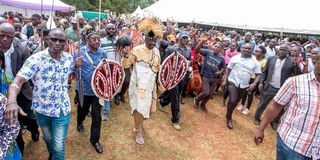
A procession escorts the casket of former Prime Minister Raila Odinga during the public viewing at the Jomo Kenyatta International Stadium in Kisumu on October 18, 2025.
Photo credit: Alex Odhiambo | Nation Media Group
Then a newly sworn-in Prime Minister, he had chosen that platform to deliver one of his most controversial messages yet: a call for Luo men to embrace voluntary medical male circumcision as part of the fight against HIV/Aids.
The statement stunned his audience, with elders from the Luo Council of Elders led by then Ker Riaga Ogallo, dumbfounded.
Ker Ogallo had in the past stood his ground, saying the practice was not Luo culture and the community needed time to embrace it.
But at the event, he stepped down from his hard-line stance and conceded that the cut provided it was voluntary and for medical purposes, not a rite of passage.
The meeting was the fourth in a series under the Nyanza Task Force on Male Circumcision and a research team. The first three meetings made little headway.
For generations, the Luo community — Kenya’s third-largest ethnic group — had stood firm against the practice. But Mr Odinga, ever the reformist and bridge-builder, saw beyond cultural symbolism.
He saw a public health crisis threatening to wipe out an entire generation, and he was ready to challenge even his own people’s value systems to save lives.
At the time, western Kenya bore the highest HIV prevalence rates in the country — nearly 15 percent, more than double the national average.
Scientific research, then, they argued, had shown that circumcision could reduce the risk of HIV infection in men by up to 60 percent.
The Ministry of Health, working with international partners, was preparing to roll out a massive Voluntary Medical Male Circumcision (VMMC) campaign. But there was a challenge: how to sell the message.
The body of former Prime Minister Raila Odinga at Jomo Kenyatta Stadium, Kisumu on October 18, 2025 during the public viewing.
Photo credit: Sila Kiplagat | Nation
The HIV prevalence in the region began to drop. Studies by the Kenya Medical Research Institute (Kemri) and CDC Kenya linked the decline partly to the success of the circumcision campaign.
Mr Odinga’s bold stance had not only saved lives but also shattered one of the last remaining taboos in Luo society.
“Raila transformed a people’s mindset,” says Kisumu Governor Prof Anyang’ Nyong’o. “He taught us that culture is not a cage but a guide. He proved that leadership means doing what is right, not what is popular.”
The programme continues under the Ministry of Health, with clinics in Kisumu, Siaya, Homa Bay, and Migori still offering free VMMC services.
The HIV prevalence rate in Nyanza has since fallen to around eight percent — nearly half of what it was when Mr Odinga first championed the cause.
For the fallen former Prime Minister, the battle for a modern Kenya was never just about politics or power — it was also about progress. He proved that true leadership sometimes means taking the knife to tradition — not to destroy it, but to heal it.