The final resting place of former Prime Minister Raila Amolo Odinga—Kenya’s towering political enigma and liberation hero—will be beside that of his late father, Jaramogi Oginga Odinga, at Kang’o ka Jaramogi in Bondo, Siaya County.
The serene compound, a national heritage site, will now eternally unite the two Odingas—father and son—whose footprints are deeply engraved in Kenya’s political soil.
Siaya Senator Oburu Oginga, his step mother Betty Oginga (in blue dress) and members of the clergy moments after identifying Raila Odinga's burial site and saying a prayer.
Photo credit: Rushdie Oudia | Nation
Mr Odinga’s elder son, Fidel Odinga, was also buried at Kang’o ka Jaramogi in 2015, though at the family cemetery.
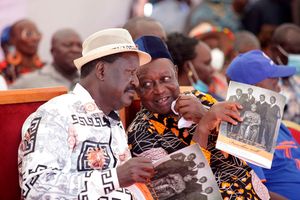
Raila Odinga (in hat), then Tourism Cabinet Secretary Najib Balala and CS Raphael Tuju at the Jaramogi Oginga Odinga Mausoleum in Bondo, Siaya County on February 18, 2019.
Photo credit: File | Nation
For decades, Mr Odinga’s name was inseparable from his father’s, both bound by their shared vision of justice, democracy, and freedom.
As the nation mourns Mr Odinga’s passing, Kang’o ka Jaramogi transforms once again into a national shrine—a pilgrimage site where Kenya’s long and turbulent journey to democracy will be told for generations.
Kang’o ka Jaramogi sits quietly on a gentle slope in Sakwa, Bondo, overlooking the plains that stretch towards Lake Victoria.
From the main Bondo-Usenge road, a narrow, tree-lined path leads to the Jaramogi Oginga Odinga Mausoleum—a cultural and historical treasure that has, for decades, preserved the story of Kenya’s liberation struggles.
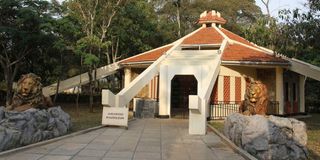
Inside the compound stands a simple yet majestic mausoleum—cream-walled, high-roofed, and ringed by gardens dotted with sculptures of lions.
Renovations at the Jaramogi Oginga Odinga mausoleum at Kang'o ka Jaramogi in Bondo, Siaya County on February 24, 2012.
Photo credit: File | Nation
The lions, as former curator Samuel Aduol once explained to this journalist in 2019, symbolise “the relentless spirit of opposition politics” embodied by Jaramogi and inherited by Mr Odinga.
“This place is not just about the Odinga family,” Mr Aduol said during an interview in 2019. “It is a living museum of Kenya’s political resilience. Every wall, every artefact here, tells a story—of struggle, sacrifice, and leadership.”
It is in this hallowed ground that Mr Odinga’s marble grave will lie—next to his father’s—marking the continuation of a lineage that defined Kenya’s politics from independence to the present day.
It was established in honour of the country’s first Vice-President, Jaramogi, a man whose influence cut across generations.
Jaramogi Oginga Odinga Mausoleum at Kang'o ka Jaramogi in Bondo, Siaya County.
Photo credit: File | Nation
The museum, protected by the National Museums of Kenya, offers visitors a journey through the intertwined histories of Kenya and the Luo nation.
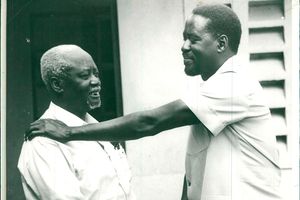
On its walls hang rare photographs capturing defining moments in Jaramogi’s political life: his meetings with Mzee Jomo Kenyatta, his fiery speeches calling for equality, and his years in political isolation after falling out with the government.
Weapons once owned by Jaramogi—spears, shields, bows and arrows—are carefully displayed, representing his role as ‘Ker’, the traditional leader of the Luo community.
According to oral tradition, the title ‘Ker’ traces back more than 400 years to the reign of Ramogi Ajwang’, the legendary Luo king.
“The artefacts represent power and authority,” Mr Aduol once told the Nation . “They remind us that Jaramogi was not just a political figure but also a custodian of culture and identity.”
Jaramogi Oginga Odinga Mausoleum at Kang'o ka Jaramogi in Bondo, Siaya County.
Photo credit: File | Nation
The museum’s collection includes the skins of a python, leopard, and oryx, along with stuffed birds and animals considered sacred in Luo folklore. Each carries symbolic meaning—wisdom, courage, resilience—qualities that defined both Jaramogi and Raila in their political lives.
Born on January 7, 1945, the former ODM leader grew up within the shadows of this compound, absorbing the ideals and values his father stood for.
Raila Odinga (in hat) and then Tourism Cabinet Secretary Najib Balala at the Jaramogi Oginga Odinga Mausoleum in Bondo, Siaya County on February 18, 2019.
Photo credit: File | Nation
When Jaramogi opposed colonial injustice, Mr Odinga watched. When Jaramogi refused to take power without Kenyatta’s release, Mr Odinga listened. And when Jaramogi fell out with Kenyatta over ideology, he learned.
Over time, he would inherit not just his father’s name but also his cause.
From the 1982 coup attempt that landed him in detention for nearly a decade, to his relentless fight for multiparty democracy in the 1990s, to his five presidential runs and countless political comebacks, Mr Odinga’s life mirrored that of his father—defiant, courageous, and unyielding.
“Both father and son paid heavy personal prices for their convictions. Both spent years in political wilderness, and both re-emerged as national symbols of resistance,” says veteran journalist Kenneth Ogosia.
Now, in death, the two will rest side by side—the patriarch who opened Kenya’s political space and the son who kept its democratic flame burning.
A view of the Jaramogi Oginga Odinga Mausoleum at Kang'o ka Jaramogi in Bondo, Siaya County.
Photo credit: File | Nation
Following a 2019 visit by then-Tourism Cabinet Secretary Najib Balala, the government unveiled plans to upgrade the mausoleum into an educational and cultural centre.
“Our aim is to open a new gallery showcasing the Big Five—the elephant, lion, rhino, leopard and buffalo,” curator Aduol revealed at the time. “We want young people to understand the history of the region and learn about Kenya’s first Vice-President and his contribution to the nation.”
The museum has since become a hub for school tours, researchers, and international visitors tracing Kenya’s political heritage. The number of tourists increased sharply after a visit by former President Uhuru Kenyatta, who described Jaramogi as “a man who chose principle over power”.
In the years that followed, the mausoleum expanded its collection, adding multimedia installations and rare photographs chronicling the independence struggle, the KPU years, and the multiparty movement of the 1990s.
The president Uhuru Kenyatta lays a wreath at the late Jaramogi Oginga Odinga Mausoleum in Bondo, Siaya County in December 2018. He was accompanied by Hon. Raila Odinga and Hon. Oburu Oginga.
Photo credit: File | Nation
The compound also houses the family’s homestead, where Jaramogi’s widow, Mary, lived until her death in 1984. A small chapel nearby hosts annual memorial services, where family, friends, and political allies gather to honour the Odingas’ legacy.
For the Luo community, Kang’o ka Jaramogi carries immense cultural and spiritual significance. It is not only the final home of one of their greatest sons but also a repository of their collective identity.
In Luo tradition, leaders of great stature are buried within their ancestral compound—a mark of continuity and respect.
The choice to lay Mr Odinga beside his father, therefore, resonates deeply within the community’s cultural fabric.
“This is not just a burial,” explains Mzee Olang’o Nyabola. “It is a symbolic passing of the torch. Raila’s grave beside Jaramogi’s completes a generational cycle—the father who started the fight for liberation and the son who carried it to its logical conclusion.”
The entrance to the Jaramogi Oginga Odinga Mausoleum at Kang' ka Jaramogi in Bondo, Siaya County.
Photo credit: File | Nation
In recent years, Kang’o ka Jaramogi has hosted dignitaries, scholars, and political pilgrims. Presidents, prime ministers, and foreign diplomats have walked through its gates, reflecting on Kenya’s long march to freedom.
Every corner of the compound tells a story. The marble grave of Jaramogi gleams softly under the Bondo sun. Beside it, Mr Odinga’s tomb—being constructed under strict cultural and architectural guidelines—will mirror the father’s in design and dignity.
National Museums of Kenya officials say the site will be expanded to accommodate a peace and democracy centre, a reflection of Mr Odinga’s lifelong advocacy for inclusive governance and continental unity.
“Raila’s burial beside his father will immortalise a political dynasty that never ruled but always mattered,” says Mzee Ambrose Nyapada, 94. “It is poetic—that two men who shaped the country’s conscience will now rest within the same soil that bore their dreams.”
The County Government of Siaya, working with the National Museums of Kenya and the Ministry of Tourism, is planning a major facelift, including digital archives, guided tours, and cultural exhibitions.
Visitors queue at the Jaramogi Oginga Odinga Mausoleum at Kang' ka Jaramogi in Bondo, Siaya County in this past photo.
Photo credit: File | Nation
“This place is sacred,” Mr Orengo said. “It represents the foundation of Kenya’s political evolution. We must protect it not just for the Odinga family, but for the country.”
Already, plans include the construction of a research centre dedicated to democracy and governance, a library archiving Jaramogi and Raila’s speeches, and an amphitheatre for civic education events.
In the stillness of this sacred ground, history comes full circle.
The son joins the father, both now part of the nation’s eternal story—the unyielding spirit of Kang’o ka Jaramogi, where Kenya’s struggle and soul forever rest side by side.