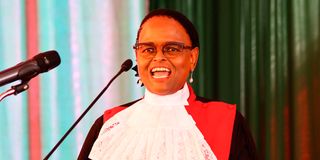
A bid to remove Chief Justice Martha Koome from the Judicial Service Commission's (JSC) leadership over claims she shielded two judges from disciplinary action has failed.
Citing lack of jurisdiction, the High Court rejected a petition seeking Ms Koome's ouster and ruled that litigants cannot bypass the JSC's constitutional mandate to handle complaints touching on the conduct of judges, including the CJ, and other senior Judiciary officials.
The court also said that Ms Koome cannot be removed as JSC chairperson without first being removed from the office of Chief Justice.
The case was filed by Nemwel Momanyi, who describes himself as patron of the Gusii Regional IDPs Steering Committee and the IDPs Fraternity.
He accused the JSC of failing to act on his complaints seeking the removal of two judges, whom he alleged had been compromised and denied justice to him and the people he represents.
Momanyi said the court petition was prompted by 17 years of unsuccessful litigation in courts, which he attributed to the conduct of two judges.
After the commission allegedly failed to take action, Rev Momanyi turned to the High Court seeking the removal of CJ Koome as chairperson of the JSC and Chief Registrar of the Judiciary Winfridah Mokaya as the commission's secretary.
He argued that the two officials had abused their offices by failing to address his complaints and asked the court to suspend and remove them from those positions.
The petitioner wanted the court to stop CJ Koome and Ms Mokaya from exercising their duties as JSC chairperson and JSC secretary, respectively, while leaving them in their substantive offices.
However, the court struck out the petition after finding that the Constitution provides a specific process for removing the Chief Justice and other judicial officers through the Judicial Service Commission, not through a constitutional petition before the High Court.
"The proper way to remove the Chief Justice is by way of a petition to the Judicial Service Commission pursuant to Article 168 of the Constitution," the court said.
Lawyers for the respondents opposed the case, arguing that the court lacked jurisdiction to handle petition for removal of Chief Justice and that the Constitution provides a clear disciplinary framework under the JSC.
They also told the court that Rev Momanyi had already lodged a similar removal petition before the commission, making the High Court case an attempt to sidestep the prescribed process.
Their counsel, Robert Kibor, stated that the petitioner sought to circumvent the disciplinary framework established under Articles 168 and 172 of the Constitution.
In its ruling, the court held that Ms Koome serves as chairperson of the commission by virtue of being Chief Justice.
Removing her from the commission's leadership without first removing her as Chief Justice was therefore constitutionally impossible because the two offices are inseparably linked.
"The Chief Justice is the Chairperson of the Judicial Service Commission by virtue of holding the office of the Chief Justice. She cannot, therefore, be removed as the Chairperson of the Judicial Service Commission so long as she is the Chief Justice, as the two positions are inextricably linked. This is clear from Article 171 (2) (a) of the Constitution," explained the judge.
The court further found that the petitioner had alternative remedies available before the Commission and had not shown that pursuing them was unavailable or impractical.
"It is clear that there are other remedies the petitioner should have pursued. He can still prosecute his claim before the Judicial Service Commission," judge said.
Alternative legal mechanism
The court also invoked the doctrine of constitutional avoidance, which requires courts to decline constitutional petitions where another legal mechanism exists to resolve the dispute.
It ruled that the High Court should not determine matters that can conveniently be addressed through institutions established by the Constitution for that purpose.
The court also found the petition lacked the precision required in constitutional litigation, saying the pleadings did not clearly identify the alleged constitutional violations or the remedies sought, making it difficult for the respondents to answer the claims fairly.
Further, the court held that the dispute was res-subjudice because a similar complaint remained pending before the JSC.
"The prayers sought by the petitioners, to wit, the suspension of the Chief Justice and Chief Registrar of the Judiciary, are not matters that this court has jurisdiction to determine," the court said.
The ruling leaves intact the petitioner's option of pursuing his complaints against the two judges through the JSC, which the court identified as the constitutionally mandated forum for considering such disciplinary matters.