Counties not ready to handle Ebola despite Duale assurances

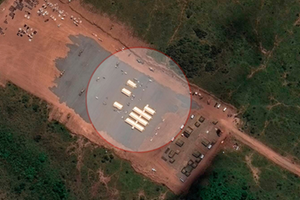
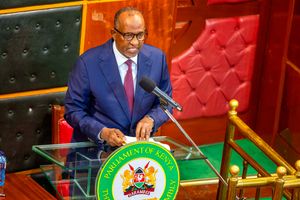
Health Cabinet Secretary Aden Duale. In the background is a satellite image of the US-backed Ebola quarantine facility in Laikipia.

The Ebola isolation centres repeatedly mentioned by the Ministry of Health exist largely on paper. A Nation spot check at a number of county referral hospitals found little to show for them.
There is no personal protective equipment, no installed containment gear and, in some counties, no isolation centres at all. What exists is a list of plans waiting to be implemented, with county governments saying they are awaiting communication and support from the national government.
The counties say they cannot establish isolation centres without national government support, which has yet to arrive. The national government, however, has on several occasions stated that isolation centres are being established at referral hospitals across the country.
At the Jaramogi Oginga Odinga Teaching and Referral Hospital in Kisumu, sitting on a major transit corridor to Busia, an hour from the Kenya-Uganda border, nothing is underway. They are yet to set one up, and public participation is still ongoing.

The entrance of Jaramogi Oginga Odinga Teaching and Referral Hospital along Kisumu -Kakamega Highway.
Kisumu County is banking on the Kisumu County Teaching and Referral Hospital to handle Ebola suspects and patients, drawing on its experience managing Covid-19. But the facility is not ready.
"After handling Covid-19 cases, the isolation centre has remained operational, handling other infectious diseases. At the moment, however, it is not equipped to handle Ebola patients," said Dr Tom Mboya, the hospital's medical superintendent.
The facility is still waiting for the procurement and installation of the necessary equipment. Its staff are currently undergoing sensitisation in preparation.
Dr Mboya noted that Kisumu remains one of the high-risk counties given its proximity to Uganda, where several infections have been reported.
"The best thing we can do is have our staff trained as we wait for the installation of the equipment," he said.
Makueni County has no quarantine facility for Ebola patients, yet the Ministry of Health has classified it as high-risk. The county sits along more than 180 kilometres of the Nairobi-Mombasa highway, a key transit corridor linking Kenya to the Democratic Republic of Congo, where Ebola has been active.
Dr Andrew Mulwa, head of the National Aids and STIs Control Programme, has raised this directly with Makueni Governor Mutula Kilonzo Junior.
"What will happen if a truck driver tests positive for Ebola at Emali Township? We need an Ebola isolation facility in Makueni County, the way we had a Covid-19 isolation facility at Makindu Township," he said.
The county's chief health officer, Dr Harvey Mulei, said the problem is not just equipment. County governments simply do not have the capacity to run such facilities.
"County governments do not have the capacity to set up and manage Ebola quarantine facilities. County askaris cannot secure an Ebola isolation facility. It needs to be manned by the Kenya Defence Forces to prevent patients from sneaking out and spreading the disease," Dr Mulei told Nation.
Homa Bay County has a building ready for use. The facility, converted from a Covid-19 isolation centre, has been inspected and certified and has a capacity of 70 beds. However, the county is reluctant to disclose its location for fear of public resistance similar to what happened in Laikipia.
But the facility has no personal protective equipment.
"We do not have any personal protective equipment. We also need other forms of support from the national government. It is their role to support us during such situations," said Amos Dulo, the county's director of curative health services.
Managing Ebola requires Level 4 personal protective equipment, powered air-purifying respirators, full-body suits and specialised containment gear that most county hospitals in Kenya do not stock.
“Without it, a certified building is little more than a room," Mr Dulo said.
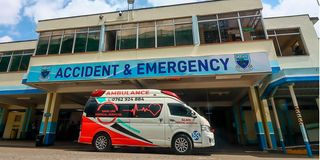
The entrance of the Accident and Emergency unit at Kenyatta National Hospital in Nairobi.
At the national level, Kenyatta National Hospital (KNH) has an eight-bed isolation and treatment unit designated for infectious diseases, including Ebola. The unit was established in 2014 and handles diseases such as tuberculosis, measles, and chickenpox. It forms part of a three-tiered network alongside the National Police Service Hospital and various county-level facilities.
But even this facility has its limits. If the unit fills up with other infectious patients, it cannot admit Ebola cases. A hospital insider told Nation that the Ministry of Health has yet to support the establishment of a standalone isolation unit for Ebola suspects.
"This is a KNH initiative and a hospital isolation unit, and we are hopeful that the government will come on board to help us add more beds," said the source, who asked not to be named.
At Murang'a County Referral Hospital, the picture is the same. A source there told Nation the hospital has no isolation ward for Ebola suspects or patients. The only isolation infrastructure in the building is eight cubes in the medical ward, four in the female ward and four in the male ward, reserved for severely ill tuberculosis patients. Staff training is ongoing.
"During the Covid-19 period, the training came earlier, via webinar. We were supplied with personal protective equipment. Then there was a designated quarantine facility for suspect cases and an isolation centre for positive Covid cases," the source explained.
Nairobi County is further into its assessment process. Dr Carol Ngunu, the county's director of preventive and promotive health, said two facilities have been identified, one in Embakasi and another in Lang'ata, and that simulation exercises are underway.
"We did a simulation exercise at Mbagathi County Referral Hospital on Wednesday and are preparing a report to present so we can give feedback to the County Executive Committee and see how that can be actualised," Dr Ngunu said.
Mama Lucy Kibaki Hospital has not yet been assessed because of the high patient load, but visits are planned before the end of June as the county awaits further guidance.
Dr Ngunu added that while the county is aligning with national preparedness efforts, the ongoing activities are being led by the Nairobi County Government.
Meanwhile, the one dedicated national facility in the works has run into legal trouble. Health Cabinet Secretary Aden Duale told a court that the Ministry of Health has officially halted construction of an Ebola quarantine and isolation facility at Laikipia Airbase.
"I wish to confirm to the court that the establishment of quarantine facilities at Laikipia Airbase, forthwith, has been stepped pending the substantive determination of the petition," CS Duale stated in his affidavit.
The suspension came after a 22 June 2026 High Court ruling that cited Duale for contempt of court. He had attempted to continue construction at the military base under the banner of national disease surveillance, despite earlier conservatory orders halting a joint Kenya-US health collaboration.
Following the suspension, Nora Mbagathi, executive director at the Katiba Institute, wrote to the United States Department of Health and Human Services, urging immediate compliance with the court orders.
"This letter serves as a formal and public request for your immediate compliance with the binding orders of the Kenyan judiciary regarding the establishment of the proposed Ebola quarantine and bio-isolation facility at Laikipia Airbase. Proceeding with this project in defiance of the courts undermines Kenya's constitutional sovereignty and rule of law," she wrote.
"Following the court's finding, CS Duale issued a formal apology and affirmed on the official court record that the Kenyan government had fully complied with the court orders by stopping the establishment of the Ebola facility at Laikipia Airbase. Given the US government's stated position that it relies on direct communication from the Kenyan executive branch, we trust that these unequivocal and on-the-record commitments by a Kenyan Cabinet Secretary satisfy those requirements. We trust that these government statements will result in the immediate halt of all construction and implementation of the facility and that the full orders of the Kenyan court will be respected by both governments," she added.
In his affidavit, CS Duale noted that Kenya has not yet recorded a confirmed case of Ebola virus disease, but remains at high risk of importation given its status as a regional travel hub. The Ministry of Health has screened over 140,000 travellers arriving from affected areas and investigated more than 100 alerts, all of which have tested negative.
He warned that a single confirmed case would place enormous pressure on regional referral hospitals. Drawing parallels to the DRC, where over 40 healthcare workers have been killed by the virus, Duale cautioned that a local outbreak would disrupt regional trade corridors, tighten border controls, cause widespread public anxiety, and drain public resources from other priorities.
With the Laikipia project frozen pending the court petition filed by the Katiba Institute and the Law Society of Kenya, Kenya's Ebola preparedness now rests largely on the readiness of its regional civilian hospitals.
Follow our WhatsApp channel for breaking news updates and more stories like this.
By Angela Oketch, Mercy Chelangat, George Odiwuor, Pius Maundu, Angeline Anyango