Chief Justice Martha Koome has said that the Judiciary is prepared to adjudicate electoral disputes fairly.
The CJ spoke during the launch of the Judiciary Committee on Elections Operational Plan 2025–2028. She pledged full support for the committee as it works toward an effective electoral dispute resolution process for the 2027 election cycle.
Drawing from past experience, Justice Koome underscored the need for adequate resourcing. She said previous limited funding had affected the scale of Judiciary training programmes and logistical support for electoral courts—particularly for High Court judges deployed outside their regular duty stations.
Ms Koome stressed that electoral justice is a shared responsibility, and that sustained collaboration among all stakeholders is necessary to achieve a peaceful and transparent process that upholds the constitutional vision of free and fair elections.
“I also call upon all our partners — the Law Society of Kenya, the Independent Electoral and Boundaries Commission, other electoral stakeholders, and our development partners — to continue walking this journey with us,” she said.
CJ Koome commended the committee on elections for confronting systemic challenges such as the need for timely electoral law reforms, continuous capacity building for judicial officers and fostering stronger synergies with other actors in the electoral process.
“Particularly commendable is the proactive approach towards public engagement aimed at countering disinformation and building public trust in the Judiciary’s handling of electoral disputes,” she said.
Law Society of Kenya (LSK) President Faith Odhiambo, who also spoke at the event, warned politicians against making claims or jokes about rigging the 2027 General Election. She said that such utterances pose a threat to constitutional order.
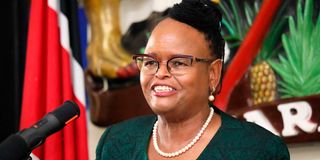
Law Society of Kenya President Faith Odhiambo.
Photo credit: File | Nation Media Group
“It is unfortunate when leaders entrusted with legislative power speak of rigging elections—whether in jest or in seriousness,” she said.
Ms Odhiambo further noted that when such leaders treat constitutional term limits as optional and mock the democratic process, they erode public trust and risk ushering in authoritarianism.
“As a legal profession, we must remind our leaders: the Constitution is not a buffet. You don’t pick the clauses that please you and discard the rest like food leftovers at a political rally,” she said.
Ms Odhiambo added that the committee on elections must anticipate judicial workload not only after the elections but also in the lead-up to the ballot.
She said there is a need for the Judiciary to integrate technological awareness into its training and operational frameworks.
“In the age of Artificial Intelligence, deepfakes, digital disinformation, and algorithmic opacity, the law must evolve to protect the truth — not lag behind it. It’s not enough to be legally prepared; we must also be technologically literate,” she said.
Ms Odhiambo urged the Judiciary to not only interpret the law but to also serve as a stabilising force in the democratic process through timely, authoritative, and principled adjudication.
She further challenged legal practitioners to be ready to support, critique, and contribute to the jurisprudence emerging from future electoral litigation.
Chief Registrar of the Judiciary Winfridah Mokaya said that the Judiciary embraces its constitutional duty, not just as an arbiter of disputes, but as a guarantor of electoral credibility.
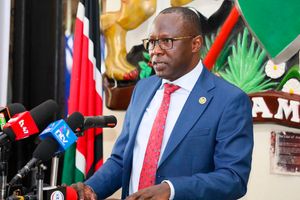
Chief Registrar of the Judiciary Winfridah Mokaya.
Photo credit: Pool
She said the Judiciary Committee on Elections Operational Plan outlines a roadmap for strengthening electoral dispute resolution, building internal capacity, fostering inter-agency coordination, and deepening public trust.
Justice Njoki Ndung’u.
Photo credit: File | Nation Media Group
“It reflects a Judiciary that is not reactive but anticipatory—one that is deliberately planning, innovating, and investing in institutional excellence,” Ms Mokaya said.
Supreme Court Judge Njoki Ndung’u officially took over as chairperson of the Judiciary Committee on Elections, succeeding fellow Supreme Court Judge Mohammed Ibrahim.