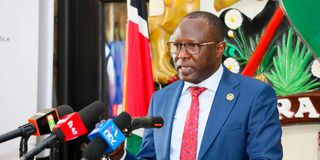
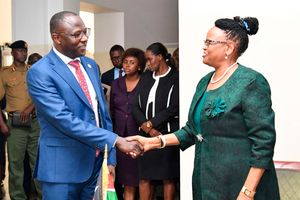
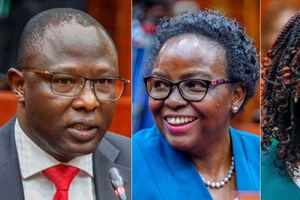
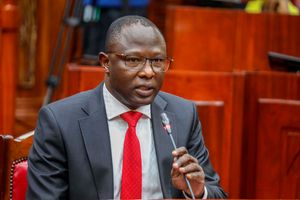
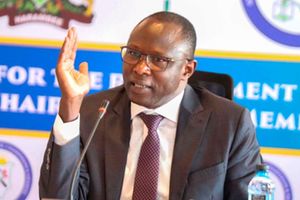
The four men and three women who will referee Kenya’s elections, starting with 22 mini-polls ahead of the 2027 General Election, were sworn in on Friday July 11, with a promise to serve with sincerity and integrity.
Chairperson Erastus Edung Ethekon, vice chairperson Fahima Araphat Abdallah, and commissioners Ann Njeri Nderitu, Moses Alutalala Mukhwana, Mary Karen Sorobit, Hassan Noor Hassan and Francis Odhiambo Aduol took the oath before Chief Justice Martha Koome to serve a six-year term.
“My first and foremost loyalty is to the people of Kenya, who hold sovereign power under Article 1 of the Constitution. That power is exercised through your vote. Fellow Kenyans, your vote is your voice, your future—and yes, it counts,” Mr Ethekon said after he took oath office.
But the work of getting that vote secured — and guaranteed — is an arduous one, with Mr Ethekon saying it starts with building trust and confidence in the system and the commission.
The Independence Electoral and Boundaries Commission (IEBC) Chairperson, Erastus Edung Ethekon, takes an oath during the swearing-in of the new IEBC Commissioners at the Supreme Court in Nairobi on July 11, 2025.
Photo credit: Bonface Bogita | Nation Media Group
“Credible election is not the responsibility of the IEBC alone-it is a national duty. Political parties, public institutions, civil society, media, and every Kenyan have a role to play,” Mr Ethekon said.
While Mr Ethekon did not say much in his speech, an analysis of his plan which he revealed to the National Assembly during his vetting for the top job reveals the mind of the lawyer who turns 49 years on October 2.
During the vetting, Mr Ethekon promised to build public confidence in the electoral process, address voter apathy, deploy technology to seal loopholes, and tame the high cost of elections.
Mr Ethekon outlined that with the General Election fast approaching in 2027, he will work with the secretariat to undertake a comprehensive review of the electoral process, ranging from data verification and transmission to training and public engagement.
The Independence Electoral and Boundaries Commission (IEBC) Commissioner Fahima Araphat Abdallah takes an oath during the swearing-in of the new IEBC Commissioners at the Supreme Court in Nairobi on July 11, 2025.
Photo credit: Bonface Bogita| Nation Media Group
“Technology will be central to this transformation. We will prioritise transparency, real-time access to information and citizen empowerment,” Mr Ethekon said.
He also had a message to the lawmakers whom he called upon to enact responsive legislation that will enhance delivery of a credible election.
Mr Ethekon said he would leverage on technology to enhance the integrity and efficiency of Kenya’s electoral process.
Mr Ethekon said he would only settle on technology to be used upon wide consultations with experts to meet local needs.
In addressing voter apathy, Mr Ethekon promised to restore public confidence through accelerating registration drives and deploying targeted, inclusive communication that inspires civic engagement and broaden participation.
Mary Karen Sorobit takes an oath during the swearing-in of the new IEBC Commissioners at the Supreme Court in Nairobi on July 11, 2025.
Photo credit: Bonface Bogita| Nation Media Group
“There is need to have tailored messages encouraging the young people not only to register but also to participate during elections,” Mr Ethekon said.
He regretted that there has been growing voter apathy and declining turnout, attributing it to widespread disillusionment and mistrust in the electoral system.
Credible and verifiable elections
“We need to ask ourselves, why are people disillusioned? Is there something that can be done to resolve the situation and I will operate on an open door policy to find solutions,” Mr Ethekon said.
In the run up to the 2022 elections, voter apathy affected the IEBC drive to net in at least 4.5 million new voters as young people, who said they believed their vote did not count, kept off the registration centres.
And after he was sworn-in on Friday, he assured the young people that their energy, voice and ideas are not a disruption but an essential part in delivering a credible poll.
The Independence Electoral and Boundaries Commission (IEBC) Commissioner Moses Alutalala Mukhwana takes an oath during the swearing-in of the new IEBC Commissioners at the Supreme Court in Nairobi on July 11, 2025.
Photo credit: Bonface Bogita| Nation Media Group
“Young people, you are not just tomorrow’s leaders, you are today’s custodians. Learn the laws, understand the processes and participate not just as voters but as election officials, civic educators and policy advocates. Be counted. Be involved,” Mr Ethekon said.
Since last year, when they started they held demonstrations against the Finance Bill 2024, the youth have displayed robust political awareness on social media and during protests.
On restoring credibility, Mr Ethekon said Kenyans must begin by trusting in themselves, the constitution and the institutions created by law to ensure there is free, fair and verifiable elections.
“When we trust ourselves, then we begin to look at what are the legal frameworks: do the bodies created by the constitution to manage our electoral process serve us; do we trust in those institutions?” he asked, adding that as chairman he would ensure fidelity to the law in conducting free, fair and verifiable elections.
On the high election costs, Dr Ethekon told the vetting panel in May that the huge amount spent is mainly due to the deficit in public trust.
To address this, Mr Ethekon told the National Assembly Justice and Legal Affairs Committee that he will enhance transparency and invite greater public scrutiny and engagement in the activities of IEBC.
The Independence Electoral and Boundaries Commission (IEBC) Commissioner Anne Njeri Nderitu takes an oath during the swearing-in of the new IEBC Commissioners at the Supreme Court in Nairobi on July 11, 2025.
Photo credit: Bonface Bogita| Nation Media Group
Mr Ethekon said he would open up the IEBC to continuous public dialogue and accountability in seeking to rebuild trust and reduce the financial and social costs of managing elections.
Treasury data shows that the total allocation for direct and indirect expenditures for the 2022 General Election was Sh43.9 billion.
Some of the factors that drive up the cost of elections include legal fees, which the commission has budget for, purchase of ballot boxes, printing of ballot papers abroad and purchase of election technology systems and advertisements among others.
Other costs incurred include transport of polling officers, wages and allowances of two police officers in every polling station, payment of network providers for transmission of results and refilling of gas cylinders.
He committed to be strictly guided by the law in both interpreting the existing electoral frameworks and in holding accountable any individuals or institutions that undermine the electoral process through malpractice.
The Independence Electoral and Boundaries Commission (IEBC) Commissioner Hassan Noor Hassan takes an oath during the swearing-in of the new IEBC Commissioners at the Supreme Court in Nairobi on July 11, 2025.
Photo credit: Bonface Bogita| Nation Media Group
In order to ensure that the commission will work in harmony, Mr Ethekon promised to run a consultative commission and build a resilient system that prevents unnecessary turmoil and eliminate malpractices.
On the pending by-elections that were frozen due to lack of the commission, Mr Ethekon promised that he would act swiftly and lawfully to conduct all pending mini-polls as he reaffirmed the commission’s mandate.
Challenged by MPs on whether he will be influenced by those in authority, Mr Ethekon said he would solely be guided by the Constitution.
“I took this role knowing there is a lot Kenyans expect from us. The issues of trust, credibility and transparency. I will be guided by the constitution of Kenya and follow all the laws of Kenya that will lead us to credible and verifiable elections,” Mr Ethekon added.
IEBC commissioner Nderitu told Parliament that genuine transparency and inclusive decision-making are key to building public trust and safeguarding the credibility of elections.
The Independence Electoral and Boundaries Commission (IEBC) Commissioner Prof. Francis Odhiambo Aduol takes an oath during the swearing-in of the new IEBC Commissioners at the Supreme Court in Nairobi on July 11, 2025.
Photo credit: Bonface Bogita| Nation Media Group
“I have been at IEBC before that is why they call me an insider and therefore I am coming to an institution that I know and will provide solutions especially on voter education and electoral processes which I have been invited to do in other countries,” Ms Nderitu said.
Mr Moses Mukhwana said the trust deficit in Kenya’s electoral process stems not from the IEBC, but from a political culture. He described the problem as a systemic issue requiring a national reconfiguration of the political ecosystem.
Prof Aduol, who impressed the vetting panel over his grasp of the delicate issue of boundary delimitation, said if the next process is to be undertaken, it must transcend population metrics alone, advocating for the inclusion of geographic, administrative and community considerations to ensure fair and effective representation.
Prof Aduol, who played an active role in the 2011 boundary review conducted by the Interim Independent Boundaries Review Commission, proposed the integration of Geographic Information Systems, Global Positioning System and advanced spatial technologies as essential tools for achieving equity and precision in the process.
Meanwhile, Deputy President Kithure Kindiki said the opposition should prepare for the 2027 contest now that there was a commission in place.
“It is the people of Kenya through their vote in an election supervised by IEBC that will determine who leads our country from the lowest level. There is no other route,” said the DP, who was speaking in Cherangany