Consumer lobby loses second bid to challenge proposed Sh8-per-kilometre Mau Summit toll
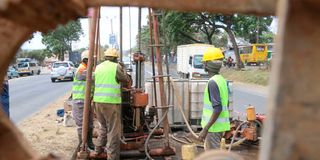
China Road and Bridge Corporation workers conduct geotechnical investigation for a flyover at Kolen in Nakuru along the Nakuru-Eldoret highway on January 19, 2026, as part of the Sh200 billion dualling of Rironi-Mau Summit highway.

A tribunal has thrown out a petition by the Consumers Federation of Kenya (Cofek) challenging the government’s plan to charge motorists Sh8 per kilometre to use the Nairobi–Nakuru–Mau Summit and Rironi–Maai Mahiu–Naivasha highways.
The Public Private Partnership Petition Committee ruled that Cofek filed the case outside the seven-day deadline set by law.
The ruling comes a month after the High Court struck out a similar case, citing Cofek's failure to exhaust the statutory dispute-resolution process under the Public Private Partnerships Act, which requires such complaints to be taken to the PPP Petition Committee.


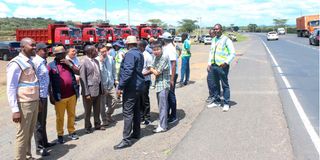
Kenya National Highways Authority (Kenha) officials, led by Corridor B Director Kibet Terigin, Presidential Protocol team, together with CRBC and Shandong road contractors inspect project launching sites for the dualling of the Rironi - Mau Summit (A8) road on November 26, 2025, ahead of the official launch by President William Ruto on Friday.
In rejecting the petition, the committee found that Cofek had not stated when the Kenya National Highways Authority (KeNHA) issued the disclosure document it challenged and which contained details of the proposed project. But records showed it existed before September 2, 2025, when stakeholder consultations began.
“We find that the petition dated September 30, 2026 and lodged on October 2, 2026 was lodged out of time. Consequently, the Petition Committee does not have the jurisdiction to hear and determine the matter,” the committee said.
The law requires such petitions to be filed within seven days of the disputed decision, with appeals against the committee’s determination going to the High Court.
Cofek had sought project approvals, feasibility studies, financial models, procurement records, tolling plans and public participation documents.
It argued the disclosure document did not explain affordability, value for money, the proposed tariff methodology, toll-free alternatives, exemptions or allocation of financial risks. The lobby wanted the committee to order production of the documents; examine the documents and satisfy itself that the Public Private Partnerships Act was followed.
The committee’s decision marks Cofek's second procedural setback in its bid to challenge the proposed tolling of the two highways.
In September, the Milimani High Court struck out an earlier constitutional petition because the lobby had not first used the review process under the Public Private Partnerships Act.
The dispute concerns the road expansion project covering 233 kilometres, comprising 175 kilometres between Rironi and Mau Summit and 58 kilometres between Rironi and Naivasha through Maai Mahiu.

An artist’s impression of the Nairobi-Mau Summit Superhighway.
KeNHA previously said the roads will be upgraded, expanded and operated under a Design-Build-Finance-Operate-Maintain-Transfer model with motorists paying tolls under a user-pay system. This will be under a proposed 30-year public-private partnership tolling framework.
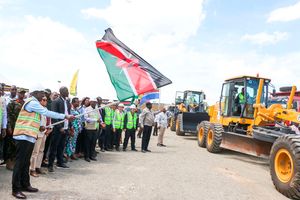
President William Ruto launched the project in November 2025. The highway is the main transport corridor linking Nairobi to the North Rift, Western Kenya and the wider East African region, and serves as the principal route for the movement of passengers, fuel, agricultural produce, manufactured goods and other essential commodities.
The project, implemented through a Public-Private Partnership between China Road and Bridge Corporation (CRBC) and the National Social Security Fund (NSSF), is set to be constructed over two years at a cost of $863 million (Sh111.7 billion).
KeNHA told the Public Private Partnership Petition Committee that a proposed tariff of approximately Sh8 per kilometre formed part of the project’s financing model. It said the rate remained subject to implementation under the PPP Act and the Public Roads Toll Act.
KeNHA said affordability, value for money and risk allocation had been considered, and that the law did not require the provision of a free or parallel alternative road to a tolled road.
The model covers design, construction, financing, operation, maintenance and eventual transfer of the road facilities to government.
KeNHA said it had disclosed information required by law. It cited two disclosures on the project proponents, stakeholder meetings held between September 2 and 8, 2025, and a public participation report issued that month.
Cofek said the disclosure did not show the tariff method, traffic forecasts, project risks, exemptions or practical alternatives for motorists. It sought consultation notices, materials shared with the public, submissions received and the authority’s responses.
The lobby asked the committee to examine the records and determine whether the project complied with the law. It wanted affected decisions set aside if material breaches were found, and returned for reconsideration.
The committee accepted that the KeNHA disclosure was an administrative decision open to review. But it found Cofek had failed to prove when it was issued.
The committee noted that Cofek had relied on the disclosure in its earlier High Court case before a preliminary objection dated July 23, 2026. KeNHA records showed consultations took place after the disclosure.
“The KENHA Disclosure was issued at a date before September 2, 2025,” the committee said. It concluded that the October 2026 petition was outside the seven-day period.
The committee further said Cofek could not ask it to investigate the entire project without identifying the specific decision and showing how it had been aggrieved.
“The Petition Committee cannot be invited to determine something in the abstract devoid of any pleadings and proof,” it said.
Follow our WhatsApp channel for breaking news updates and more stories like this.