Mariera Bosibori had spent years selling vegetables at Nyanchwa market in Kisii, hoping that one day she would earn enough to transform her life.
So, when a friend introduced her to Asha Hasan, who claimed to operate a licenced overseas recruitment agency, she believed her fortunes had finally changed.
The offer sounded too good to ignore. She was promised a two-year contract as a food packer in Thailand, earning $2,000 (about Sh258,000) a month, more money than she could ever make from her small vegetable business.
To secure the opportunity, she was told to pay Sh300,000 for recruitment and visa processing.
She emptied her savings and borrowed the rest from her SACCO, convinced the sacrifice would be worthwhile.
Instead of beginning a new life in Thailand, Ms Bosibori would spend months trapped in a heavily guarded compound in neighbouring Myanmar, forced to work up to 17 hours a day running online cryptocurrency scams, beaten when she failed to meet targets and cut off from the outside world.
Awarded compensation and damages
More than a year after she was rescued, the Employment and Labour Relations Court has ruled that she was a victim of human trafficking, forced labour and servitude, awarding her more than Sh7.3 million in compensation and damages while describing her ordeal as one of deception, exploitation and modern-day slavery.
In a judgment delivered in Kisumu on July 8, 2026, Justice Nzioki wa Makau ruled that Ms Bosibori had been lured abroad through false promises before being delivered into the hands of traffickers operating one of Southeast Asia's notorious cybercrime compounds.
The court heard that Ms Bosibori travelled to Nairobi in November 2024 after being invited by the recruiter, who claimed to have secured overseas employment opportunities.
She was offered a job packing food products in Thailand at a monthly salary of Sh 258,500 ($2,000) for two years.
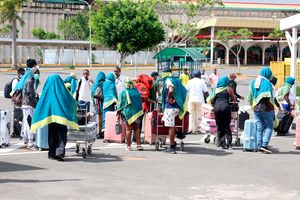
Kenyans who were rescued from Myanmar arrive at the Jomo Kenyatta International Airport on April 5, 2025.
Photo credit: Bonface Bogita | Nation Media Group
The recruiter assured her that once she paid the required Sh300,000, all travel arrangements and work documentation would be processed.
The vegetable vendor raised the money through a combination of savings and a loan from her SACCO before making the payments through cash and electronic transfers.
Before travelling, she noticed something that troubled her.
Instead of the promised work visa, she had been issued with a visitor's visa.
When she questioned the recruiter, she was assured that the visa would be converted into a work permit once she arrived in Thailand
On arriving in Bangkok alongside 10 other Kenyans, Ms Bosibori expected to be taken to her workplace.
Instead, the court heard, she and her companions were met by Chinese nationals, driven for several hours and secretly ferried across the Moei River into Myanmar under the cover of darkness. Waiting on the other side were armed guards.
The group was escorted into a fortified compound surrounded by security personnel. It was then that Ms Bosibori realised the promised factory job had never existed.
Inside the compound, traffickers confiscated her phone, effectively severing communication with her family and anyone who could help.
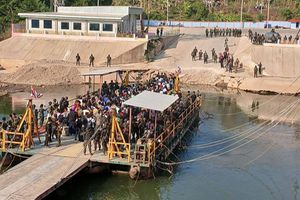
Multinational victims of scam centres, who were trafficked into working in Myanmar and were sent to Thailand, wait for their embassies to pick them up, in Tak province, Thailand February 19, 2025.
Photo credit: Reuters
She was assigned a false identity and trained to impersonate wealthy property investors on social media.
Her job was to lure unsuspecting victims into fake cryptocurrency investment schemes before passing their details to supervisors who carried out the fraud.
Rather than earning the promised salary, she worked for approximately 17 hours every day without pay.
According to the evidence accepted by the court, anyone who failed to meet daily targets was subjected to brutal punishment.
Victims were beaten, shocked with electricity, denied food, forced to endure prolonged physical punishment and refused medical treatment.
The court also heard that psychological abuse and constant intimidation were used to keep victims obedient.
Justice Makau said the medical report produced before the court corroborated Bosibori's account of physical abuse.
"One can only imagine the horror of violence meted out to one abroad. This must have been one of the most traumatic of experiences and given the fact that her phone had been confiscated and she could not reach out to authorities either here or in Thailand, she was at the mercy of her abductors," the judge observed.
The judge noted that she had no freedom to leave the compound and no means of contacting the outside world.
Her passport remained under the control of the traffickers, while her captors demanded thousands of dollars before she could regain her freedom.
Justice Makau observed that she was required to work for approximately seventeen hours daily without remuneration and that despite working for several months she received no salary.
Her captivity only ended on March 19, 2025, when military forces raided the compound, rescued those being held and facilitated her return to Kenya.
Only after returning home and seeking legal advice did she discover that the woman who had recruited her had never been licensed to recruit Kenyans for overseas employment.
She also learnt that she had never been issued with the mandatory foreign employment contract required under Kenyan law.
"The Respondent's false representation of operating an employment agency and promising the Petitioner employment as a food packer in Thailand when the Respondent knew full well that no such job existed establishes deceptive recruitment," he ruled.
The judge found that the demand for Sh300,000 and the assurance that the tourist visa would later become a work visa were central to the trafficking scheme.
The court rejected any suggestion that the recruiter bore responsibility only for arranging Ms Bosibori's travel.
Justice Makau held that participation at any stage of the trafficking chain was sufficient to establish liability under Kenya's Counter-Trafficking in Persons Act.
"The fact the respondent participated in orchestrating her delivery to Myanmar, there is ample proof the Respondent participated in the Petitioner's trafficking," he ruled.
"The Respondent was not only cruel and callous in the manner she treated the Petitioner and subjected the Petitioner to slavery, servitude, human trafficking, forced labour and forced criminality contrary to Articles 28, 29, 30, 39 and 41 of the Constitution," Justice Makau said.
Although the National Employment Authority (NEA) was named in the petition, the court found it could not be held liable because the recruiter had never been registered as a licensed employment agency.
He urged the authority to rethink its enforcement strategy as traffickers adopt increasingly sophisticated recruitment methods.
"The modes of recruitment are constantly evolving, necessitating the inclusion of fresh roles such as online monitoring, surveillance at points of exit and the like to ensure there is a collation of the information gathered on illegal recruiters," Justice Makau said.
He further directed the NEA to ensure the recruiter is not permitted to operate a recruitment agency within Kenya for having participated in trafficking of persons.
The court awarded Bosibori Sh5 million as compensation for trafficking, Sh1.03 million in unpaid wages converted from the promised $8,000, Sh300,000 as a refund of recruitment fees, Sh1 million in exemplary damages, Sh15,095 for her confiscated mobile phone and Sh21,011 being interest paid on the SACCO loan she used to finance the recruitment.
Justice Makau also ordered the recruiter to pay the costs of the case together with interest on all the sums awarded until payment is made in full.