The High Court has ordered the Ethics and Anti-Corruption Commission (EACC) to release payment vouchers linked to Sh6.1 billion in disputed National Youth Service (NYS) bills, easing pressure on suppliers racing against a looming verification deadline.
The court ruled that the documents must be handed to the NYS accounting officer for onward transmission to the Pending Bills Verification Committee, whose mandate expires on December 31, 2025.
The decision offers temporary relief to several companies, including six firms associated with businessman Ben Gethi, whose payments were frozen amid allegations that the claims were fictitious.
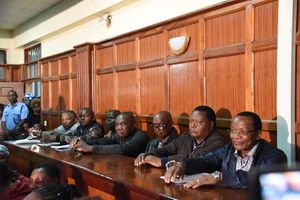
Businessman Ben Gethi when he appeared before the National Assembly's Public Accounts Committee over the Sh791 million NYS scam on October 4, 2016.
Photo credit: File | Nation Media Group
“The lapse of the Pending Bills Verification Committee’s mandate would be prejudicial,” the court noted, warning that there was no guarantee the government would extend the committee’s term or form another.
The suppliers had accused the EACC of withholding vouchers despite criminal investigations concluding without charges and the Director of Public Prosecutions declining to prosecute.
Justice Alexander Muteti ruled that verification of bills was distinct from payment and would not undermine the civil recovery suit filed by the EACC.
“It is the view of this court that verification of pending bills is not akin to payment. The two processes are undertaken by different bodies,” he said, adding that the committee’s role was to assess genuineness, not release funds.
The court stressed that no payment had been authorised and directed NYS not to pay any bills until the application and suit are determined.
“For the avoidance of doubt, this court has not sanctioned any payment of the pending bills,” Justice Muteti said.
The dispute originated from claims worth Sh6.1 billion submitted by multiple suppliers for goods allegedly delivered to NYS, including foodstuffs, clothing, boots, and cooking oil.
The EACC froze the payments, arguing that investigations showed no goods or services were supplied and that documents such as local purchase orders and delivery notes were forged.
The suppliers included Highview Trading, Schoolwork Enterprises, Newtool Mart Trading, Ratego Technologies, Realtool Trading, and Comptool Trading Ltd—all allegedly linked to Mr Gethi.
The EACC stated that Mr Gethi, through the six entities, collectively claimed Sh3.4 billion from NYS for supplying various items.
Other firms involved were Link General, Jimchar Enterprises Ltd, Tyson Limited, and Liz Link General Supplies.
The companies sought payments for supplying goods such as milk powder, blankets, corned beef, biscuits, white sugar, tinned pineapples, baked beans, boots, and cooking oil to NYS.
Mr Gethi, previously charged in the wider NYS scandal, was cleared by the court in October 2023. Several firms linked to him are among those seeking payment.
In their application, the companies said their claims had already been scrutinized by a Cabinet-appointed Pending Bills Multi-Agency Team, which included EACC representatives.
They cited an October 2020 report recommending payment of over Sh5.3 billion while flagging about Sh812 million for further investigation.
The court noted that an EACC officer sat on that team and signed the report recommending the processing of most bills.
“The respondent did not rebut the submission that their member of staff sat on the MAT-Pending Bills Committee and signed the minutes,” the judge observed.
The court rejected the EACC’s argument that releasing the documents would render the suit nugatory, stating that the commission could still present its concerns to the committee.
“If, as alleged, the claims are fraudulent, the Pending Bills Committee would also be able to establish as much,” it said.
The court also faulted the commission’s stance that the committee’s expiry would not cause prejudice, calling that view “with respect, flawed.”
Justice Muteti held that withholding the documents risked violating the suppliers’ right to property under Article 40 of the Constitution.
“The applicants face the possibility of the committee winding up its business without reviewing their vouchers,” the ruling stated.
The court ordered the EACC to release the documents and directed NYS to return them to the commission by January 14, 2026.
Justice Muteti described the order as a temporary structural intervention aimed at balancing public interest with individual rights as the case proceeds.
“All that this court will concern itself with is making an order that serves the ends of justice for all parties,” he said.