Kenya will take a major step towards positioning itself as a regional energy and industrial hub when President William Ruto leads the groundbreaking for the proposed Sh2 trillion East African Refinery in Lamu tomorrow.
Backed by Nigerian billionaire Aliko Dangote, the 700,000-barrel-per-day refinery is expected to be the largest of its kind in East Africa and supply refined petroleum products to Kenya and neighbouring markets. Its strategic location at Lamu Port is also expected to strengthen Kenya’s position as a gateway for energy and trade to the wider region.
The ceremony will be attended by several heads of state and other high-profile guests, including Mr Dangote. Behind the investment’s enormous capacity and grand ambitions is a man whose name has become synonymous with African business success.
So, who is Aliko Dangote?
Mr Dangote is widely regarded as Africa’s richest person, with Forbes estimating his net worth at about $31.4 billion as of September 2026. He is the founder, president and chief executive officer of Dangote Group, one of West Africa’s largest business conglomerates. His life story began in Kano, Nigeria, where he was born on April 10, 1957, into a wealthy Hausa Muslim family.
His mother, Mariya Sanusi Dantata, came from the influential Dantata trading family, while his father, Mohamed Dangote, was a businessman and an associate of the Dantatas. Business, therefore, was hardly unfamiliar territory in the Dangote household. Commerce was part of the environment in which he grew up.
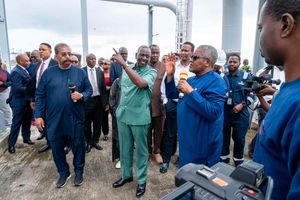
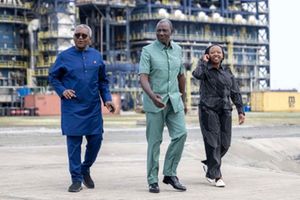
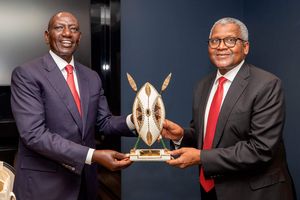
President William Ruto and Dangote Group President and CEO Aliko Dangote during a tour of the Dangote Refinery in Lekki, Lagos State, Nigeria on September 25, 2026.
Photo credit: PCS
Through his mother, Dangote is the great-grandson of Alhassan Abdullahi Dantata, one of the wealthiest and most prominent merchants in West Africa during the British colonial era. Dantata built his fortune through the trade in commodities, including kola nuts and groundnuts, establishing a commercial legacy that would later form part of Mr Dangote’s family heritage.
Perhaps even his name offered a hint of what lay ahead. According to biographical accounts, Aliko means “the victorious one who defends humanity”.
Whether the name influenced the man or the man eventually gave the name its own meaning is impossible to establish. But an intriguing coincidence can be inferred.
Mr Dangote went on to build a business empire whose factories, farms, refineries and other enterprises employ thousands of people across Africa.
Raised as a Muslim, he received early religious instruction at a madrasa before continuing with his formal education. He later attended government college, completing his secondary education in the 1970s.
He then travelled to Cairo, Egypt, where he studied Business Studies and Administration at Al-Azhar University. His education provided the academic foundation. But it was what followed his return from Cairo that would begin to alter the course of his life.
Back in Nigeria, he entered the world of commerce with financial support from his family.
Accounts of his early career say he obtained a loan from his uncle and used the money to trade in commodities such as rice, sugar and cement. Dangote himself has also spoken about his fascination with business from childhood, recalling how he bought sweets and gave them to others to sell on his behalf.
The young businessman was doing more than simply moving goods from one person to another. He was learning the mechanics of trade: buying, selling, distribution, demand and, perhaps most importantly, how to turn a small opportunity into a bigger one.
President William Ruto and Dangote Group President and CEO Aliko Dangote during a tour of the Dangote Refinery in Lekki, Lagos State, Nigeria on September 25, 2026.
Photo credit: PCS
In 1978, Mr Dangote formally began his business career in commodity trading. By 1981, the business had evolved into the Dangote Group, initially operating mainly as a trading enterprise importing commodities such as cement, rice, sugar, flour and salt.
The family legacy was evident, but Mr Dangote would eventually take it far beyond traditional trading by steadily expanding the business.
His maternal great-grandfather, Alhassan Dantata, had built an enormous commercial enterprise through the movement of commodities across West Africa and overseas. Dantata was regarded as one of the wealthiest men in West Africa when he died in the 1950s.
Mr Dangote inherited more than a famous family name. He grew up in an environment where commerce, risk-taking and enterprise were woven into everyday life.
After his father died, he reportedly donated his inheritance to charity, while much of his upbringing was influenced by his maternal grandfather.
The inheritance that would ultimately prove most valuable, however, was not money. It was an understanding of business.
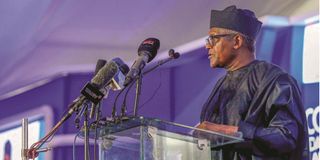
Dangote Group founder Aliko Dangote.
Photo credit: Pool
The transformation of Dangote Group from a trading house into a manufacturing powerhouse began in earnest in the 1990s. The company increasingly moved into large-scale production, particularly cement, eventually building an industrial empire that stretched far beyond its original commodity-trading roots.
Today, Dangote Group has interests in cement, sugar, salt, flour, fertiliser, petrochemicals, energy and infrastructure. Its operations extend across numerous African countries, while its cement business has grown into one of the continent’s dominant producers.
Now, with the business magnate expanding his footprint into Kenya through the oil refinery in Lamu, which is expected to serve more than five African countries, Dangote’s story is that of a businessman who took a family tradition of trading and transformed it into one of Africa’s most recognisable industrial enterprises.