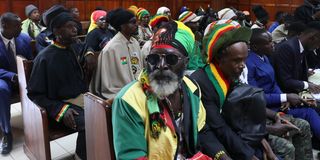
For the last five years, the High Court in Nairobi has been handling a smoking hot case that the trial judge says should ignite national debate on Kenya’s cannabis laws.
The constitutional challenge filed by the Rastafari Society of Kenya and its leaders sought to exempt rastafarians from arrest and prosecution for cultivation, possession and use of bhang as a religious sacrament.
Clad in dashikis, scarfs and head wraps incorporating the colours of the Ethiopian flag—red, gold, and green— rastafarians put up a spirited fight in the trial that was punctuated by drama in and out of the courtroom.
They staged peaceful cultural demonstrations outside the Milimani Law Courts, singing and displaying symbols of their faith to call for recognition, respect and non-discrimination.
And keen to prove to Justice Bahati Mwamuye that weed, as bhang is commonly known, is their sacrament, in February they sought to present as evidence raw seeds of cannabis sativa, a request that the judge blew out.
"I cannot breach the law by permitting members of the Rastafari society to traffic into court a drug that is prohibited under the law," ruled Justice Bahati Mwamuye on February 4, 2026.
And on Wednesday, Justice Mwamuye dismissed the entire petition but used the same judgment to question whether Kenya's long-standing approach to marijuana remains sustainable— urging a broader national conversation.
He found that the petitioners had failed to prove that the law unconstitutionally violated their rights and had bypassed available statutory licensing mechanisms before turning to the courts.
Yet the judge concluded by observing that cannabis use had become widespread across Kenyan society and questioned whether scarce law enforcement resources should continue targeting small-scale possession while acknowledging that any policy shift belongs to Parliament and the public rather than the judiciary.
"It is not a question for the Rastafarian Community only, it is a national question that cuts across the entire spectrum of our society," Justice Mwamuye said.
"We ought to have a full and frank conversation on cannabis and which direction we should take. The status quo appears untenable."
The petition challenged provisions of the Narcotic Drugs and Psychotropic Substances (Control) Act that criminalise cannabis.
The petitioners argued the law violated their constitutional rights to freedom of religion, equality, dignity, privacy and association because cannabis is a sacred sacrament used in worship, meditation and communal "reasoning" sessions.
They did not seek the general legalisation of cannabis. Instead, they asked the court to exempt Rastafarians from criminal liability for cultivating and using the drug in private homes and designated places of worship or require the State to establish a legal framework accommodating the practice.
The government, through the Attorney-General opposed the petition, arguing the law protects public health and safety, applies equally to all Kenyans and complies with Kenya's international obligations on narcotics control.
The National Authority for the Campaign Against Alcohol and Drug Abuse (Nacada), which joined the proceedings as an interested party, argued that cannabis poses documented health risks and that creating a religious exemption would undermine enforcement.
In its judgment, the court first found the petition had been filed prematurely because the petitioners had not exhausted mechanisms already available under the law.
The court said the Act provides a licensing framework allowing controlled access to narcotic substances under specified circumstances but the petitioners had not demonstrated they had formally pursued that process before seeking constitutional remedies.
"The petitioners have not exhausted the available legal and administrative mechanisms under the Narcotic Drugs and Psychotropic Substances (Control) Act," the judge said. "I therefore find and hold that the Petition is premature and the court lacks jurisdiction to entertain it at this stage."
Nevertheless, the court examined the constitutional issues raised by the petition because of their public importance.
Justice Mwamuye accepted that Rastafari is a religion entitled to constitutional protection under Article 32 of the Constitution, describing that question as no longer contestable.
Evidence weakened by main argument
However, he found the petitioners' own evidence weakened their central argument that cannabis is indispensable to the faith.
During cross-examination, some witnesses acknowledged that Rastafarians could worship without cannabis and that some adherents never used it.
"The inconsistency in the evidence suggests that there is no consensus within the Rastafari community on the centrality of cannabis use," the judge said.
He concluded that the petitioners had failed to establish that cannabis use was an essential religious requirement rather than a preferred form of worship.
Justice Mwamuye also ruled that the prohibition did not amount to unconstitutional discrimination because the law applies uniformly regardless of religion and that any limitation of rights was justified by the State's obligation to protect public health and safety.
The court accepted Nacada's evidence that cannabis is Kenya's most widely used illicit drug and that its regulation serves a legitimate public interest.
Still, the court departed from a conventional dismissal by reflecting on changing social realities surrounding cannabis.
It noted that cannabis-related products are openly sold in shops, prominent Kenyans have publicly admitted using the drug and references to cannabis have become commonplace in popular culture.
"This is not to excuse cannabis use or to argue that it should be legalized merely because 'the war is lost'," the court said.
"Rather, it is to ask whether we need to have a national social conversation, outside of courts and legislative houses, on what do we now do with this phenomenon in light of what it has become in our society."
The court also questioned whether "the expenditure of our nation's very scarce law enforcement and prosecutorial resources on small amounts possession or personal use is appropriate."
Despite those observations, the court dismissed the petition in its entirety.